
Official statement
What you need to understand
What does Google's statement about review sentiment actually mean in practice?
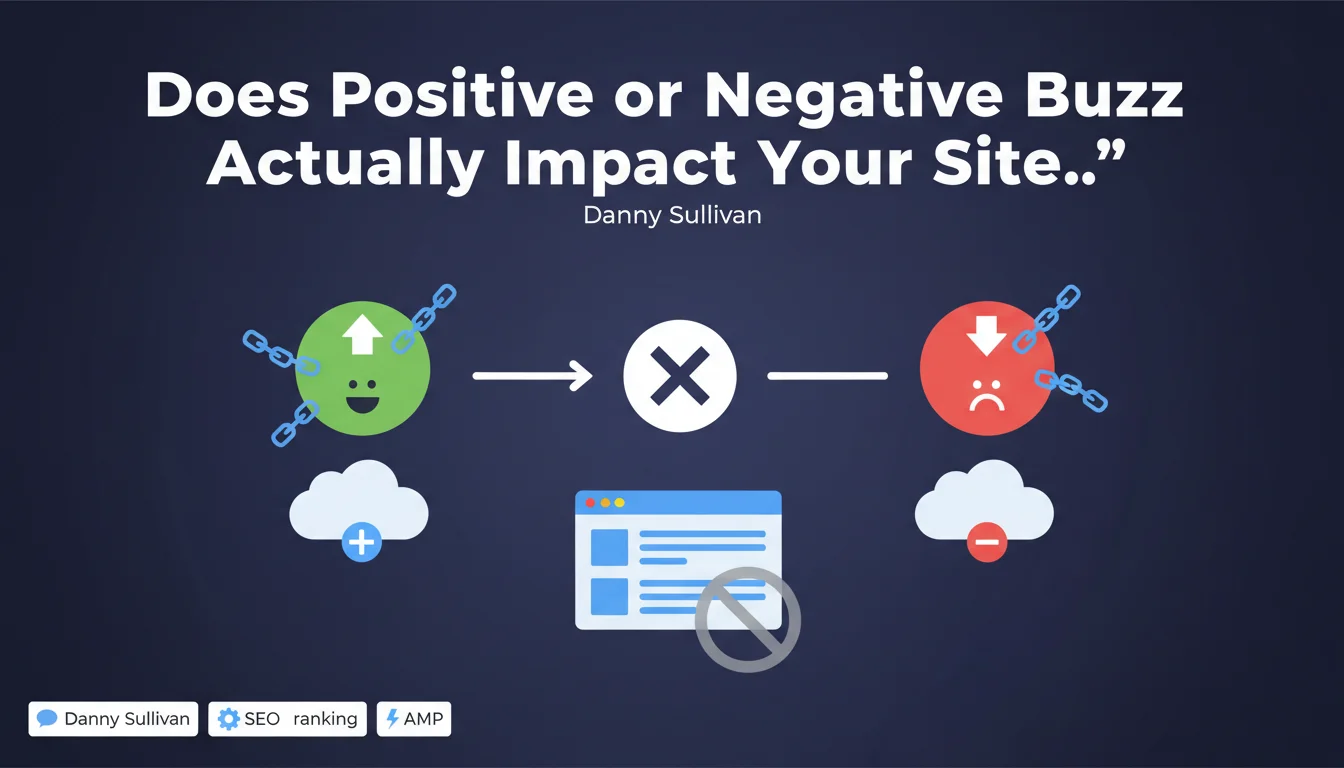
Google officially states that sentiment analysis (positive or negative) associated with a website does not impact its ranking in search results. Whether it's customer reviews, social media comments, or mentions in articles, the emotional tone of these references is not taken into account by the algorithm.
In concrete terms, this means that a site receiving numerous negative reviews will not be penalized in its organic search rankings. Conversely, a site benefiting from massive positive enthusiasm will not be favored for this reason alone.
Why doesn't Google take sentiment from mentions into account?
Large-scale sentiment analysis on the web represents a major algorithmic challenge. Human language is complex, contextual, and subject to irony, sarcasm, or cultural nuances. Correctly interpreting whether a text is positive or negative would require an advanced semantic understanding that Google does not yet master sufficiently to integrate into its ranking algorithm.
Moreover, this type of signal would be too easily manipulated. Bad actors could massively generate fake negative reviews to harm competitors, or conversely, artificially create fake positive buzz.
What elements in reviews and mentions actually matter?
While sentiment is not taken into account, other aspects of reviews and mentions do indeed influence SEO. The quantity and recency of reviews, particularly on Google Business Profile, are important factors for local SEO.
- The volume of mentions of a brand can contribute to its perceived authority
- Links contained in these mentions transmit popularity if they are backlinks
- The frequency of reviews on Google Business Profile impacts local ranking
- The response rate to reviews demonstrates the company's engagement
- Keywords present in reviews can influence thematic relevance
SEO Expert opinion
Is this statement consistent with what we observe in the field?
After 15 years of observing SERPs, Google's position does indeed correspond to reality. Many sites with a controversial reputation or negative reviews continue to rank well. The algorithm focuses on objective and measurable signals: content quality, link authority, thematic relevance, user experience.
I've observed cases where sites with major media scandals even saw their organic traffic temporarily increase, simply because the volume of mentions (even negative ones) reinforced their notoriety and generated backlinks from authoritative media outlets.
What important nuances should be added to this statement?
Although Google does not directly penalize negative sentiment, the indirect consequences can affect SEO. A bad buzz can degrade the click-through rate in SERPs if users recognize the brand negatively, which can influence ranking over time.
Furthermore, certain sectors are subject to specific rules. Health or financial sites falling under YMYL (Your Money Your Life) may be impacted if scandals call their credibility into question, not through sentiment analysis, but through manual evaluation by Quality Raters.
In what cases could sentiment indirectly affect search rankings?
Sentiment influences behavioral metrics that Google observes. A site with a poor reputation may see its bounce rate increase, its visit time decrease, or its conversion rate collapse. These negative engagement signals can, over time, impact ranking.
Additionally, online reputation management remains crucial for overall business. A customer who reads negative reviews before clicking on your organic result will be less inclined to convert, reducing the ROI of your SEO efforts even if your ranking remains stable.
Practical impact and recommendations
What should you actually do regarding your SEO strategy?
This statement allows you to readjust your priorities. Rather than dedicating excessive resources to fighting every negative review from a purely SEO perspective, focus on factors that truly influence the algorithm: content quality, technical architecture, link profile.
However, don't completely neglect review management. Responding professionally to criticism improves brand image and can influence the decisions of users who discover your site through organic searches. Your SEO objective doesn't stop at ranking, but at final conversion.
What strategic mistakes should you absolutely avoid?
The major mistake would be thinking that online reputation has no importance for SEO. Even if the algorithm doesn't analyze sentiment, users do. A low CTR in SERPs due to a poor reputation can signal to Google that your result isn't relevant.
Also avoid falling into the opposite trap: buying massive amounts of fake positive reviews thinking it will improve your SEO. Not only will this have no effect on algorithmic ranking, but Google can detect these manipulations and apply manual penalties. Always prioritize authenticity.
How can you optimize your online presence while accounting for this reality?
Adopt a balanced approach that clearly separates technical SEO optimization and reputation management. For SEO, focus on fundamentals: quality content, coherent internal linking, optimized loading time, mobile-first, quality backlinks.
For reputation, implement a strategy for collecting authentic reviews, systematically respond to comments (both positive and negative), and monitor mentions of your brand. These two aspects are complementary and together contribute to the overall performance of your digital presence.
- Prioritize technical SEO optimizations rather than chasing positive reviews
- Maintain monitoring of brand mentions without obsessing over sentiment
- Respond professionally to negative reviews for image, not for ranking
- Encourage authentic customer reviews on Google Business Profile
- Measure the real impact of reviews on conversion rate, not on ranking
- Never buy fake reviews or artificially manipulate sentiment
- Optimize CTR in SERPs through attractive title tags and meta descriptions
- Monitor engagement metrics (bounce rate, visit time) that may be affected by reputation
💬 Comments (0)
Be the first to comment.