
Official statement
What you need to understand
Why did Google remove the 80-word minimum rule?
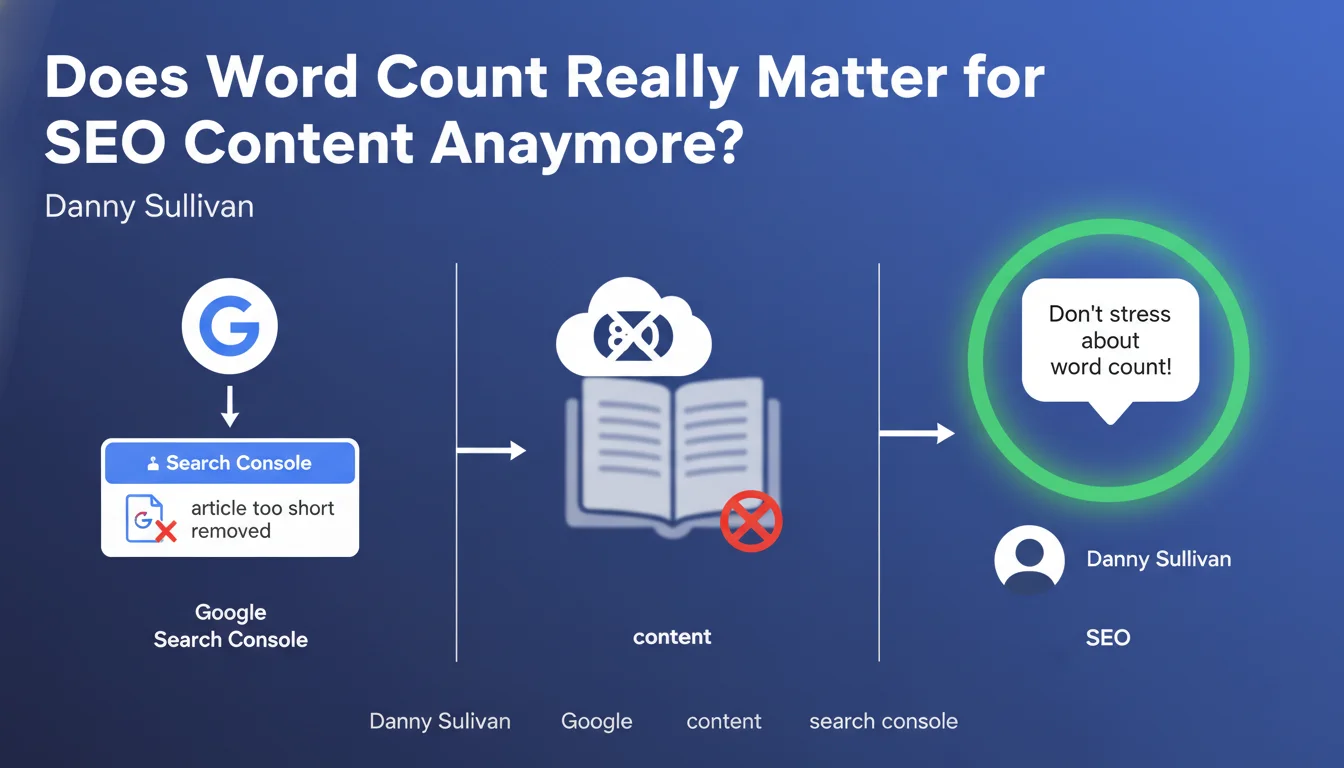
Google recently made a significant change in its Search Console by removing the "article too short" error for sites registered in Google News. This error previously appeared when an article had fewer than 80 words.
Danny Sullivan, Google spokesperson, justified this removal by explaining that content creators shouldn't stress about word count. The goal is to refocus attention on quality and relevance rather than on arbitrary metrics.
What does this actually mean for SEO?
This statement indicates a shift in philosophy in Google's communication. The search engine wants to discourage practices of artificially filling pages to reach a word quota.
However, this doesn't mean that content length has no importance. Longer texts generally provide more semantic information that algorithms can analyze to better understand the subject being covered.
What's the difference between content quantity and quality?
Short but extremely relevant and well-structured content will always rank better than long, hollow, and repetitive text. Informational density matters more than simple word counting.
At equal quality however, a longer text that covers the subject in depth will tend to perform better because it answers more questions and covers more semantic variations related to the query.
- Google removes the 80-word minimum requirement for News
- Content quality takes precedence over quantity
- Long texts rank better because they provide more semantic signals
- Short but relevant content always beats long low-quality content
SEO Expert opinion
Is this statement consistent with what we observe in practice?
In practice, we indeed observe that long content generally dominates the top positions for competitive queries. But it's not simply a matter of raw length.
Well-ranked pages are long because they answer the search intent exhaustively, not because they reach a word quota. This nuance is fundamental to understanding Google's message.
What nuances should we add to this recommendation?
Removing the 80-word rule doesn't mean that a 50-word article can compete with a comprehensive 3000-word guide on the same topic. Search intent remains the determining criterion.
For a quick definition or factual answer, short content can be perfectly appropriate. For a complete guide or expert article, in-depth development will be necessary. Context dictates the ideal length.
In which cases does content length remain critical?
For complex informational queries, long content remains essential. A user searching for a complete guide will expect exhaustive content covering all facets of the subject.
Conversely, for transactional or navigational queries, more concise and direct pages may perform better. The challenge is to adapt the length to user intent, not to follow a universal rule.
Practical impact and recommendations
How can you determine the ideal length for your content?
Start by analyzing the SERP for your target keywords. Examine the top 10 results: what's their average length? What level of depth do they offer?
Use semantic analysis tools to identify sub-topics and associated questions that your competitors cover. Your goal is to create the most complete and relevant content, not simply the longest.
What mistakes should you avoid following this statement?
Don't fall into the trap of artificially reducing your existing content that performs well. If a long article generates traffic and engagement, its length is probably justified.
Also avoid the opposite pitfall: no longer caring at all about depth of treatment. Superficial content will always struggle to compete with comprehensive resources on complex topics.
What should you do right now?
Audit your existing content not on their word count, but on their ability to fully respond to search intent. Identify weak pages that need enrichment.
For each new piece of content, first define the user intent and the necessary depth of treatment, then let the length flow naturally from these constraints.
- Systematically analyze the SERP before creating content
- Evaluate your pages on relevance and comprehensiveness, not word count
- Adapt length to the specific search intent
- Enrich content with varied semantic elements (FAQ, lists, examples)
- Measure user engagement (time on page, bounce rate) to validate relevance
- Don't reduce your performing content without strategic reason
💬 Comments (0)
Be the first to comment.