
Official statement
What you need to understand
What exactly does Google say about missing H1 tags?
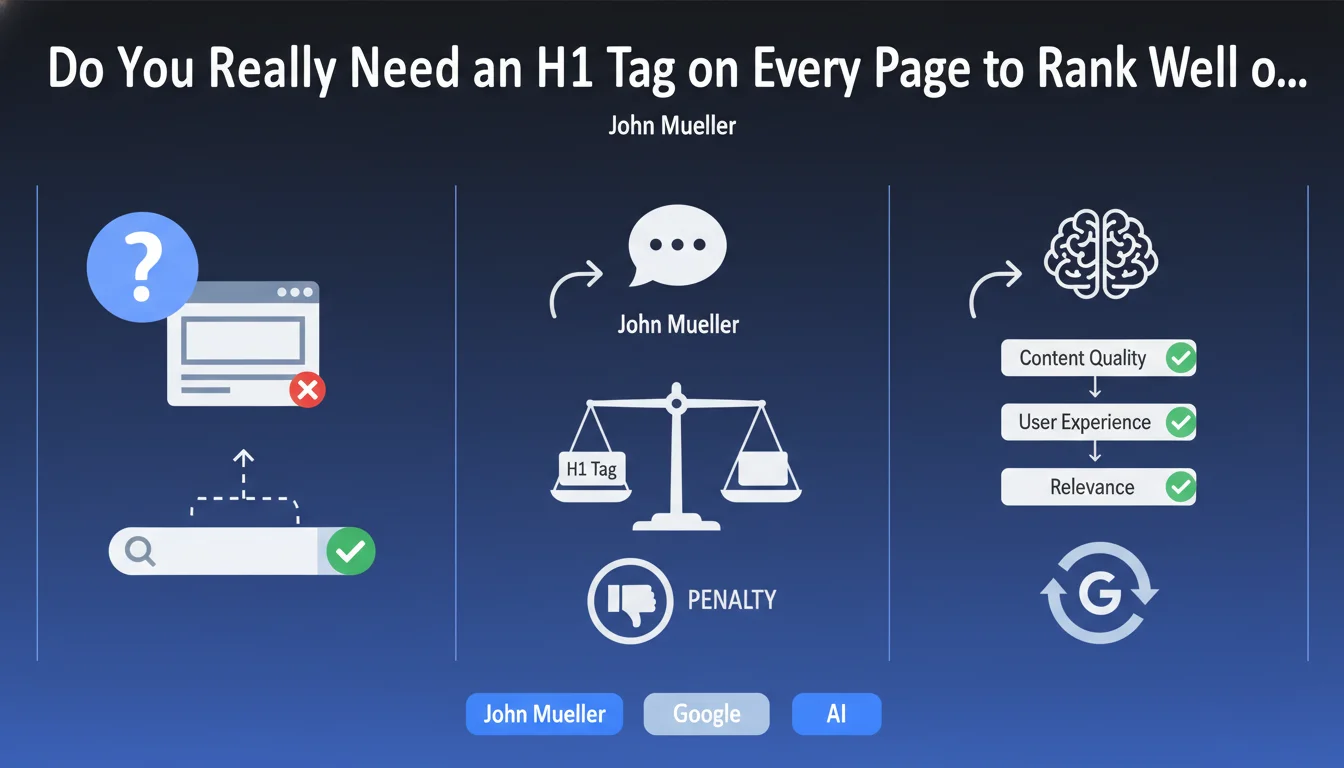
Google clearly states that no algorithmic penalty is applied to pages without an H1 tag. This is an important distinction: the search engine won't actively demote a page simply because it lacks this structural element.
However, this absence of penalty doesn't mean there are no consequences for SEO. This nuance is critical for any SEO practitioner who wants to optimize their pages effectively.
What's the difference between a penalty and lack of optimization?
A Google penalty implies a punitive action, such as an algorithmic filter or manual action that drastically drops rankings. This is not the case with a missing H1.
On the other hand, not using an H1 represents a missed optimization opportunity. The page deprives itself of a semantic signal that Google uses to understand the main topic of the content and its thematic hierarchy.
Why does the H1 tag remain important despite this statement?
The H1 tag provides Google with a high semantic weight area to immediately identify the topic being addressed. This is particularly crucial for competitive queries where every signal counts.
It also structures the content hierarchy and improves accessibility, two factors that indirectly influence user experience and therefore the behavioral signals captured by Google.
- Google doesn't penalize missing H1s, but this absence limits semantic optimization
- The H1 tag helps Google quickly identify the main topic of the page
- It's part of a coherent Hn structure that facilitates content understanding
- The impact is more visible on competitive queries requiring all possible signals
SEO Expert opinion
Is this statement consistent with real-world observations?
Absolutely. Our analyses of thousands of pages confirm that no direct penalty is applied to pages without an H1. High-performing sites exist without H1s on certain pages, particularly in e-commerce or on minimalist landing pages.
However, A/B tests consistently show that adding an optimized and relevant H1 generates ranking improvements on moderately competitive queries. The gap widens further when the H1 is integrated into a complete and logical Hn structure.
What critical nuances should be added to this statement?
Google's statement is technically accurate but dangerously incomplete for guiding an SEO strategy. Not being penalized doesn't mean being optimally positioned.
In a competitive environment where your competitors use perfectly optimized H1s, your page without an H1 starts with a semantic handicap. Google will have to infer your main topic from other signals, a less direct and less reliable process.
In what specific cases can you skip the H1?
Established brand pages seeking only their name, or pages with massive authority on their topic, can technically afford this absence. The search intent is so clear that Google doesn't need this additional signal.
Some application interfaces or highly interactive pages, where traditional content is minimal, can also function without an H1. But these are exceptions, not the rule for standard editorial or commercial content.
Practical impact and recommendations
What should you actually do on your current pages?
Conduct a systematic audit of all your strategic pages to identify those without an H1. Prioritize high-potential commercial or editorial pages that already generate traffic but could gain positions.
Implement unique and descriptive H1s on each page, naturally incorporating the target primary keyword. Ensure they accurately reflect the search intent and the content that follows.
Verify that your H1 is part of a coherent Hn structure (H2, H3, etc.) that logically hierarchizes information. This overall semantic architecture multiplies the impact of your H1.
What critical mistakes should you avoid when using H1s?
Never create duplicate H1s across multiple pages, which dilutes their semantic differentiation power. Each page must have its own identity expressed in a unique H1.
Avoid overly generic H1s like "Home" or "Welcome" that provide no usable semantic information for Google. Be descriptive and specific about the topic addressed.
Don't use multiple H1s per page just because HTML5 technically allows it. Even if it's not a technical error, it dilutes the main signal you're sending Google about your central topic.
How can you check and optimize your heading structure?
Use tools like Screaming Frog or Semrush to crawl your site and extract all Hn tags. Identify pages without H1s, those with duplicate H1s, and inconsistent structures (H3 before H2, for example).
Test the impact on a sample of pages by implementing optimized H1s, then measure the evolution of rankings over 4 to 8 weeks. Document the gains to justify large-scale deployment.
- Audit all strategic pages to identify missing or deficient H1s
- Create unique, descriptive H1s incorporating each page's primary keyword
- Check the consistency of the complete Hn structure (H1 > H2 > H3) on each page
- Eliminate duplicate H1s that dilute semantic differentiation between pages
- Avoid generic H1s without semantic value ("Home", "Welcome")
- Use a single H1 per page to concentrate the main semantic signal
- Measure the impact of optimizations on rankings after 4-8 weeks
💬 Comments (0)
Be the first to comment.