
Official statement
What you need to understand
What is Google's official stance on structured data errors?
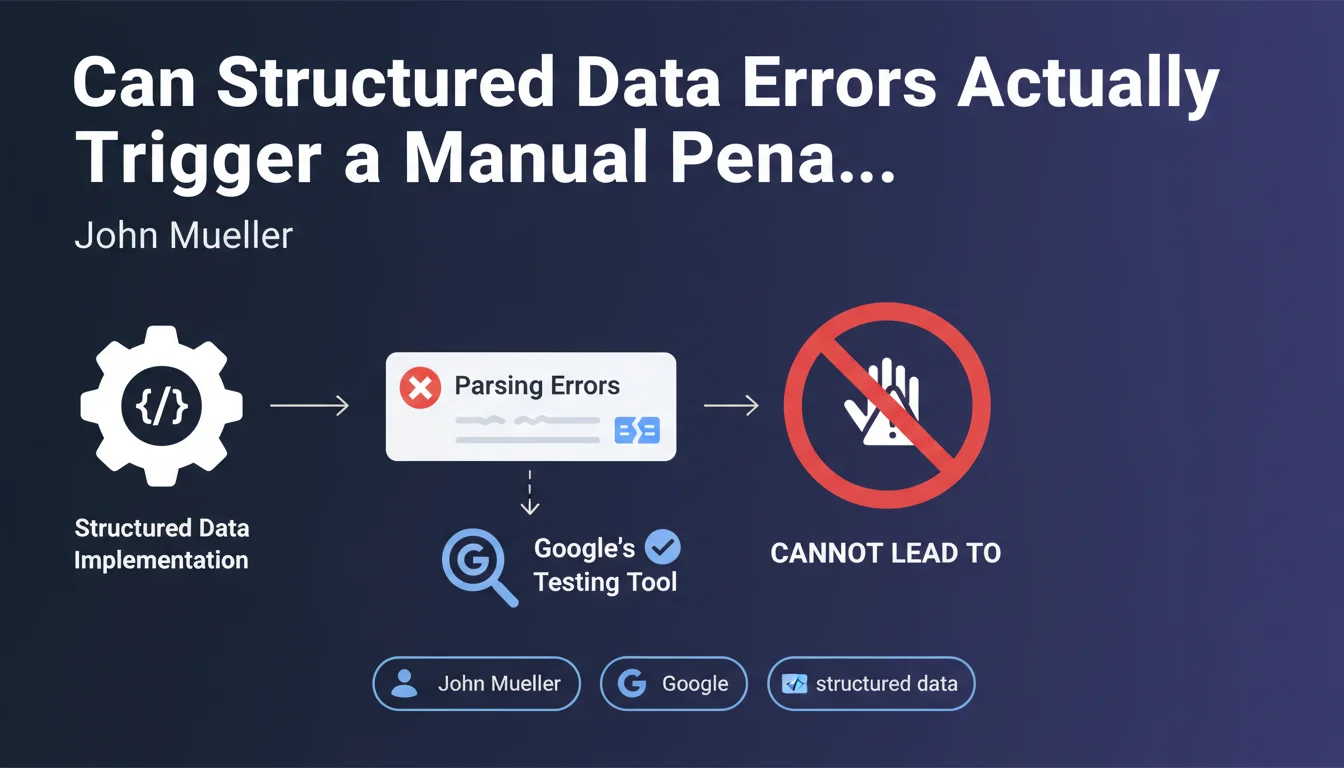
John Mueller clarified on Twitter that no manual action will be triggered by Google when parsing errors appear in structured data tags. This particularly concerns errors detected by Google's rich results testing tool.
This statement is reassuring for webmasters: even if your implementation contains technical errors, you don't risk a manual penalty from Google's teams. The search engine shows tolerance towards these integration issues.
Why doesn't Google penalize these errors?
The reason is pragmatic: a very significant proportion of websites have errors in their structured tags. Systematically penalizing these errors would amount to sanctioning a considerable portion of the web.
Google favors an educational approach rather than a punitive one. The search engine prefers to simply ignore poorly formatted data rather than penalize sites that attempt to implement them.
Does this mean that structured data quality doesn't matter?
Absolutely not. While errors don't trigger a manual penalty, they have other negative consequences. Poorly implemented tags simply won't be taken into account by Google.
- No manual action will be applied for syntax errors in structured data
- Poorly formatted data will simply be ignored by Google
- The absence of a penalty doesn't mean errors are without consequence
- Tags must comply with official recommendations to be effective
- Google's testing tool remains a valuable indicator for correcting errors
SEO Expert opinion
Is this statement consistent with practices observed in the field?
After 15 years of observation, this position from Google is completely consistent with reality. I have never seen a manual penalty related solely to structured markup errors, even on sites with massive errors.
However, it's important to distinguish between technical errors (incorrect syntax, missing properties) and deliberate abuses (misleading data, markup spam). The latter fall under a different problem and can indeed trigger manual actions for manipulation.
What important nuances should be added to this statement?
Google's tolerance concerns implementation errors, not manipulation attempts. If you use structured data to display misleading information or information not present on the page, you risk a penalty.
Furthermore, even without a penalty, errors have a considerable opportunity cost. A site without rich results loses visibility in SERPs compared to properly marked-up competitors. Click-through rates can drop by 20 to 40% depending on the queries.
In what cases might this rule not apply?
Google's tolerance has its limits when it comes to markup spam. If you create structured data invisible to users or describing content absent from the page, you're moving beyond simple technical errors.
Similarly, using inappropriate schemas to attempt to obtain undeserved rich results (like marking standard content as Recipe just to get stars) can be considered manipulative and lead to manual deactivation of rich snippets, or even more severe action.
Practical impact and recommendations
What should you actually do with this information?
Don't let this tolerance from Google lead you to neglect your structured data. On the contrary, consider it an opportunity to improve your implementation without excessive pressure.
Regularly use Google Search Console's rich results testing tool to identify and correct errors. Focus first on strategic pages: product pages, main articles, service pages.
What errors should you absolutely avoid in your structured tags?
Avoid creating data invisible to users. Any marked-up information must be visible somewhere on the page, even if the presentation differs slightly.
Don't attempt to manipulate results by using inappropriate schemas or artificially inflating your review ratings. Google detects these practices and can disable your rich results in a targeted or global manner.
How can you effectively verify and optimize your structured data?
Implement a systematic validation process for all your implementations. Test not only the syntax, but also consistency with the visible content of your pages.
- Audit your strategic pages with Google's rich results testing tool
- Correct critical errors that prevent the display of rich snippets
- Verify that all marked-up data is visible to users
- Use appropriate schemas according to your actual content type
- Monitor Search Console to detect indexing issues related to structured data
- Prioritize high-impact schemas: Product, Review, FAQ, Article, Breadcrumb
- Test actual display in SERPs via preview tools
- Document your implementations to facilitate future maintenance
💬 Comments (0)
Be the first to comment.