
Official statement
What you need to understand
What is Google's official position on this topic?
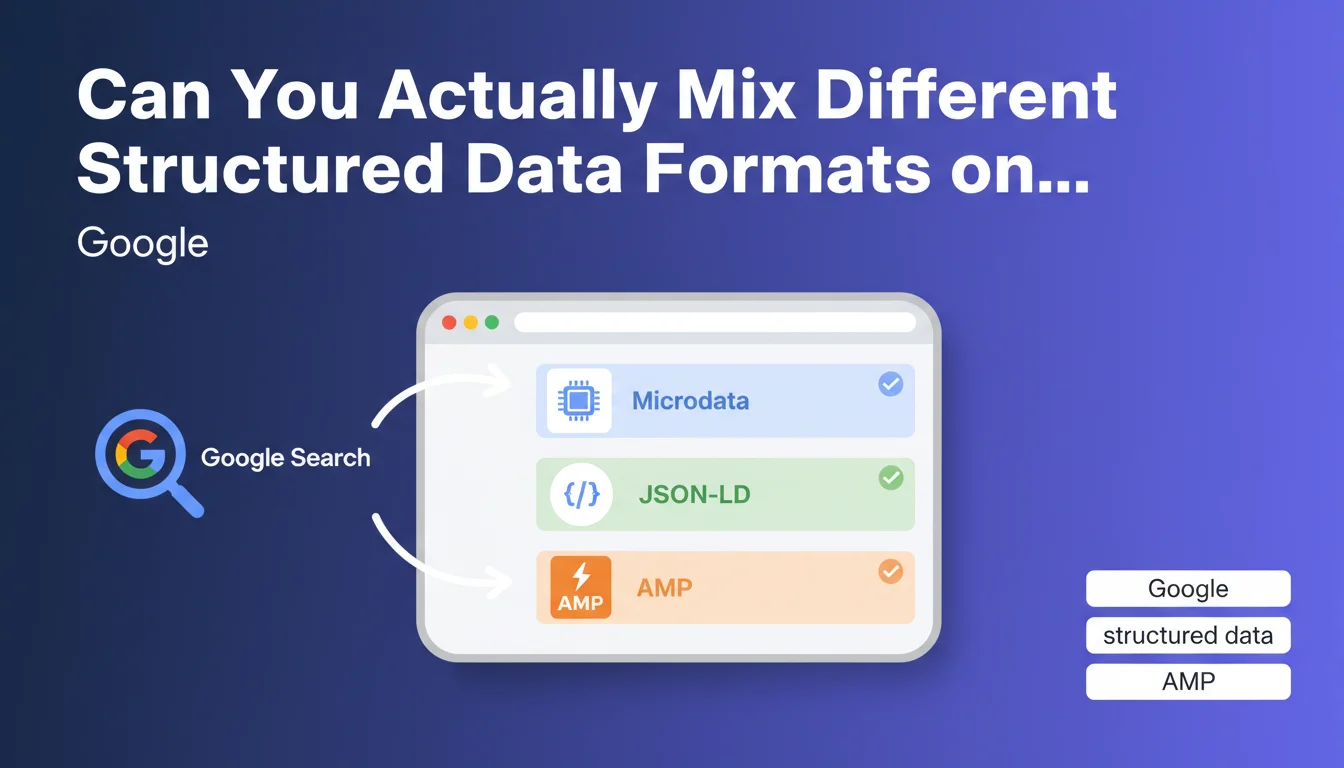
Google officially confirms that it is perfectly acceptable to use multiple structured data formats on the same page. You can therefore combine different vocabularies or even mix syntaxes.
More specifically, it is possible to mix JSON-LD, Microdata and RDFa on a single URL without this posing any problem for the search engine. This technical flexibility is good news for development teams.
Why does this flexibility matter in real-world practice?
In actual web development, certain structured data tags are easier to implement in one format rather than another. For example, JSON-LD integrates easily via a template system, while Microdata inserts naturally into existing HTML.
This flexibility allows developers to choose the most suitable solution for their technical architecture without compromising their SEO. This is particularly useful during progressive migrations or when different teams work on distinct sections of the site.
What are the limitations of this approach?
Google emphasizes a crucial point: implementing structured data (stars, prices, events, recipes) absolutely does not guarantee their display in search results.
- Correct markup is a necessary but not sufficient condition
- Google sovereignly decides whether or not to display rich snippets according to its own logic
- Content quality and relevance remain the determining factors
- The format used (JSON-LD vs Microdata) does not influence display chances
SEO Expert opinion
Does this statement match what we observe in the field?
After 15 years of experience, I confirm that this Google position does indeed correspond to technical reality. I have tested numerous sites mixing formats without ever observing any penalty or indexing problem.
However, this needs nuance: while Google tolerates this mixing, it doesn't mean it's the optimal solution. In practice, multiplying formats increases maintenance complexity and the risk of markup errors.
What risks does this approach actually carry?
The main danger is not technical but organizational. When different formats coexist, it becomes difficult to maintain consistency of structured data across the entire site.
I have observed cases where contradictory information was present in two different formats on the same page. Google can then completely ignore your structured data or arbitrarily choose which version to prioritize.
When does this flexibility become truly useful?
This possibility finds its usefulness in specific contexts: during a progressive migration from an old system to a new one, when you use third-party plugins that impose their format, or when technical constraints make one format more practical for certain types of data.
For example, it makes sense to use JSON-LD for global organizational data (Organization, WebSite) while keeping legacy Microdata for product sheets if a complete overhaul is not immediately possible.
Practical impact and recommendations
What strategy should you adopt for your structured data?
My main recommendation: prioritize JSON-LD as the single format for all your new implementations. It's the format that Google officially recommends and that offers the best maintainability.
If you must mix formats, document precisely which section uses which format and why. Create a clear map to facilitate future maintenance and avoid duplicates.
What mistakes should you absolutely avoid with structured data?
The most common mistake is to mark up the same information in two different formats on the same page. This creates redundancy that can confuse Google and dilute the clarity of your signals.
Also avoid marking up content not visible to the user. Google may consider this as markup spam and ignore all your structured data.
- Regularly audit your pages with Search Console and the structured data validator
- Verify that there is no duplication of information between different formats
- Test eligibility for rich snippets with the Rich Results Test tool
- Document your markup strategy in an internal guide
- Prioritize JSON-LD for any new implementation
- Monitor error reports in Search Console monthly
How can you ensure optimal implementation?
Implementing structured data requires sharp technical expertise and constant monitoring of Schema.org standards and Google guidelines evolution. A syntax error or poorly thought-out strategy can render all your markup ineffective.
If your site has a complex architecture or if you want to maximize your chances of obtaining rich results, it may be wise to get support from a specialized SEO agency. A professional audit will identify opportunities specific to your sector and avoid costly mistakes in terms of time and visibility.
💬 Comments (0)
Be the first to comment.