
Official statement
What you need to understand
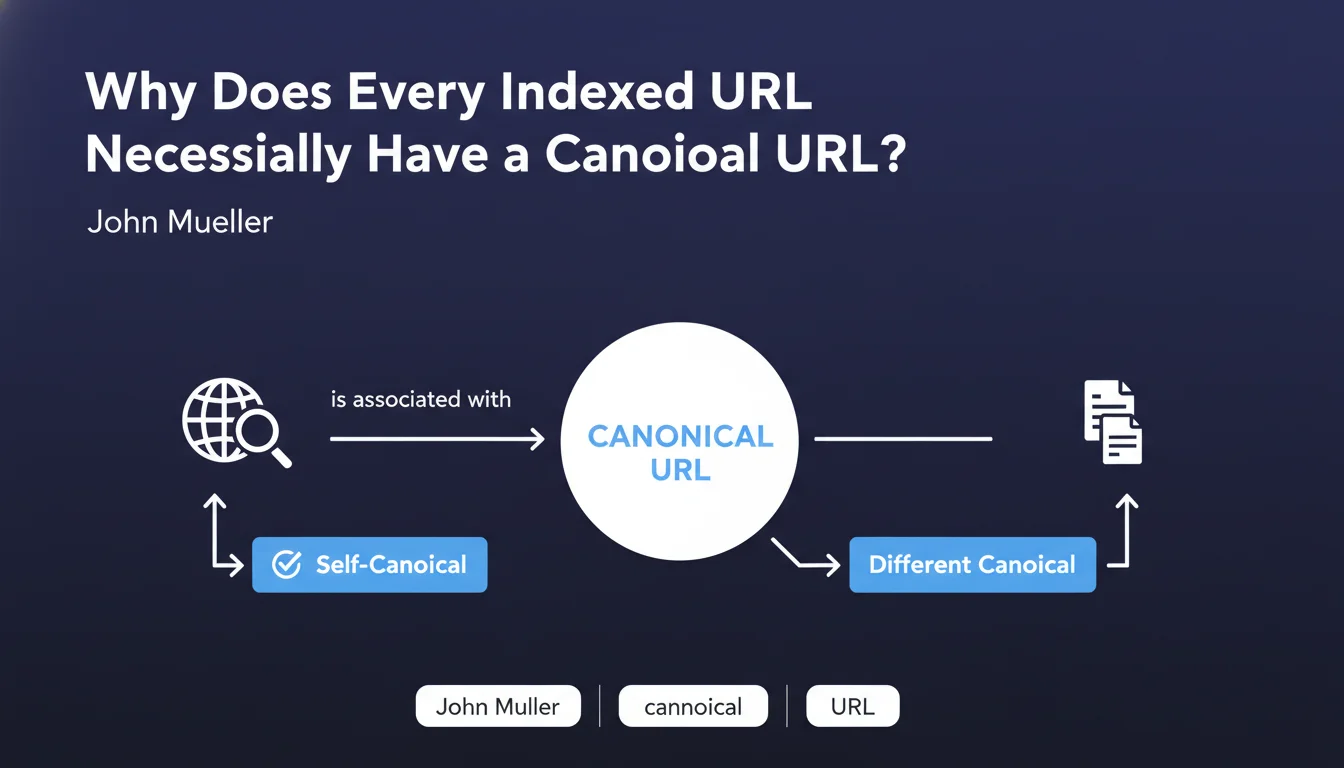
Google automatically associates a canonical URL with every indexed web page, even if that page does not have an explicit canonical tag. This mechanism is at the heart of the DUST (Duplicate URL, Same Text) system.
Concretely, when Google discovers multiple URLs presenting identical or very similar content, it chooses one as the reference canonical version. This is the URL that will be prioritized in search results and that will consolidate SEO signals (links, authority).
If you do not explicitly specify which URL should be considered canonical, Google makes this decision for you, and its choice does not always align with your strategic preferences.
- Every indexed URL has a canonical: either itself or another URL
- The absence of a canonical tag does not mean the absence of canonicalization
- Google may ignore your canonical tag if it deems its choice more relevant
- The DUST system aims to avoid duplicate content in the index
- SEO signals concentrate on the chosen canonical URL
SEO Expert opinion
This statement confirms what SEO practitioners observe daily: Google systematically canonicalizes, whether you want it to or not. In my audits, I regularly find cases where Google ignores poorly implemented canonical tags or chooses a different URL from the one indicated.
The important nuance here: the canonical tag is a recommendation, not a directive. Google may follow it or not based on its own analysis. I have seen sites where Google preferred URLs with UTM parameters rather than the clean URLs defined as canonical, simply because they received more external links.
Consistency remains essential: your canonical tags must be aligned with your XML sitemaps, your internal links, and your URL structure. A discrepancy between these signals creates confusion and leaves Google to arbitrate alone.
Practical impact and recommendations
- Systematically audit all indexable pages to verify the presence of a canonical tag
- Define an explicit canonical URL on every page, even if it points to itself (self-canonical)
- Check in Search Console which canonical URL Google has actually selected versus the one you declared
- Standardize signals: the canonical URL must match the one present in the XML sitemap
- Prioritize internal links to canonical versions only
- Avoid canonical chains: page A should not canonicalize to B which canonicalizes to C
- Handle pagination variants, filters, sessions with canonicals pointing to the main page
- Use absolute URLs in canonical tags (complete https:// protocol)
- Regularly monitor the canonical URLs chosen by Google to detect drifts
In summary: Canonicalization is not optional, it happens systematically. It is better to actively control it rather than let Google decide alone.
Optimal management of canonical tags requires a comprehensive view of the site architecture and continuous monitoring. These technical optimizations, particularly on large-scale sites or complex e-commerce platforms, require in-depth expertise and specialized analysis tools. To ensure a coherent and high-performing canonicalization strategy, support from an experienced SEO agency helps avoid costly mistakes and ensures regular monitoring adapted to your site's evolution.
💬 Comments (0)
Be the first to comment.