
Official statement
What you need to understand
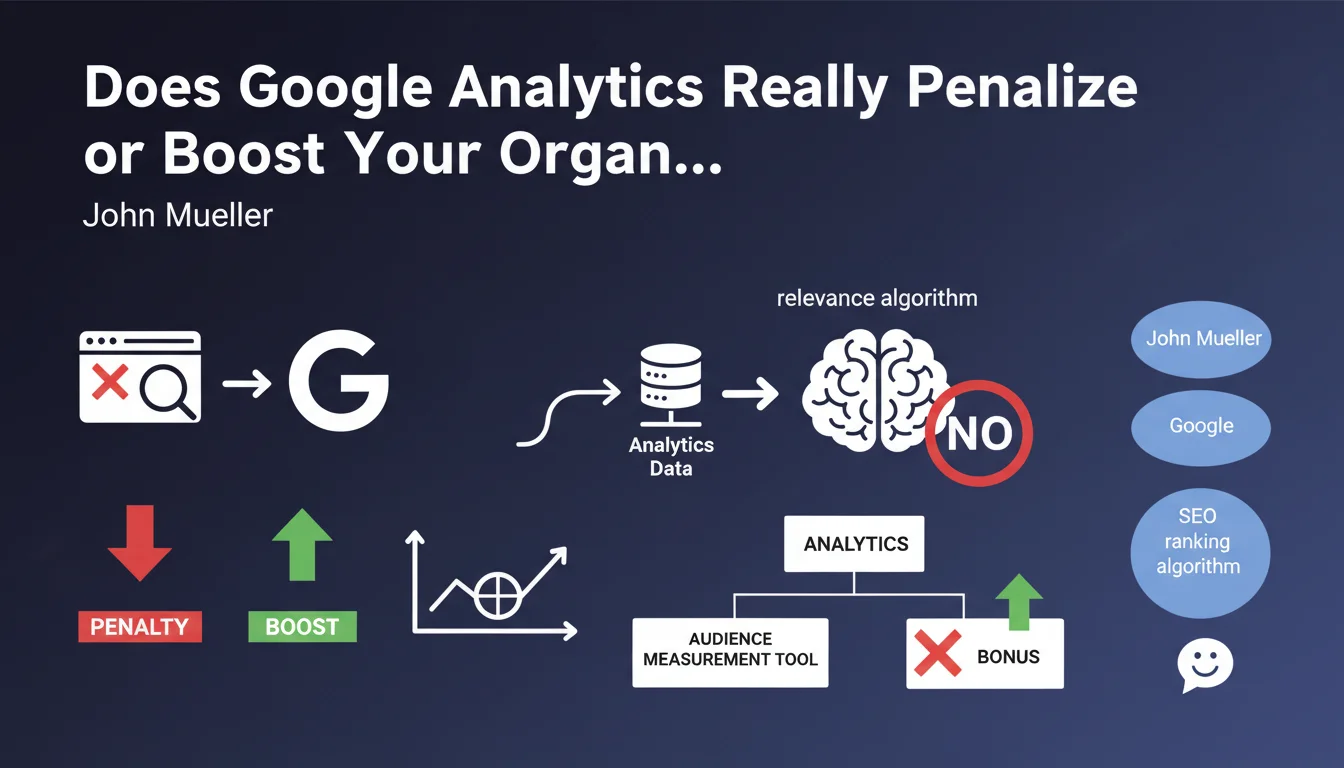
Google reaffirms a consistent position: the data collected by Google Analytics is absolutely not used by the search results ranking algorithm. This clarification comes up regularly because many SEO practitioners maintain legitimate doubts about this question.
Concretely, this means that your bounce rate, your session duration, or your number of page views in Analytics do not directly influence your position in the SERPs. Simply installing or not installing the Analytics tracking code on your site has no impact on your SEO performance.
Two things must be clearly distinguished: Analytics as a measurement tool versus real user engagement signals. Google can measure engagement through other means (Chrome, Android, repeated searches) without needing to access your Analytics account data.
- Analytics metrics (bounce rate, session duration) are not ranking factors
- Installing Analytics generates neither a bonus nor an SEO penalty
- Google has other sources of data on user behavior
- Analytics data remains compartmentalized from the search algorithm
SEO Expert opinion
This statement is consistent with field observations over the years. Many sites without Analytics perform excellently in SEO, while others with Analytics can stagnate. There is no observable correlation between Analytics usage and organic performance.
The important nuance lies in the distinction between correlation and causation. While Google doesn't use Analytics data directly, the search engine does indeed measure user engagement through other channels: Chrome data (browsing, time spent), clicks from SERPs, repeated searches, Android signals. A site with poor real engagement will be penalized, but not because of Analytics.
Practical impact and recommendations
- Don't optimize your SEO based on Analytics metrics alone – focus on real user experience rather than dashboard numbers
- Use Analytics to understand behavior, not to please the algorithm – this tool remains valuable for identifying UX problems to fix
- Don't remove Analytics out of fear of a penalty – there is no SEO risk in using it and it remains an indispensable analysis tool
- Invest in real user experience: loading speed, quality content, intuitive navigation, mobile-first
- Monitor Core Web Vitals in Search Console rather than Analytics metrics to understand what Google actually measures
- Cross-reference your data sources: Search Console, server data, heatmaps, user testing for a complete picture
In summary: Analytics is an excellent analysis tool but not a direct SEO lever. Focus your efforts on real user experience measured by the signals that Google actually captures.
Implementing a holistic SEO strategy that simultaneously optimizes user experience, Core Web Vitals, content architecture, and real engagement signals can prove complex. Faced with these multiple technical and strategic dimensions, support from an experienced SEO agency often allows for faster and more sustainable results, avoiding false leads and properly prioritizing optimization projects.
💬 Comments (0)
Be the first to comment.