
Official statement
What you need to understand
What exactly does Google say about structured data as a ranking criterion?
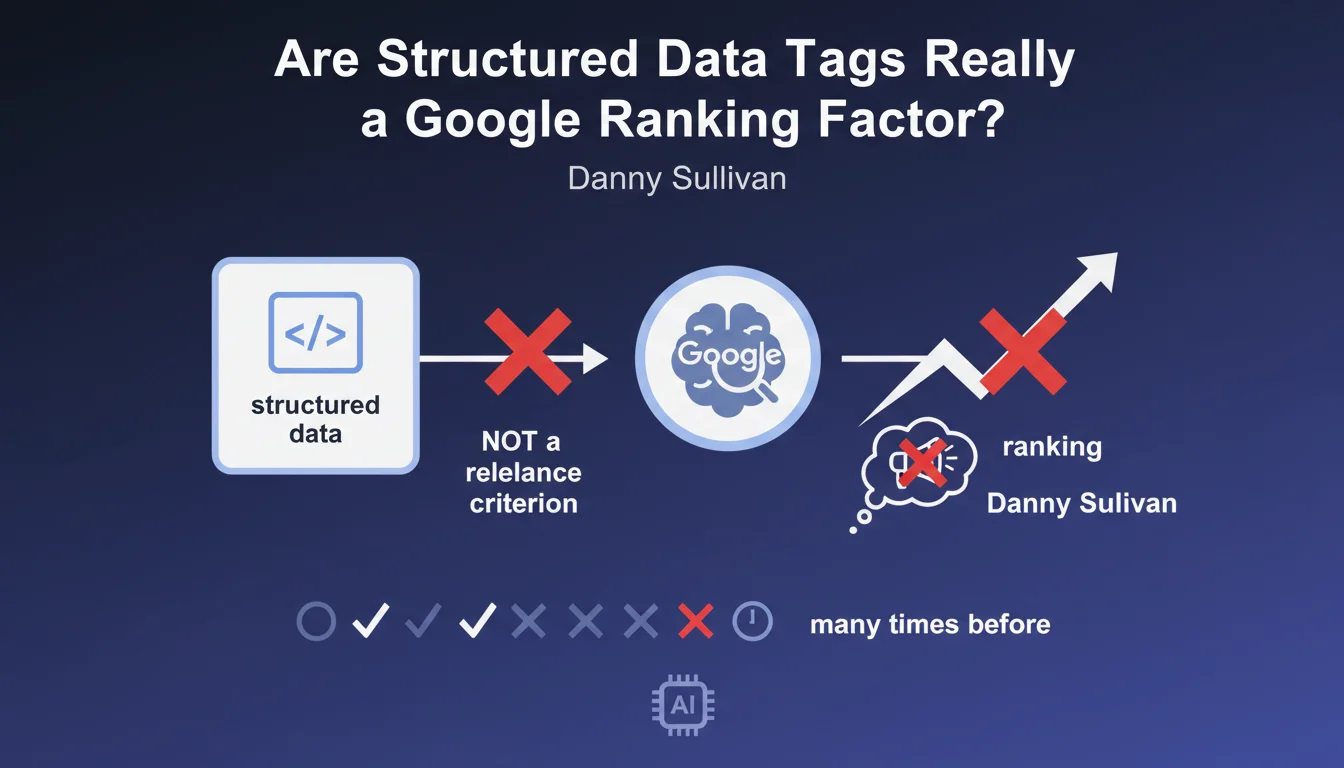
Google clearly states that using structured data markup (Schema.org, JSON-LD, Microdata) is not a direct relevance criterion for ranking in search results. In other words, adding Schema.org to your site won't automatically move you up in positions.
This statement, repeated several times by Google, aims to clarify a common confusion: structured data is not a ranking signal in the same way as backlinks or content quality.
Why then does Google encourage their use?
Structured data primarily serves to improve the semantic understanding of your content by indexing robots. They allow Google to better identify entities, relationships between elements, and the context of your page.
This improved understanding translates into indirect benefits: eligibility for rich snippets, enhanced display in SERPs, better presence in the Knowledge Graph, and potentially more accurate interpretation of your content's relevance.
What's the difference between direct and indirect SEO impact?
A direct criterion explicitly influences a page's ranking score (like loading speed or backlinks). An indirect criterion improves aspects that can subsequently impact rankings.
Structured data belongs to this second category: they improve visibility in SERPs via rich snippets, increase click-through rates, and help Google better contextualize your expertise.
- Structured data is not a direct ranking factor according to Google
- They improve the semantic understanding of your content by robots
- They provide access to rich snippets and enhanced displays in results
- The SEO impact is indirect but can be significant on visibility
- Without structured data, you remain eligible for ranking but lose opportunities for enhanced display
SEO Expert opinion
Is this statement consistent with real-world observations?
After 15 years of observation, I can confirm that structured data does not work as a direct ranking boost. A page without Schema.org can easily outrank a page that uses it, with equal content and authority.
However, the impact on click-through rate is measurable and significant. Pages displaying review stars, prices, preparation times, or enriched FAQs capture more attention and often generate 15 to 30% additional clicks. This improved CTR can subsequently positively influence ranking.
What important nuances should be added to this statement?
Google deliberately simplifies its message, but reality is more complex. Certain types of structured data are virtually mandatory to appear in specific features: Recipe Carousels, Job Postings, Events, Products in stock.
In these vertical contexts, not implementing structured data completely excludes you from certain visibility zones. It's not about ranking, but eligibility: you're simply not in the race.
In which cases do structured data have the most impact?
Impact is greatest for e-commerce sites (prices, availability, reviews), content sites (articles, recipes, videos), local sites (LocalBusiness, hours, reviews), and event or training sites.
For simple informational content without particular structured elements, impact remains limited. However, for any content containing identifiable entities (people, places, products, events), structured data becomes a major strategic asset.
Practical impact and recommendations
What should you actually implement on your site?
Start by identifying priority content types on your site: articles, products, services, events, FAQs, reviews. Each type corresponds to a specific schema (Article, Product, Event, FAQPage, Review, etc.).
Favor the JSON-LD format, recommended by Google as it's easier to implement and maintain. Place your structured scripts in the or at the end of , and use complete properties rather than minimal ones.
For an e-commerce site, focus on: Product (with price, availability, SKU), AggregateRating (average ratings), Offer (sales conditions), and Breadcrumb (breadcrumb trail). For a blog: Article or BlogPosting with author, date, image.
What critical mistakes should you absolutely avoid?
Never include invisible data for users in your structured tags. Google requires strict correspondence between what is marked up and what is displayed on the visible page.
Avoid misleading markup: inflated ratings, incorrect prices, false availability. Systematically test your implementations with Google's Rich Results Test before production deployment.
Don't use multiple formats simultaneously (JSON-LD + Microdata) for the same data, this creates confusion for robots. Choose one format and remain consistent.
How can you check and optimize your existing structured data?
Regularly use Google's Rich Results Test and Search Console (Enhancements section) to identify errors and warnings. Immediately correct critical errors that prevent enhanced display.
Monitor your SERP performance: track the actual appearance of rich snippets, measure CTR evolution on marked-up versus non-marked-up pages. Adjust your strategy based on observed results.
- Identify priority content types to mark up on your site
- Implement JSON-LD with recommended complete properties
- Test each implementation with the Rich Results Test before publication
- Verify strict consistency between structured data and visible content
- Monitor Enhancements reports in Search Console
- Immediately correct any critical errors or warnings
- Measure impact on CTR and visibility in SERPs
- Progressively extend markup to all eligible content
- Maintain and update structured data during content updates
💬 Comments (0)
Be the first to comment.