
Official statement
What you need to understand
Why does this question about HTTP vs HTTPS even come up in SEO?
Ever since Google imposed HTTPS as a security standard and ranking factor in 2014, many SEO practitioners have been questioning how links are treated. The main concern was that outbound HTTP links from an HTTPS site might lose their value or be devalued.
This confusion stems from the fact that Google clearly favors secure sites in its index. Some logically thought that this preference would also extend to PageRank transmission through links.
What does this statement from Google actually mean in practice?
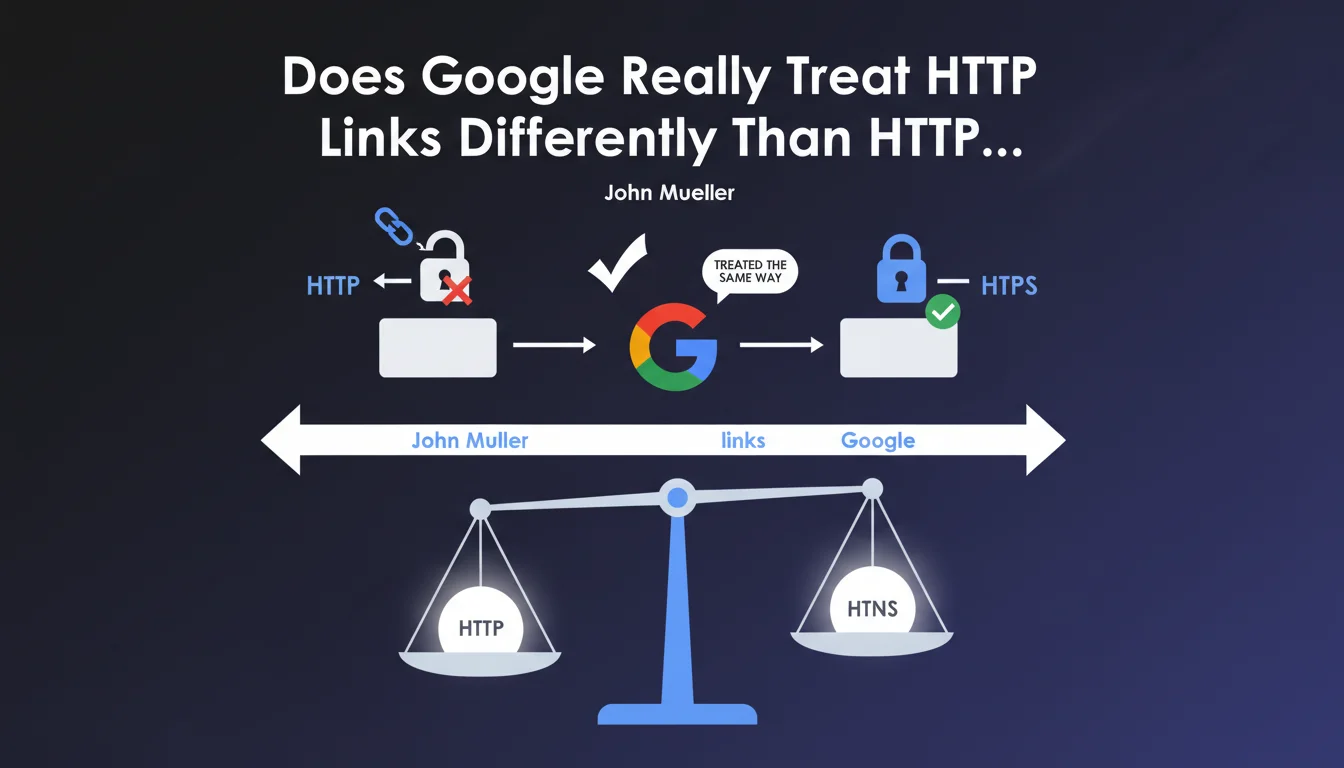
Google officially confirms that the protocol used in a URL (HTTP or HTTPS) does not affect how the search engine treats the link for authority transfer. A link is a link, regardless of its protocol version.
This means that an HTTP backlink to your site will have exactly the same value as an HTTPS backlink, all other things being equal. PageRank flows identically in both cases.
What are the key takeaways from this clarification?
- Complete equivalence: Google makes no distinction between HTTP and HTTPS in its link analysis
- Link value preserved: PageRank and authority are transmitted the same way regardless of protocol
- No penalty: Linking to an HTTP site from an HTTPS site (or vice versa) has no negative SEO impact
- HTTPS still matters: This equivalence only concerns links, not the overall site ranking which still favors HTTPS
SEO Expert opinion
Is this statement consistent with practices observed in the field?
Absolutely. In my 15 years of experience, I've observed that HTTP sites continue to transmit PageRank perfectly effectively. Link profile analyses show that a backlink's impact depends on its quality, relevance, and context, never on the protocol used.
This clarification confirms what empirical testing already showed: Google analyzes the link graph in a protocol-agnostic way. The HTTP/HTTPS distinction comes into play at the indexing and final ranking level, not at the link graph level.
What important nuances should we add to this rule?
Be careful though: while links are treated identically, this doesn't mean HTTP and HTTPS are equivalent for your overall SEO. An HTTPS site benefits from a slight ranking boost and inspires more trust in users, which improves behavioral signals.
Additionally, modern browsers display security warnings on HTTP sites, which can hurt click-through rates and conversions. Link equivalence therefore shouldn't be an excuse to neglect HTTPS migration.
In what contexts does this rule make complete sense?
This clarification is particularly important for link building and backlink acquisition. It confirms that you shouldn't systematically reject link opportunities from sites still on HTTP, if their authority and relevance are good.
It's also reassuring for HTTPS migrations: old HTTP backlinks to your old URLs continue to transmit their value after redirecting to HTTPS versions. No PageRank loss related to protocol change.
Practical impact and recommendations
What should you actually do with this information?
First, don't refuse a quality backlink just because it comes from an HTTP site. Evaluate it on its real criteria: domain authority, thematic relevance, content quality, link position on the page.
Second, if you manage outbound links on your site, still prefer HTTPS versions when they exist, for consistency and user experience. But don't worry excessively if some links point to HTTP.
Third, during an HTTP to HTTPS migration, focus your efforts on correct 301 redirects rather than worrying about a hypothetical loss of link value. Protocol doesn't impact authority transfer.
What mistakes should you absolutely avoid?
- Don't disavow quality backlinks solely because they're HTTP
- Don't refuse guest posting opportunities on relevant and authoritative HTTP sites
- Don't panic if your link profile contains an HTTP/HTTPS mix (it's normal)
- Don't create complex redirections to "force" HTTPS in your outbound links at the expense of UX
- Don't delay your HTTPS migration thinking it will affect your existing backlinks
How can you optimize your link strategy in light of this clarification?
Focus your link building strategy on real quality criteria: authority, relevance, anchor diversity, profile naturalness. The HTTP/HTTPS protocol is not a relevant selection criterion for your backlinks.
For your internal linking, systematically use HTTPS URLs if your site is migrated, for technical consistency. For external links, prefer HTTPS when available, but without obsession.
Make sure your site is fully migrated to HTTPS with correct 301 redirects. This technical migration, though simple in theory, contains many potential pitfalls: mixed content, incorrect canonicals, redirect chains, server configuration files.
💬 Comments (0)
Be the first to comment.