
Official statement
What you need to understand
What is Google's official position on HTTPS?
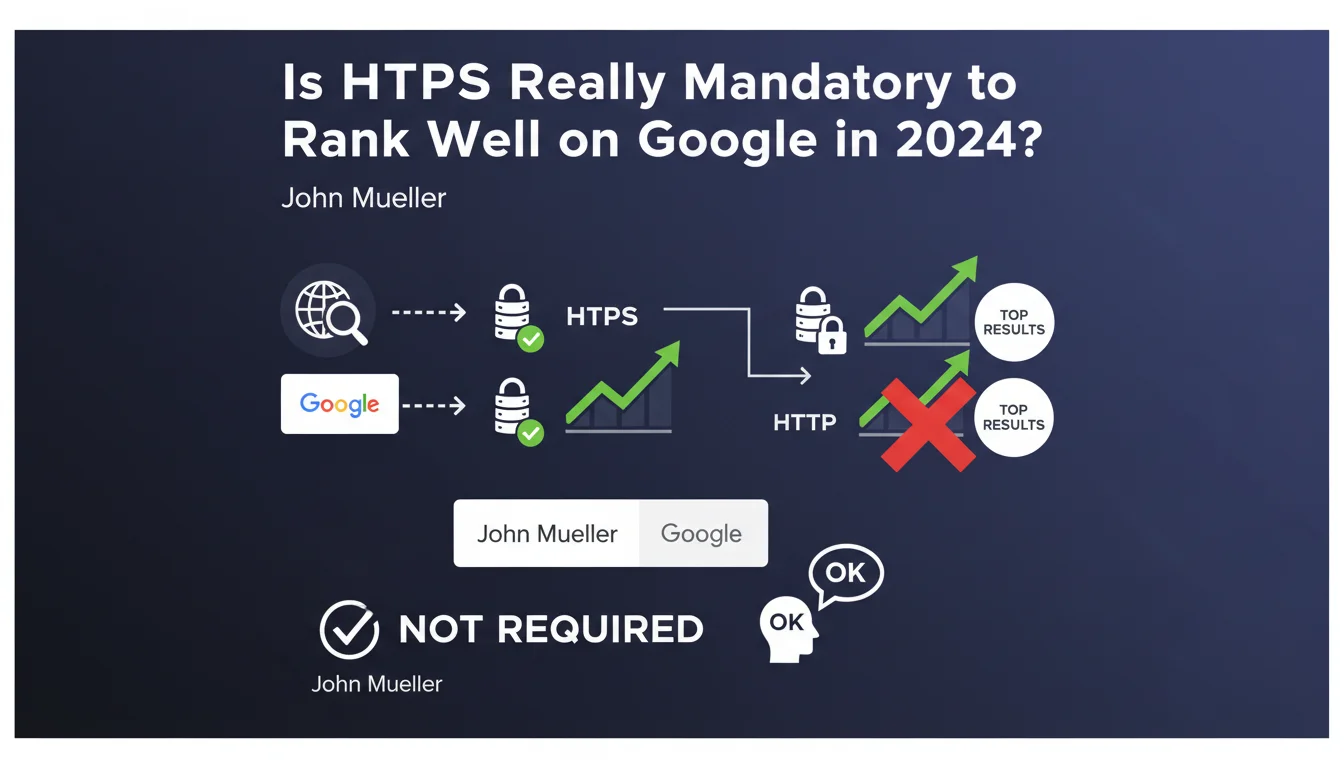
Google has officially confirmed that HTTPS is not a mandatory criterion to rank well in search results. Many HTTP sites continue to be perfectly indexed and can reach top positions.
This statement may be surprising given the intensive promotion of the secure protocol in recent years. Yet it reflects reality: content quality takes precedence over the protocol used.
How does HTTPS actually influence ranking?
HTTPS acts as a minor tiebreaking criterion, what's called a "tie-breaker". Specifically, if two pages have exactly the same relevance score on all other criteria, the HTTPS one will be favored.
This nuance is fundamental: HTTPS doesn't directly improve your ranking. It only comes into play in case of perfect equality between two pieces of content, which remains relatively rare in practice.
Why do we see fewer HTTP sites in the results?
If HTTP sites are becoming scarce in SERPs, it's not because Google actively penalizes them. It's simply because there are fewer and fewer HTTP sites on the web.
The massive adoption of HTTPS is more related to browser requirements, general security recommendations, and user perception than to a direct SEO impact.
- HTTPS is not mandatory to rank well on Google
- It acts as a tie-breaker in case of perfect relevance equality
- Content quality remains the determining ranking factor
- The scarcity of HTTP sites in SERPs reflects their general decline on the web
- Modern browsers alert users about non-secure sites
SEO Expert opinion
Is this statement consistent with what we observe in the field?
Absolutely. In my practice, I've found that HTTP sites can indeed outperform HTTPS competitors when their content is significantly better. Google's algorithm always prioritizes relevance and quality.
However, this technical reality shouldn't obscure the other advantages of HTTPS: user trust, potentially lower bounce rate, and absence of browser warnings. These factors can indirectly influence your SEO performance.
What important nuances should be added to this statement?
First crucial point: even though HTTPS isn't mandatory for ranking, it becomes essential in certain contexts. For an e-commerce site collecting payment data, it's a legal and ethical necessity, not just an SEO choice.
Second nuance: the psychological impact on users is real. An HTTP site displaying "Not Secure" in Chrome can generate distrust and increase bounce rate. These behavioral signals can, in turn, affect your SEO indirectly.
In what cases could this rule evolve?
Google could toughen its position if web security becomes an even more critical issue. For now, the Mountain View firm prefers to encourage rather than compel, letting browsers and the web ecosystem naturally push towards HTTPS.
In certain niches or for certain queries related to security or transactions, we can legitimately assume that Google already gives greater weight to the secure protocol, even if this isn't officially documented.
Practical impact and recommendations
Should you migrate your site to HTTPS for SEO?
The pragmatic answer: yes, but not solely for SEO. If you're still hesitating, migrating to HTTPS should be considered for reasons of user trust, regulatory compliance, and compatibility with modern web features.
In purely SEO terms, it's not an urgent priority if your site is already performing well. Focus first on content quality, technical aspects, and link acquisition. HTTPS can wait if other projects are more impactful.
What mistakes should you avoid during an HTTPS migration?
HTTPS migration is technically simple in appearance, but mistakes can be costly in SEO terms. A poorly configured redirect, mixed content (HTTP/HTTPS), or an outdated sitemap file can create indexing problems.
Many sites temporarily lose traffic after a poorly prepared migration. You absolutely must plan 301 redirects, update all internal links, properly configure Search Console, and monitor server logs.
What should you do concretely today?
If you're still on HTTP, establish a migration plan considering all aspects, not just SEO. Prioritize this migration if you collect user data or if your bounce rate is high.
If you're already on HTTPS, verify that the implementation is complete and flawless: valid certificate, no mixed content, consistent redirects, and all your tracking tools updated.
- Audit your site to identify whether you're on HTTP or HTTPS
- Check the validity and expiration date of your SSL certificate
- Scan your site to detect any mixed resources (images, scripts on HTTP)
- Ensure all HTTP URLs redirect with 301 to their HTTPS equivalent
- Update your XML sitemap with HTTPS URLs
- Declare the HTTPS version as the primary property in Google Search Console
- Verify that your canonical tags point to HTTPS URLs
- Test loading time after migration to detect any SSL-related slowdown
- Monitor your rankings and traffic for 4 to 6 weeks post-migration
💬 Comments (0)
Be the first to comment.