
Official statement
What you need to understand
What Does Google Really Mean by "Low-Quality Content"?
Google makes a fundamental distinction between existing content and useful content. The mere presence of text on a page doesn't guarantee its indexation. The search engine constantly evaluates whether content provides real added value to users.
This statement confirms that Google operates an active filtering of what deserves to be indexed. It's no longer simply about crawling and indexing everything that exists, but making choices based on perceived quality.
Why Are So Many SEO Professionals Affected by This Issue?
Large-scale content production has become common practice in SEO. Many sites multiply pages to cover as many long-tail keywords as possible, without always considering the real usefulness for the end user.
This quantitative approach now clashes with Google's quality standards. Algorithms detect generic, duplicated, or superficial content that merely reformulates what already exists elsewhere.
What Are the Signals That Indicate Low-Quality Content?
Google uses several indicators to assess content quality. Behavioral signals such as bounce rate, time spent on page, and lack of engagement suggest that the content doesn't meet expectations.
- Absence of unique perspective or real expertise on the topic covered
- Generic content that merely paraphrases other sources
- Shallow depth of analysis and lack of practical details
- Absence of direct experience or tangible evidence (case studies, data, examples)
- Excessive SEO optimization at the expense of readability and usefulness
SEO Expert opinion
Is This Google Position Consistent with Field Observations?
Absolutely. For several years now, we've observed more selective indexation from Google. Sites that massively produce content without a solid editorial strategy see indexation rates sometimes drop below 50%.
This trend has intensified with the rise of automatic generation tools and AI. Google must manage a growing volume of content and optimizes its resources by prioritizing what truly brings value.
What Nuances Should Be Applied to This Statement?
Be careful not to fall into the opposite extreme. Content can be judged as low quality by Google even if it's objectively useful, simply because it lacks trust signals or topical authority.
The notion of quality is also context-relative. Short, direct content can be perfect for answering a simple informational query, while a complex topic requires depth. Quality isn't synonymous with systematic length.
In What Cases Can Legitimate Content Be Judged as Low Quality?
Some technically correct content suffers from a lack of differentiation. If you're covering a topic already addressed by hundreds of similar pages, Google may consider that your contribution brings nothing new.
Sites with low topical authority sometimes see their content ignored, even when quality, simply because Google favors established sources on these topics. It's frustrating but it's the current algorithmic reality.
Practical impact and recommendations
How Can You Objectively Evaluate Your Content Quality?
Start with an indexation audit via Google Search Console. Identify pages discovered but not indexed, and analyze their common characteristics. Often, patterns emerge quickly.
Then perform a simple test: have someone who doesn't know the subject read your content. Does this person learn something concrete and actionable? Could they apply your advice immediately? If the answer is no, you have a quality problem.
What Concrete Actions Should Be Implemented to Improve the Situation?
The first step is to stop quantitative production to focus on editorial quality. It's better to publish one excellent article per week than five mediocre pieces of content.
Next, enrich your existing content with proof elements: screenshots, quantified data, real case studies, testimonials. These elements reinforce credibility and perceived value.
- Audit non-indexed content and identify common causes of rejection
- Implement a real editorial line based on expertise and real experience
- Add unique elements: proprietary data, original methodologies, experience feedback
- Optimize E-E-A-T signals with detailed author biographies and proof of competence
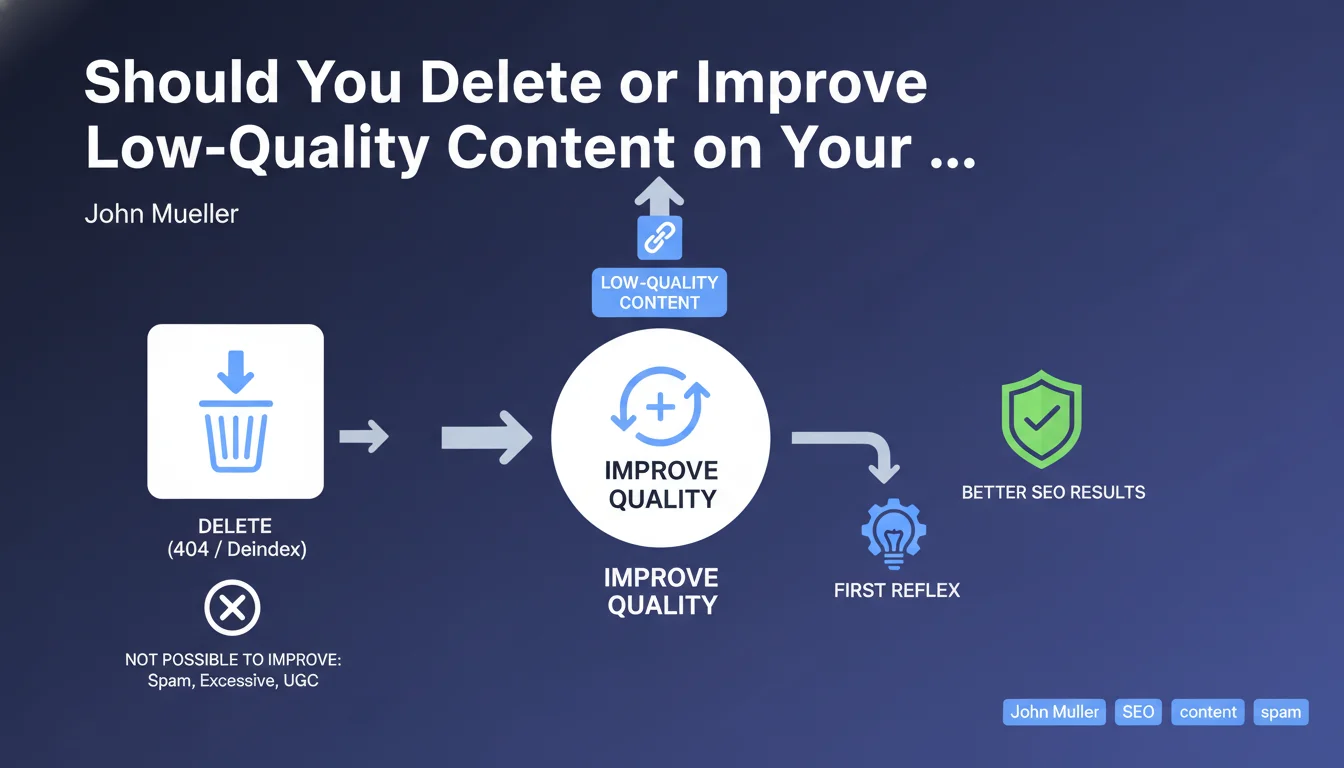
- Merge or delete weak content that cannibalizes site authority
- Monitor indexation rate via Search Console and adjust strategy accordingly
- Prioritize depth over quantity by developing comprehensive content on fewer topics
How Can You Avoid Repeating These Mistakes in the Future?
Implement an editorial validation process before publication. Each piece of content must pass through an evaluation grid: does it bring something unique? Is it based on real expertise? Does it solve a concrete problem?
Train your teams on Google's quality criteria and E-E-A-T principles. Understanding the search engine's expectations must become a reflex, not a constraint imposed after the fact.
💬 Comments (0)
Be the first to comment.