
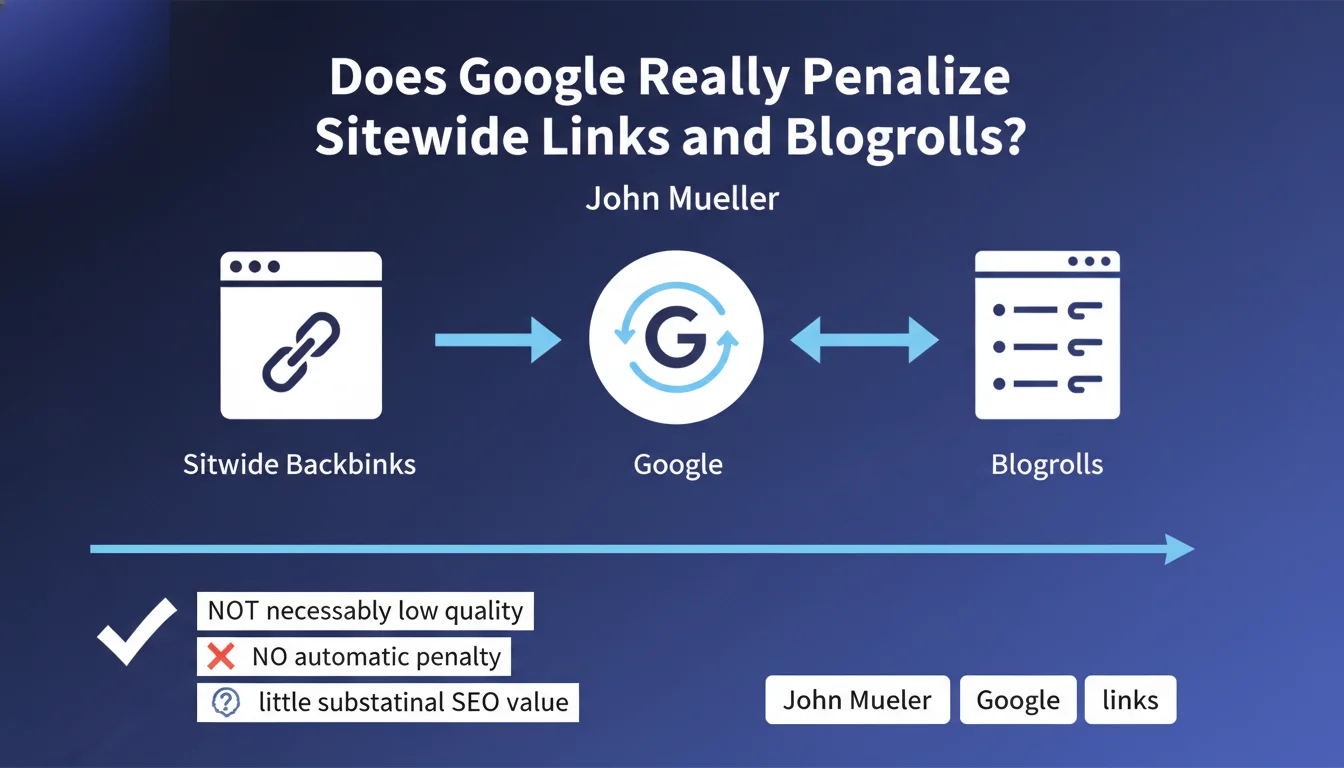
Official statement
What you need to understand
What exactly is a sitewide or blogroll link?
A sitewide link is a backlink present on all pages of a website, generally placed in the footer, header, or sidebar. For example, a link to a partner displayed in the footer across an entire 500-page site technically generates 500 backlinks.
A blogroll refers to a list of recommended links, often positioned in a sidebar column in the form of "friendly sites" or "useful links." These practices, inherited from the web of the 2000s, have long been suspected of being considered manipulative by Google.
Why were these links considered suspicious?
The SEO community long believed that Google systematically penalized these repetitive links because they can artificially inflate the number of backlinks. A single partnership can generate hundreds of identical links, which seemed contrary to Google's guidelines on natural links.
Many experts recommended disavowing these links via Google Search Console, as a precaution. This caution was explained by the fear of manual action or an algorithmic penalty like Penguin.
What does Google actually say about these links today?
John Mueller clarifies that these links are not automatically considered poor quality. Google understands that some sitewide links can be legitimate and editorial, such as an official partner mentioned in the footer or a sincere recommendation in a blogroll.
However, Mueller nuances: these links probably don't have substantial weight in the ranking algorithm. Google knows how to identify them and naturally devalues them without necessarily penalizing the site.
- Sitewide and blogroll links are not automatically considered spam
- It's not necessary to systematically disavow them
- Google identifies them and generally assigns them low weight
- A link is not artificial simply because it's in a blogroll
- Link quality depends on context and intention, not solely on its placement
SEO Expert opinion
Is this statement consistent with field observations?
This position from Google indeed corresponds to what we've been observing for several years. Sites receiving legitimate sitewide links (official partners, sponsors, suppliers) generally don't suffer penalties, contrary to the initial fears of the SEO community.
On the other hand, the positive impact of these links on ranking remains indeed marginal. Our analyses show that Google likely applies a significant devaluation coefficient to these repetitive links, counting them as a single signal rather than as hundreds of distinct backlinks.
What critical nuances absolutely need to be added?
Mueller's statement doesn't mean that all sitewide links are acceptable. A purchased or exchanged sitewide link for purely SEO purposes remains a violation of guidelines, even if it's not automatically penalized. The difference lies in intention and transparency.
Moreover, the accumulation of numerous artificial sitewide links can still trigger manual review. Google tolerates isolated legitimate sitewide links, but a link profile dominated by this type of backlink will send alarm signals.
In which cases do these links still pose problems?
Sitewide links become problematic when they constitute the majority of a site's backlink profile. If 80% of your links come from footers of 3-4 partner sites, Google will understand that your link building strategy is not natural.
Massive reciprocal blogrolls between thematically unrelated sites also remain suspicious. A plumbing site in a blogroll on a recipe blog has no editorial justification and can be ignored or penalized.
Practical impact and recommendations
Should I disavow existing sitewide links in my profile?
No, it's not necessary to systematically disavow your existing sitewide or blogroll links. If these links come from legitimate partnerships or sincere recommendations, leave them in place. Google knows how to manage them without penalizing your site.
Focus disavowal only on links that are clearly manipulative or toxic: artificial site networks, massive purchased links, or profiles with over-optimized anchors. A footer link from a real commercial partner doesn't require disavowal.
What strategy should I adopt to obtain effective backlinks?
Prioritize contextual links within editorial content rather than sitewide placements. A single link in a quality article will have infinitely more value than a footer link repeated on 1000 pages.
If you obtain a legitimate sitewide link (partnership, sponsorship), consider it a brand awareness bonus rather than a major SEO lever. Its impact on your rankings will be limited, but it won't penalize you either.
How do I effectively audit my existing link profile?
Analyze the proportion of sitewide links in your total profile via Google Search Console or tools like Ahrefs/Majestic. If more than 30% of your referring domains generate sitewide links, your profile lacks diversity.
Examine the context and relevance of each sitewide link. A partner footer in your industry sector is acceptable, but a network of blogrolls without thematic coherence should be cleaned up.
- Audit your backlink profile to identify the proportion of sitewide links
- Only disavow sitewide links that are clearly artificial or manipulative
- Keep sitewide links from legitimate commercial partnerships
- Direct your link building strategy toward contextual links within content
- Avoid accumulating new sitewide links as your primary SEO tactic
- Diversify your backlink sources for a natural and balanced profile
- Regularly monitor your link profile evolution via Search Console
- Document the legitimacy of your partnerships to justify sitewide links
💬 Comments (0)
Be the first to comment.