
Official statement
What you need to understand
What exactly does Google say about the concept of site authority?
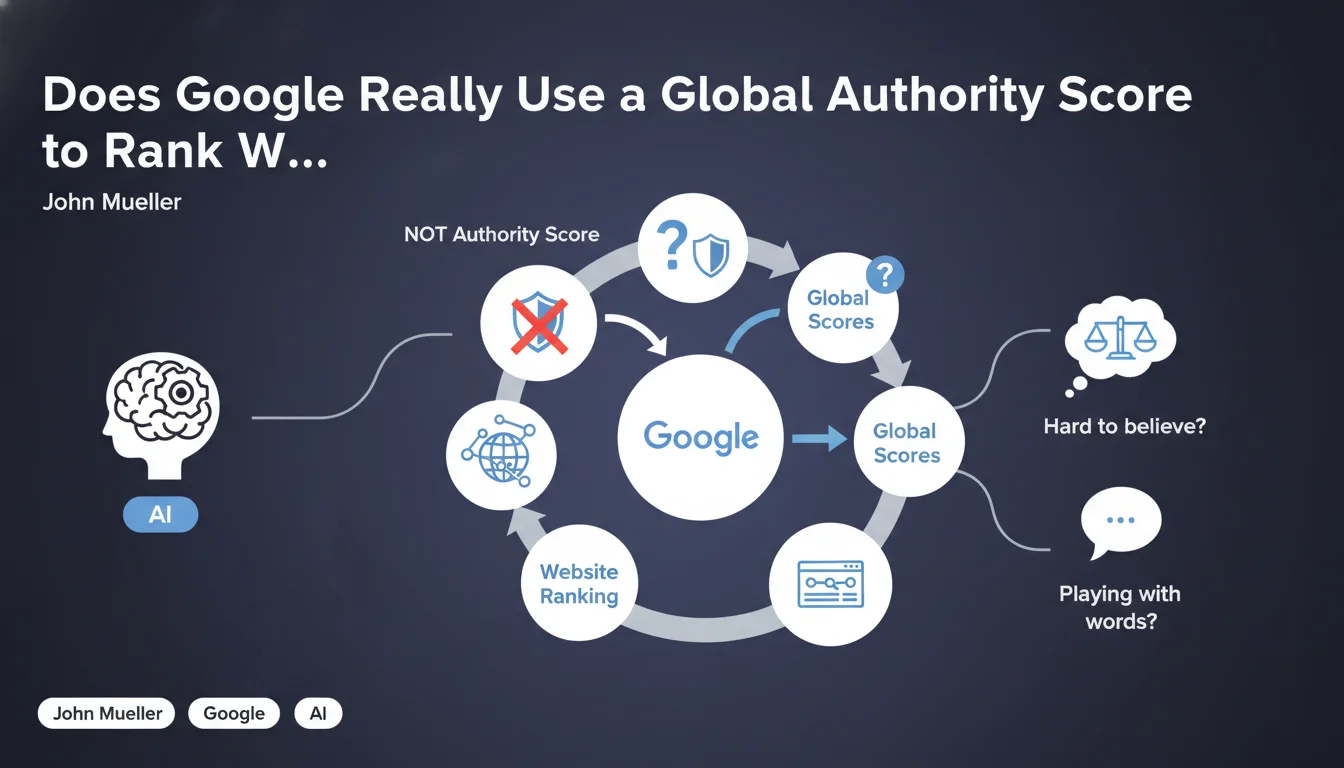
John Mueller clearly stated that Google does not use a global authority score to evaluate a website as a whole. This statement contradicts the widespread belief that each site has a single authority rating.
However, Mueller specifies that Google may use certain global scores associated with a site, without revealing their exact nature. This nuance is essential: the absence of a unified authority score doesn't mean the complete absence of site-level metrics.
Why is this distinction between authority and other scores important?
The term "authority" is indeed ambiguous and can refer to different things. For SEO practitioners, it often evokes third-party metrics like Moz's Domain Authority or Ahrefs' Domain Rating.
Google seems to reject the idea of a single, simplistic metric, preferring a multidimensional evaluation that varies according to queries, topics, and contexts. This approach is consistent with the complexity of the modern algorithm.
What site-level metrics might Google be using?
Although Mueller remains evasive, Google probably uses aggregated signals at the domain level for certain evaluations. These signals may include the site's history, overall content quality, or link patterns.
- Internal PageRank: still used but not as a single authority score
- E-E-A-T quality signals: evaluated page by page but potentially influencing domain perception
- Quality history: past performance of content and updates
- Link profile: natural and diverse vs. manipulative
- Google likely evaluates topical consistency and a domain's expertise on its subjects
SEO Expert opinion
Is this statement consistent with real-world observations?
As an SEO expert, I indeed observe that authority is not uniform across a site. A domain can excel in one topic and be insignificant in another. This observation confirms Mueller's statement.
However, it's equally evident that certain sites benefit from a systemic advantage. Established news sites, academic institutions, or government websites seem to enjoy pre-established trust. This suggests the existence of domain-level signals, even if Google avoids the term "authority".
What words is John Mueller likely playing with?
Mueller is probably using a very specific definition of the term "authority". By denying an "authority score," he may simply be rejecting the idea of a single, linear metric like DA or DR.
In reality, Google likely uses dozens of domain-level signals that, combined, create what we perceive as "authority". The distinction is semantic but allows Google to maintain ambiguity about its exact functioning.
In what cases does this nuance have the most impact?
For new sites or niche sites, this statement is encouraging. It means that a recent domain can rank for specific queries without first having to "build its global authority".
Conversely, for large established sites, this reminds us that no area of the site is immune to quality decline. Every section, every page must maintain its standards, because authority isn't automatically transferable.
Practical impact and recommendations
What should you actually do in your SEO strategy?
Rather than trying to increase a hypothetical "global authority score," focus on developing demonstrated topical expertise. Google evaluates your legitimacy subject by subject.
Build coherent content clusters around your main topics. Demonstrate your expertise through the depth, consistency, and quality of your publications on these specific subjects.
- Develop a clear topical architecture with well-defined content silos
- Create content that demonstrates real and verifiable expertise (E-E-A-T)
- Obtain contextual links from relevant sites in your topic area
- Establish proof of authority: expert mentions, citations, collaborations
- Maintain consistent quality across the entire site, not just on a few flagship pages
- Monitor quality signals page by page rather than globally
What strategic mistakes should you absolutely avoid?
Don't waste time trying to "increase your DA" as a primary goal. These third-party metrics are approximate indicators, not objectives in themselves.
Also avoid diluting your expertise by spreading yourself too thin across too many unrelated topics. A coherent and specialized site will perform better than a generalist site without a clear direction.
Don't neglect the "secondary" sections of your site thinking that global authority will carry them. Every page must earn its ranking through its intrinsic quality and relevance.
How can you effectively measure and optimize these signals?
Analyze your performance topic by topic rather than globally. Identify which subjects Google recognizes you for and which ones need reinforcement.
Use tools like Google Search Console to evaluate your visibility by query category. Cross-reference this data with analysis of your link profile and topical coverage.
💬 Comments (0)
Be the first to comment.