
Official statement
What you need to understand
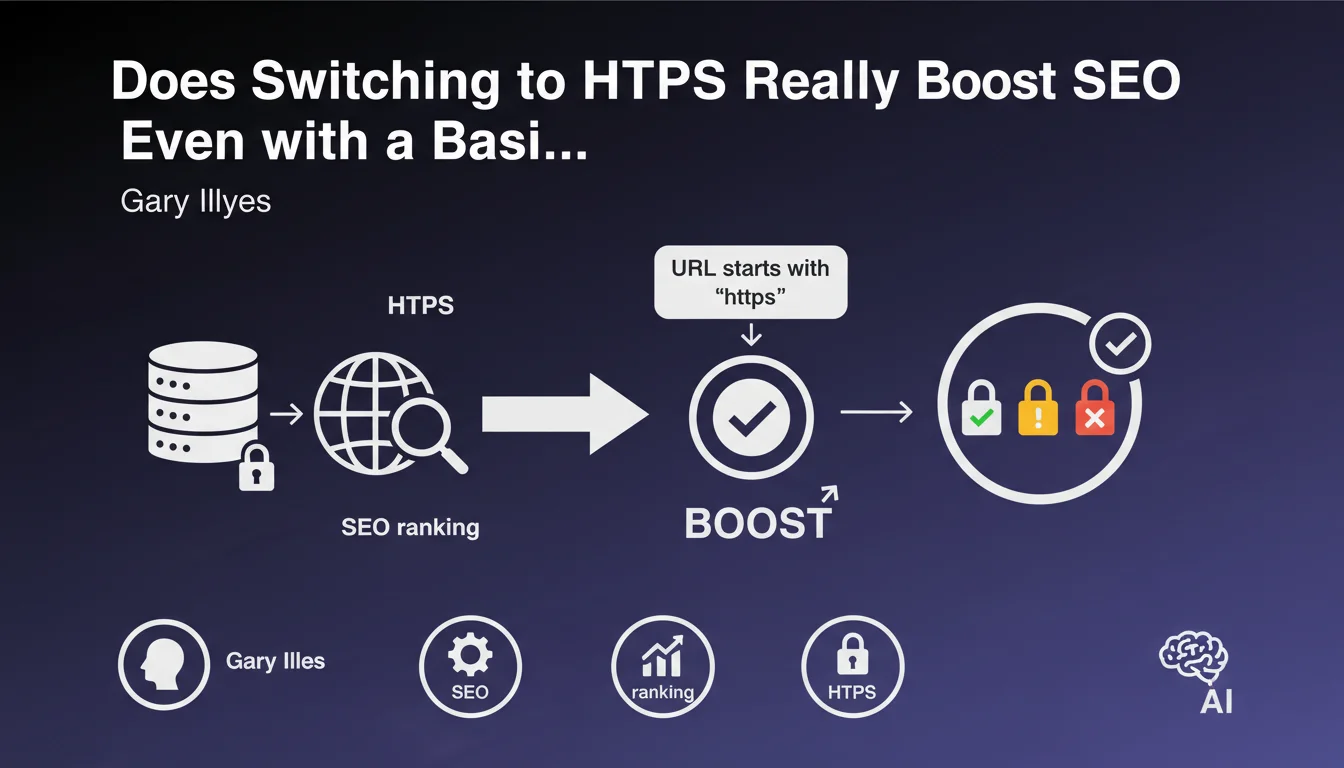
Google has confirmed that switching to HTTPS constitutes a ranking signal in its algorithm. Contrary to what some might think, this criterion is not insignificant: it affects enough queries to deserve special attention from SEO practitioners.
The statement also specifies that an invalid or expired SSL certificate does not directly penalize a page's ranking. However, it can have significant indirect repercussions on other ranking factors.
Indeed, a faulty certificate generates security alerts in browsers. These warnings negatively impact user experience and behavioral signals: high bounce rate, decreased time spent on site, lower click-through rate.
- HTTPS is a confirmed ranking signal by Google
- The impact affects a significant volume of queries
- An invalid certificate indirectly affects SEO through UX
- Switching to HTTPS remains a fundamental technical optimization
- Security has become a quality criterion for Google
SEO Expert opinion
This statement is consistent with field observations since Google's initial announcement in 2014. However, the direct importance of this factor must be put into perspective: HTTPS alone won't make you gain 10 positions in the SERPs.
In practice, the impact of HTTPS manifests primarily as a discriminating criterion when quality is equal. Between two pages similar in content and authority, the one in HTTPS benefits from a slight advantage. The effect is particularly visible on competitive queries where every micro-signal counts.
The editorial comment minimizing this criterion is partially incorrect. While the pure SEO impact remains modest, the indirect benefits are measurable: improved conversion rate, better user trust, regulatory compliance, and preparation for future algorithm evolutions.
Practical impact and recommendations
- Migrate immediately to HTTPS if not already done, as an absolute priority
- Verify the validity and expiration date of your SSL/TLS certificate
- Implement permanent 301 redirects from all HTTP URLs to HTTPS
- Update all internal links to point directly to HTTPS versions
- Fix mixed content - resources loaded via HTTP on HTTPS pages
- Update sitemap.xml files with HTTPS URLs exclusively
- Modify canonical tags to reference HTTPS versions
- Update Google Search Console with the HTTPS property
- Configure HSTS (HTTP Strict Transport Security) to enforce HTTPS at the browser level
- Monitor certificate errors through monitoring tools
- Verify that all third-party tools (analytics, pixels, scripts) work in HTTPS
HTTPS migration involves numerous interdependent technical aspects: server configuration, redirect management, link juice preservation, performance monitoring, and resolution of potential errors.
For complex sites or businesses wanting to secure this critical transition without losing visibility, support from a specialized SEO agency helps avoid costly mistakes and simultaneously optimize other technical levers to maximize results.
💬 Comments (0)
Be the first to comment.