
Official statement
What you need to understand
What is JSON-LD and why does Google prefer it?
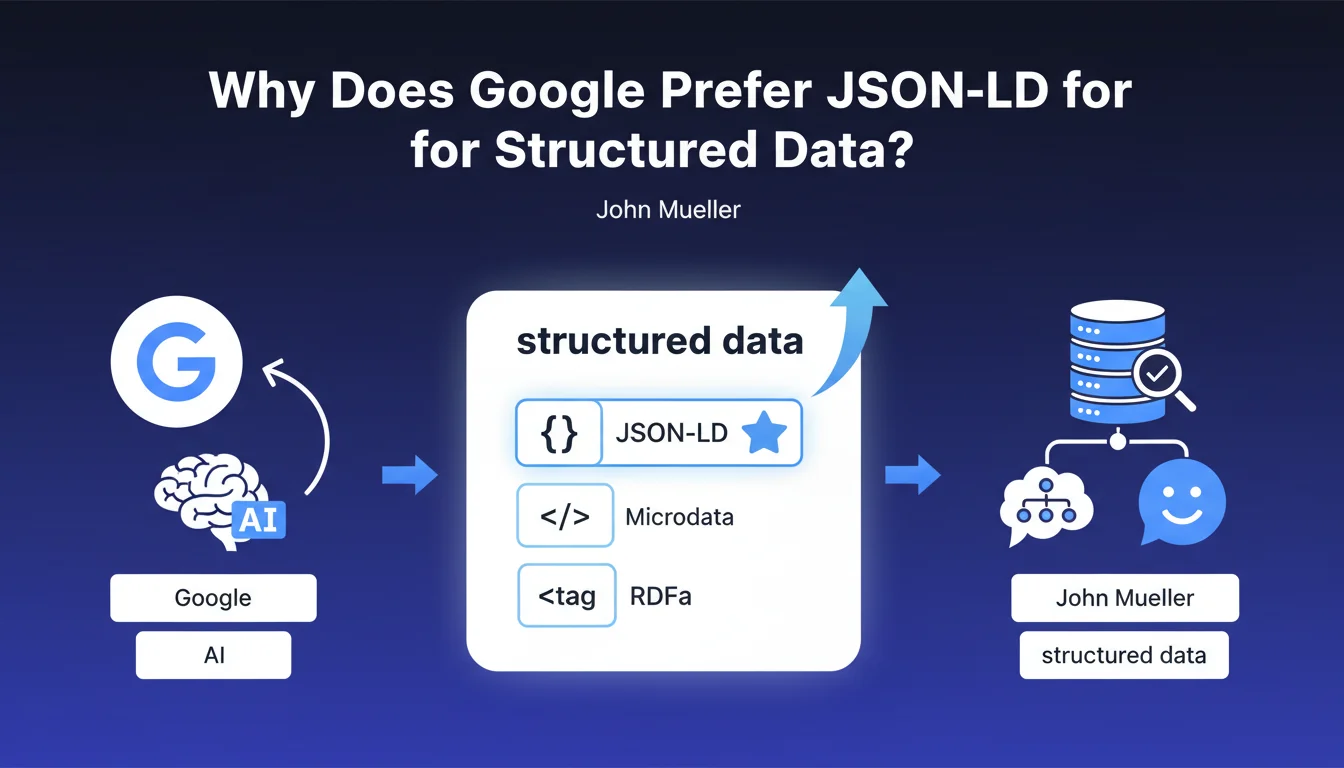
JSON-LD (JavaScript Object Notation for Linked Data) is a markup format that allows you to integrate structured data into your web pages. It stands out for its simplicity: the code is isolated within a script tag, separated from the visible HTML.
Google favors this format because it is easier to parse for its crawlers, less prone to implementation errors, and doesn't interfere with the page's visual rendering. This official preference constitutes a clear directive for SEO practitioners.
What other formats does Google accept?
Google continues to accept Microdata and RDFa formats, which integrate structured data directly into existing HTML tags. These legacy formats remain fully valid and functional.
However, their maintenance is more complex because they require modifying the visible HTML. Developers are more likely to accidentally alter the markup when making changes to the source code.
What is the real scope of this recommendation?
Mueller's statement constitutes a strong but non-exclusive recommendation. Google does not penalize sites using Microdata or RDFa, and these formats continue to work perfectly.
The goal is to guide new implementations toward the format that is most maintainable and scalable in the long term. For existing sites, migration is not urgent except during a technical redesign.
- JSON-LD is the format officially recommended by Google for structured data
- Microdata and RDFa formats remain accepted and functional
- JSON-LD is placed in a script tag separated from the visible HTML
- This separation facilitates maintenance and reduces implementation errors
- No penalty exists for sites using other formats
SEO Expert opinion
Does this recommendation reflect practices observed in the field?
Absolutely. Analysis of thousands of well-ranked sites confirms massive adoption of JSON-LD since 2018. Major CMS platforms (WordPress, Shopify, PrestaShop) have integrated this format into their reference plugins and extensions.
A/B tests conducted on different implementations show that Google treats all formats equally in terms of ranking. The difference mainly lies in technical robustness and crawler speed for bots.
What nuances should be applied to this directive?
Google's preference for JSON-LD doesn't mean you need to urgently migrate your existing implementations. If your Microdata structured data is working correctly and appears in Search Console without errors, migration is not a priority.
However, for any new implementation, JSON-LD stands out as the logical choice. The real issue concerns hybrid sites: mixing multiple formats on the same site is discouraged because it complicates debugging and can create contradictory data.
In what cases does JSON-LD have limitations?
JSON-LD can be problematic with dynamic content generated client-side (JavaScript). If your structured data needs to reflect information that changes after initial loading, you must ensure that Google can crawl it correctly.
Additionally, certain very specific types of markup such as granular word-level annotations remain more natural in Microdata. However, these use cases represent less than 2% of common implementations.
Practical impact and recommendations
How do I correctly implement JSON-LD on my site?
Start by identifying priority content types: articles, products, events, FAQs, recipes, reviews. For each type, consult the appropriate schema on Schema.org and adapt it to your context.
Place the JSON-LD code in a <script type="application/ld+json"> tag preferably in the <head> or just before the closing <body>. Use server variables to dynamically inject data specific to each page.
Systematically test your implementations with Google's Rich Results Test and monitor the "Enhancements" reports in Search Console. Immediately correct any detected errors.
What critical errors must be absolutely avoided?
The most common error is to duplicate structured data by simultaneously using JSON-LD and Microdata for the same information. This creates confusion for Google and dilutes the clarity of your signals.
Never include data not visible on the page in your structured markup. Google considers this cloaking and may penalize your site. Structured data must faithfully reflect the content actually displayed.
Also avoid improperly formatted JSON-LD: a missing comma or unclosed quotation mark renders the entire block invalid. Use a JSON validator before production deployment.
- Audit structured data currently present on your site (all formats)
- Choose JSON-LD as the standard for all new implementations
- Implement priority schemas based on your industry sector
- Validate each page with Google's Rich Results Test
- Remove or convert old formats to avoid duplications
- Configure alerts in Search Console for structured data errors
- Document your implementations to facilitate future maintenance
- Regularly test rich snippet display in SERPs
💬 Comments (0)
Be the first to comment.