
Official statement
What you need to understand
What is Google Penguin and what was its initial role?
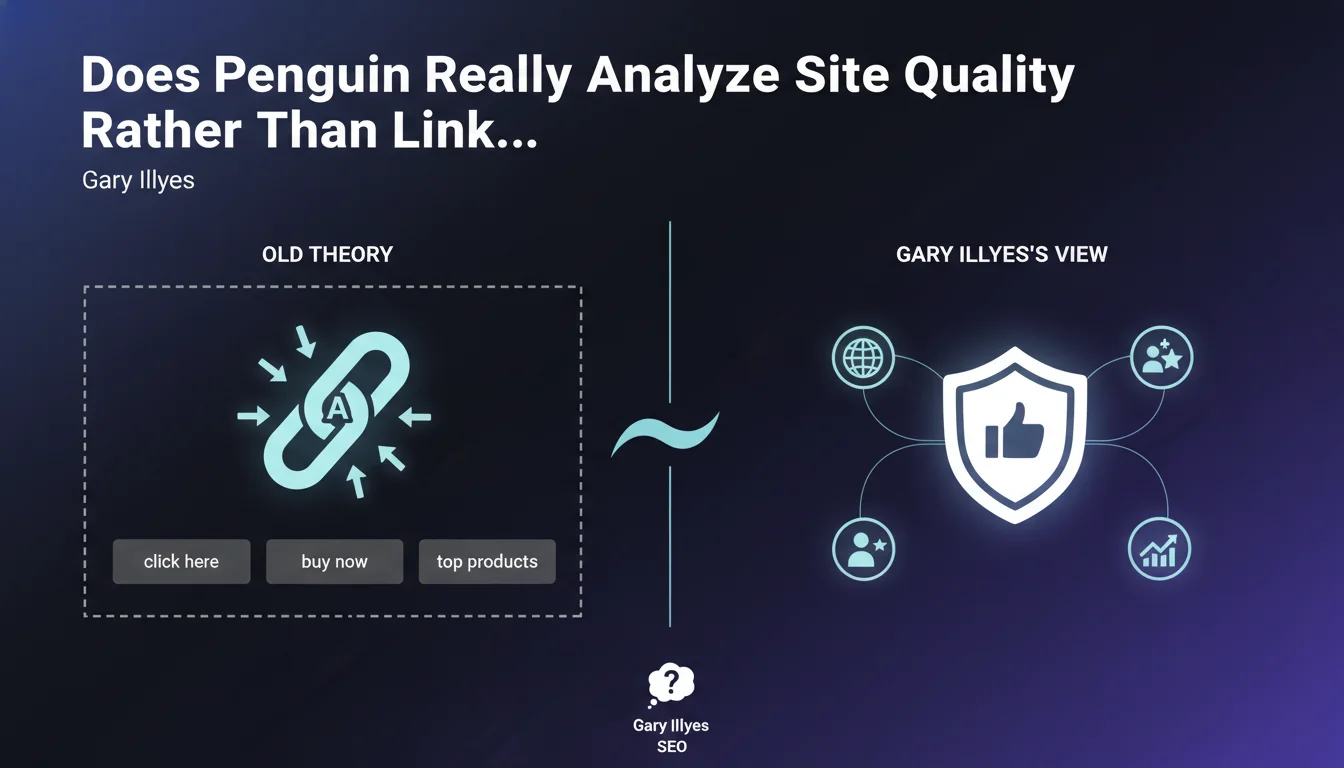
Google Penguin is an algorithmic filter launched in 2012 to penalize sites using manipulative link building techniques. For years, SEO professionals believed this filter primarily focused on analyzing over-optimized link anchors.
This dominant view was explained by the massive penalties observed on sites that had abused exact match anchors. The SEO industry therefore developed strategies around diversifying and naturalizing anchor texts.
What does Gary Illyes' statement reveal about how Penguin actually works?
According to this official statement, Penguin would primarily consider the quality of the source sites creating the links, not just the anchors themselves. This represents a paradigm shift in our understanding of the filter.
This approach means that Google evaluates the reputation and reliability of domains pointing to your site. A link with an optimized anchor from a quality site would therefore be less problematic than a neutral link from a questionable site.
Why does this revelation change the traditional SEO perspective?
This information challenges years of established best practices around anchor management. It suggests that the SEO industry may have been focusing on the wrong priority criterion.
- Link origin takes precedence over the anchor text used
- The contextual quality of the source site becomes the determining criterion
- The trust signals of the referring domain are scrutinized by the algorithm
- Anchor over-optimization remains problematic, but within a broader context
- This approach aligns with Google's overall philosophy on E-E-A-T
SEO Expert opinion
Is this statement consistent with field observations from recent years?
Analyzing Penguin penalty patterns since 2016 (when it was integrated into the main algorithm), we indeed observe that affected sites often had a suspicious backlink profile beyond simply over-optimized anchors. Sites receiving links from low-quality site networks (PBNs, spam directories, hacked sites) were systematically impacted.
This revelation also explains why certain sites with aggressive commercial anchors but from legitimate editorial sources suffered no penalties. Conversely, sites with neutral anchors but from questionable sources lost visibility.
What nuances should be applied to this statement?
It would be reductive to think that link anchors no longer matter at all. In reality, they remain an important signal, but are now evaluated in the context of the source. A commercial anchor from an authoritative and thematically relevant site will be interpreted differently than the same anchor from a suspicious site.
Google likely uses a multi-criteria approach where source site quality acts as a trust modifier. The more reliable the emitting site, the more credit Google will give to anchor signals. Conversely, links from unreliable sources are devalued or ignored, regardless of the anchor used.
How does Google concretely evaluate the quality of a source site?
Google has multiple signals to assess the reliability of a referring domain. These criteria include domain history, editorial content quality, user engagement metrics, the presence of invasive advertising, and connections with other suspicious sites.
The algorithm also integrates behavioral signals: a site that systematically places links to varied and non-thematic destinations will be identified as a commercial intermediary rather than a genuine editorial source. This contextual analysis enables detection of manipulation patterns beyond simple anchors.
Practical impact and recommendations
What should be modified concretely in your link building strategy?
The absolute priority becomes rigorous source selection for backlinks. Before seeking a link, systematically evaluate the intrinsic quality of the partner site: its thematic authority, content quality, outbound link profile, and editorial legitimacy.
Always prioritize thematic relevance and contextual coherence. A link from a high-quality site in your sector, even with an optimized anchor, will be infinitely more powerful and safe than a multitude of neutral links from mediocre or off-topic sources.
Definitively abandon indiscriminate volume tactics. Strategies based on accumulating links from generic directories, massively distributed press releases, or automated exchange platforms are now counterproductive.
How should you audit your existing backlink profile according to these criteria?
Conduct a thorough qualitative audit of your current backlinks by categorizing each referring domain according to its reliability. Identify links from questionable sources: sites with high advertising density, low-quality content, dedicated link pages, suspicious networks.
Use Google Search Console and specialized tools to extract your complete profile. For each significant referring domain, manually evaluate: editorial quality, thematic coherence, trust signals (author mentions, cited sources, content freshness), and absence of suspicious footprints.
What mistakes should absolutely be avoided when applying these recommendations?
Don't fall into the opposite extreme by massively disavowing links on the grounds that they use optimized anchors. If these links come from legitimate and contextually relevant sources, they remain valuable. Disavowal should be reserved for clearly toxic or manipulative links.
Also avoid completely neglecting anchor diversity. Even if source quality takes precedence, a natural anchor profile remains a legitimacy signal. Alternate between brand anchors, long-tail anchors, naked URLs, and generic anchors according to editorial context.
- Establish a qualitative evaluation grid for all your future link partners
- Audit your existing backlink profile by prioritizing source analysis
- Identify and disavow links from obviously suspicious domains
- Systematically prioritize quality over quantity in your acquisitions
- Maintain natural diversity of anchors even on quality sites
- Document your editorial partnerships to justify your links if necessary
- Regularly monitor new backlinks and their origin
- Integrate these criteria into your briefs for content creators and partners
- Train your teams on quality signals of a legitimate source site
💬 Comments (0)
Be the first to comment.