
Official statement
What you need to understand
What is the fundamental difference between Penguin and Panda?
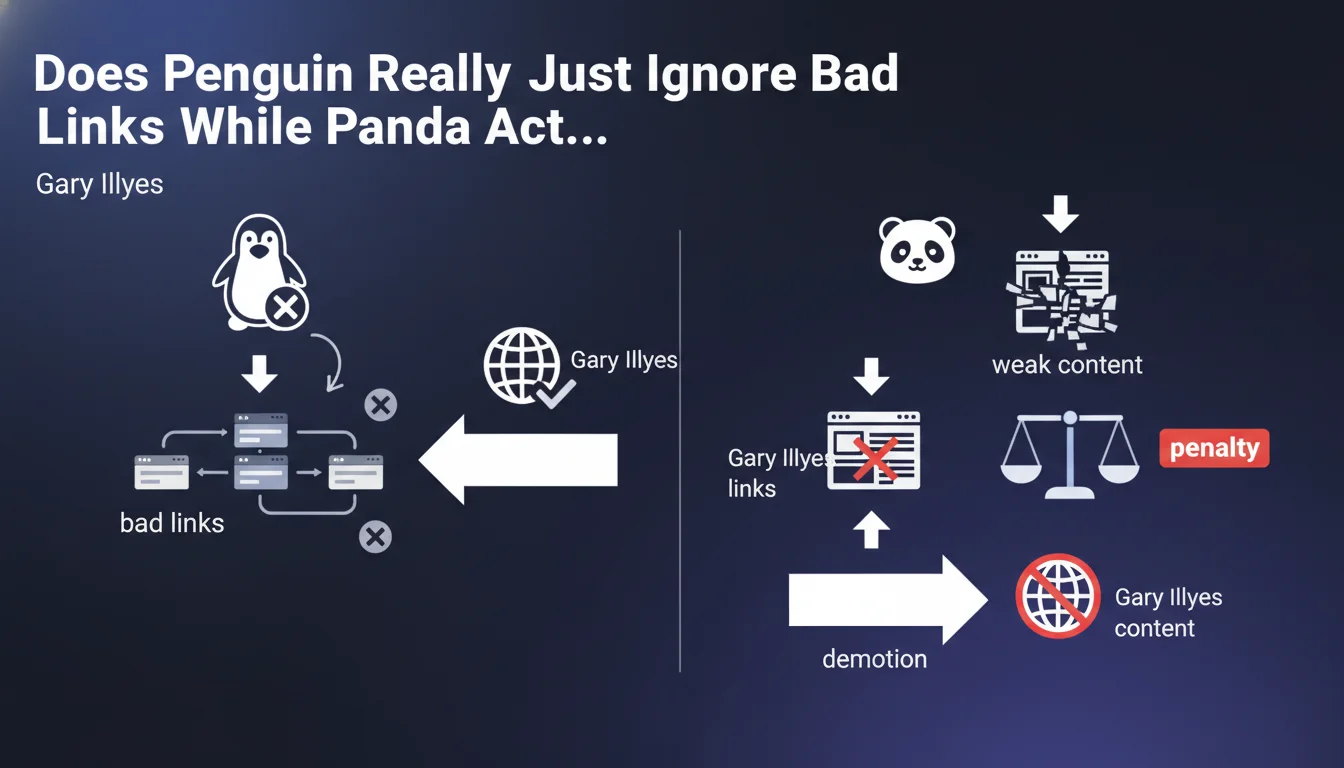
Google uses two distinct algorithms with opposing philosophies. Penguin focuses on low-quality links and simply chooses to ignore them, as if they didn't exist.
Panda, on the other hand, evaluates content quality and can actively demote pages or entire sites that offer low-value content. This distinction is crucial for understanding the risks involved.
Why does this difference in approach matter for my SEO?
This statement reveals that not all Google algorithms are equal in terms of consequences. A poor link profile simply deprives you of potential gains, while poor-quality content can actively destroy your visibility.
The impact on your strategy is major: you can survive with few links, but not with mediocre content.
What does "ignore" versus "demote" actually mean in practice?
When Penguin ignores a spam link, that link simply transmits no authority, as if it were invisible. Your site remains at its current position.
When Panda demotes a page, it applies a negative filter that causes your positions in search results to drop. It's an active punitive action.
- Penguin = neutrality: bad links are cancelled out without direct negative impact
- Panda = penalty: weak content results in active ranking degradation
- Both can affect individual pages or entire sites
- Recovery after Panda requires substantial content improvement
- Protecting yourself from Penguin is sufficient, but you must excel for Panda
SEO Expert opinion
Is this statement consistent with what we observe in the field?
Absolutely, and this distinction explains many mysterious cases. I've observed sites with questionable link profiles that maintain their positions simply because those links are ignored, without active penalty.
Conversely, sites that are "clean" in terms of links but with generic or superficial content experience brutal drops. Panda doesn't forgive mediocrity, even without manipulation.
What nuances should we add to this rule?
The reality is more complex than a simple "ignores vs penalizes." While Penguin ignores individual links, a massively spammy profile can still alert Google's manual spam team.
Moreover, the absence of good links combined with the ignorance of bad ones leaves you with zero authority. You're not penalized, but you don't rank either.
In what cases can these algorithms overlap?
A site with automated low-quality content AND spam links suffers a double impact. Panda demotes it for content, while Penguin neutralizes its link manipulation attempts.
Poor-quality affiliate sites are particularly vulnerable: their thin content triggers Panda, and their link networks are ignored by Penguin. They accumulate handicaps without benefit.
Practical impact and recommendations
What should I prioritize in my SEO strategy following this revelation?
The absolute priority must be quality content. It's the only element that can actively penalize you if it's weak. Invest massively in creating high-value-added content.
For links, adopt a defensive approach: avoid obvious spam, but don't panic over every imperfect link. Focus on acquiring natural quality links rather than obsessive cleaning.
How can I verify that my site isn't at risk of a Panda penalty?
Audit each page with a critical eye. Ask yourself the question: does this page provide unique value and substance to the user? If the answer is "maybe" or "not really," improve or delete it.
Use Google Analytics to identify pages with a high bounce rate and low time on page. These are signals of content that disappoints users and risks attracting Panda's attention.
What concrete actions should I implement right now?
- Conduct a content quality audit page by page, not just a technical audit
- Identify and enrich or delete pages with less than 300 words of unique content
- Eliminate internal duplicate content and near-identical pages
- Add expertise, original data and concrete examples to your existing content
- Disavow only obviously spammy links, not every imperfect link
- Invest 80% of your resources in content and 20% in links
- Implement a quality control process before publishing any new content
- Monitor traffic fluctuations correlated with Panda updates
💬 Comments (0)
Be the first to comment.