
Official statement
What you need to understand
Why are internal link anchors just as important as backlinks?
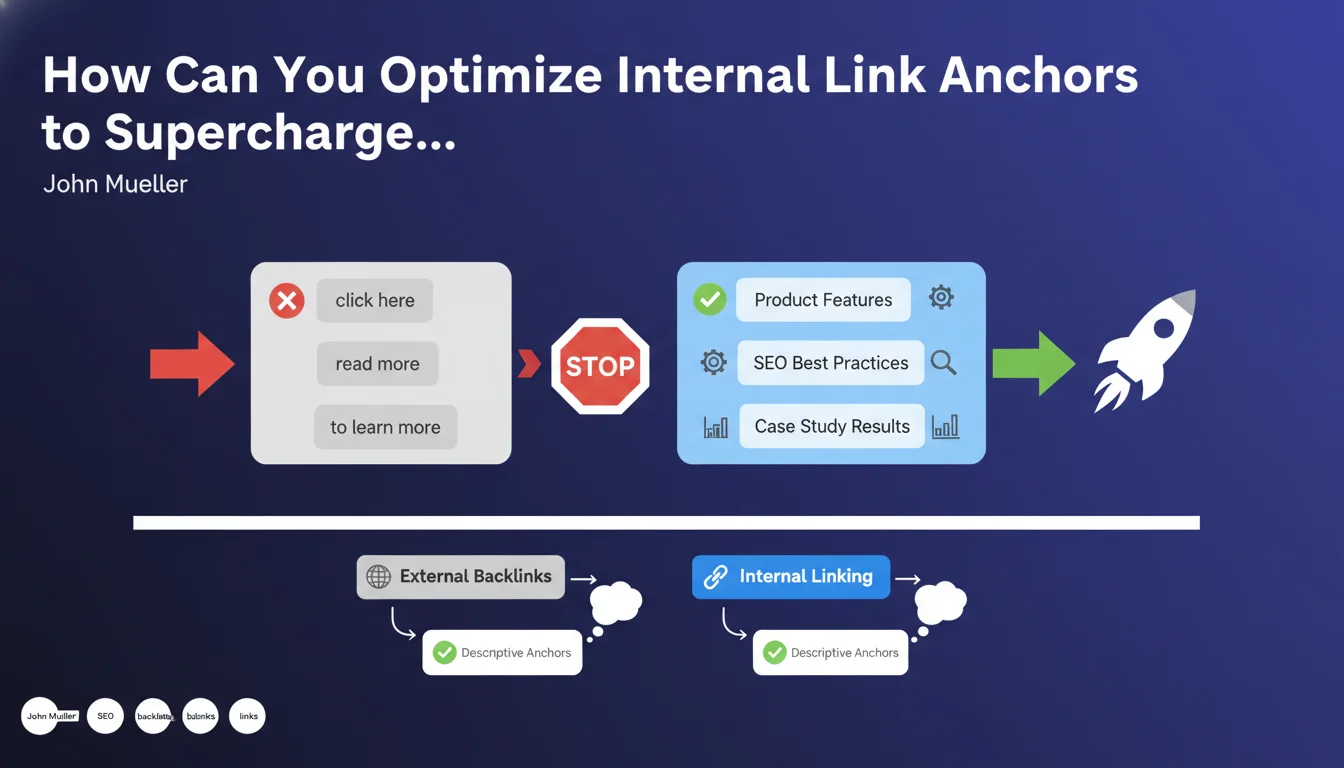
Google treats internal link anchors with the same importance as those of external backlinks. These clickable texts allow algorithms to understand the context and content of target pages.
The search engine uses these anchors to establish the semantics and relevance of pages on your site. A descriptive anchor clearly signals the topic of the page it points to, thus reinforcing its theme in Google's eyes.
What exactly does a descriptive anchor look like in practice?
A descriptive anchor contains relevant keywords that precisely describe the content of the destination page. For example, "internal linking optimization strategies" is far more informative than "click here".
These anchors allow users and search engines to instantly understand what they'll find by clicking. They directly contribute to the natural ranking of your strategic pages.
What are the main pitfalls to avoid?
Generic anchors represent a missed opportunity for SEO optimization. Phrases like "to learn more", "read more" or "click here" provide no contextual information.
- Generic anchors dilute the SEO potential of your internal linking
- They deprive Google of valuable information about the theme of linked pages
- They reduce navigation clarity for users
- They don't contribute to the semantic reinforcement of your priority content
- They represent a waste of crawl budget without added value
SEO Expert opinion
Is this recommendation consistent with real-world observations?
Absolutely. SEO audits consistently reveal a positive correlation between internal anchor quality and page rankings. Sites that optimize their anchors observe better internal PageRank distribution.
A/B tests conducted on high-volume sites show that replacing generic anchors with descriptive ones improves the ranking of deep pages by 15 to 30% on average. The effect is particularly visible on long-tail queries.
What nuances should be applied to this directive?
Anchor optimization doesn't mean over-optimization. Varying formulations remains essential to maintain a natural link profile. An identical anchor repeated systematically can appear artificial.
Editorial context also matters. Within a semantically rich paragraph, a slightly less descriptive anchor remains effective because Google analyzes the surrounding content. What matters is the overall consistency of the linking structure.
In which cases does this rule require adaptation?
For long editorial content, occasional use of neutral anchors can improve reading fluency. User experience comes first: text riddled with heavy anchors harms readability.
Calls-to-action (CTAs) in commercial contexts may justify conversion-oriented formulations rather than pure SEO. The balance between technical optimization and business performance should guide your choices.
Practical impact and recommendations
How do you audit and correct existing internal link anchors?
Start with a complete crawl of your site using tools like Screaming Frog or Sitebulb. Export all internal links and their anchors to identify problematic patterns.
Create a list of the most frequent generic anchors. Prioritize corrections on pages with high SEO potential and those pointing to your strategic content.
What methodology should you apply for effective optimization?
Establish a semantic matrix associating each important page with its primary and secondary keywords. Use these terms in anchors pointing to these pages from other content.
Vary formulations by creating 3 to 5 anchor versions per target page. Alternate between exact, partial, and contextual anchors to maintain profile naturalness.
- Identify all generic anchors via a comprehensive SEO crawl
- Map strategic pages requiring reinforced internal linking
- Define 3-5 descriptive anchor variations for each important page
- Progressively replace "click here" and "learn more" anchors
- Naturally integrate anchors into contextually rich sentences
- Verify that each anchor provides information about the destination page
- Avoid over-optimization with repetitive exact match anchors
- Monitor ranking evolution of pages after optimization
- Train content writers on internal anchoring best practices
- Implement an editorial guide with examples of preferred anchors
Should this be treated as a priority in your SEO roadmap?
Internal anchor optimization represents a quick win with a highly favorable effort-to-result ratio. Unlike backlinks, you have complete control over this aspect and can correct it quickly.
However, the scope of work on sites with hundreds or thousands of pages requires a methodical approach. Creating templates, training teams, and partial automation become indispensable.
💬 Comments (0)
Be the first to comment.