
Official statement
What you need to understand
Why Does Google Never Index All Pages of a Website?
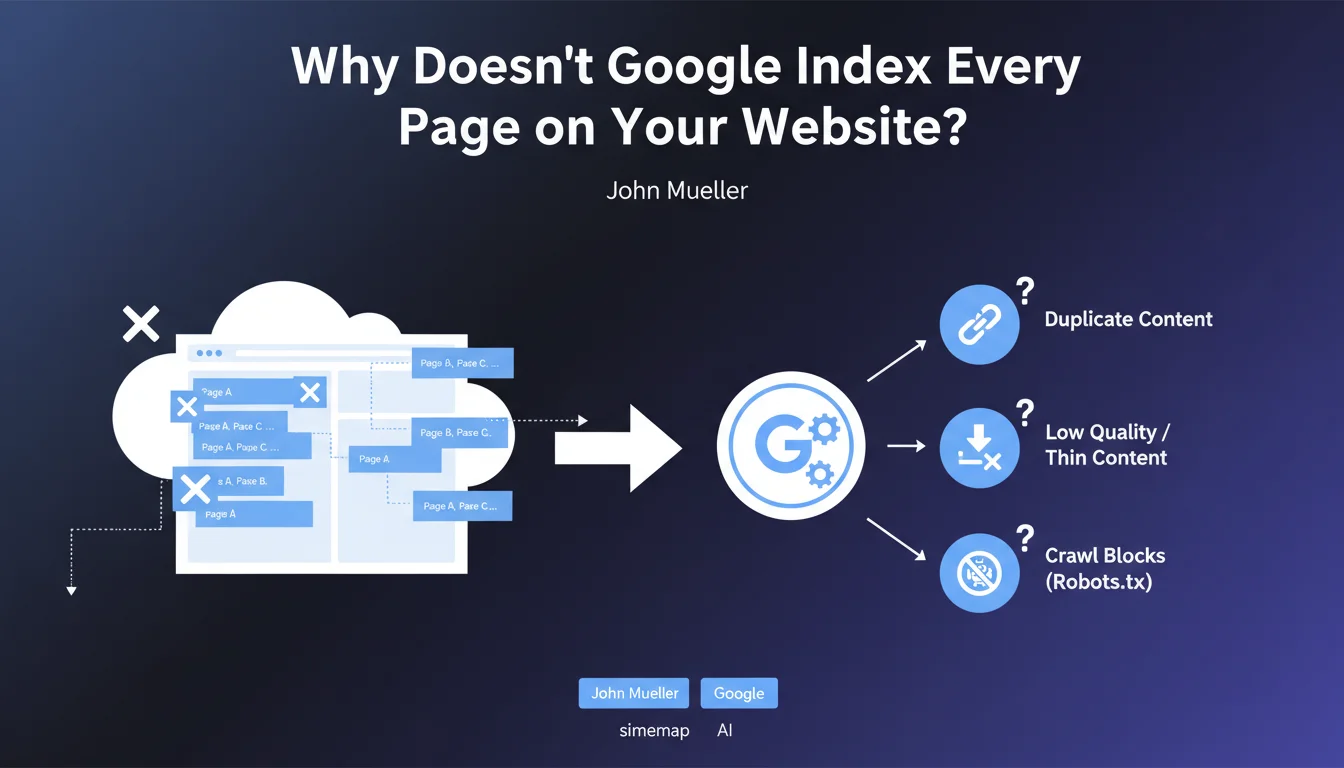
Google has a limited crawl budget for each website. The search engine must optimize its resources and cannot explore and index the entire web continuously.
Google uses quality algorithms to determine which pages deserve to be indexed. Pages deemed to have low added value, duplicated content, or little relevance are naturally excluded from the index.
What Does Google Consider a Quality Page?
A quality page addresses an identified user need with original and sufficiently in-depth content. It must provide unique value compared to other existing pages on the topic.
The criteria include content depth, demonstrated expertise, satisfaction of search intent, and user engagement signals.
What Happens If You Only Keep Your Best Pages?
The question asked is relevant: by voluntarily removing weak pages, could you improve the overall indexation rate? Logic suggests yes, but reality is more complex.
Google continues to evaluate the relative quality of the remaining pages. Even with fewer pages, the search engine will still apply its quality filters and won't necessarily index 100% of the remaining content.
- Crawl budget: limited resource allocated by Google to each site
- Qualitative selection: Google prioritizes pages with high added value
- Partial indexation: no site sees 100% of its pages indexed
- Continuous evaluation: even with few pages, Google maintains its quality criteria
SEO Expert opinion
Is This Statement Consistent with Field Observations?
Absolutely. SEO audits systematically reveal that sites see between 40% and 90% of their pages indexed depending on their overall quality. E-commerce sites with thousands of similar product pages are particularly affected.
This selection has intensified in recent years with algorithmic updates. Google has become more demanding about quality to combat the inflation of mediocre content.
What Important Nuances Should Be Added to This Statement?
John Mueller's statement remains vague about the reasons for non-indexation. Not all non-indexed pages are necessarily poor quality: technical issues, failing internal linking, or lack of domain authority can also explain these absences.
There's a crucial difference between crawled but not indexed pages and pages never discovered. The Search Console allows you to distinguish these cases via the coverage report.
In Which Cases Does This Logic Reach Its Limits?
For very large sites (millions of pages), even with excellent content, Google will never index everything for purely technical reasons. Crawl budget becomes the main limiting factor.
News sites or marketplaces face a scale challenge where freshness and volume conflict with Google's indexation capabilities.
Practical impact and recommendations
What Should You Do Concretely to Optimize Your Indexation Rate?
The first action is to conduct a complete audit of indexed pages via Search Console. Identify pages crawled but not indexed and analyze the reasons provided by Google.
Then proceed with a qualitative analysis of your content. Identify low-value pages: very short content, nearly empty pages, internal duplicates, or pages without traffic for 12 months.
For weak pages, three options are available: substantial improvement, consolidation with other similar pages, or deletion with a 301 redirect to the most relevant page.
What Mistakes Should You Absolutely Avoid in This Approach?
Never delete pages without analyzing their actual organic traffic and their role in internal linking. A page without rankings can generate valuable long-tail traffic.
Avoid massive brutal deletions. Google sometimes interprets these significant changes as negative signals. Proceed in stages and monitor the impact of each wave of modifications.
Don't forget that noindex is not the miracle solution. A noindexed page still consumes crawl budget. For truly useless content, deletion or robots.txt blocking are preferable.
How Do You Measure the Effectiveness of Your Optimizations?
Track the evolution of your indexed pages rate in Search Console week by week. A healthy improvement generally ranges between 5% and 15% depending on the volume of cleanup performed.
Also monitor overall performance metrics: organic traffic, average positions, and crawl rate. A successful strategy improves these indicators within 4-8 weeks following modifications.
- Audit indexed vs. crawled pages in Search Console
- Identify low added-value content (analytics + editorial quality)
- Analyze actual organic traffic for each page before deletion
- Prioritize improvement over deletion when relevant
- Proceed in progressive phases with constant monitoring
- Implement 301 redirects for deleted pages with traffic
- Optimize internal linking toward strategic retained pages
- Monitor indexation rate evolution over 2-3 months
- Document each modification for traceability and learning
Optimizing the indexation rate is a balancing act between quality and volume. The approach must be methodical and based on precise data rather than arbitrary deletions.
This process requires sharp technical and editorial expertise to avoid costly mistakes. The stakes are high: a bad decision can have a lasting impact on organic visibility.
Given the complexity of these optimizations, working with a specialized SEO agency allows you to benefit from a proven methodology and personalized support. An external expert perspective often identifies opportunities or risks that aren't perceived internally.
💬 Comments (0)
Be the first to comment.