
Official statement
What you need to understand
What's the difference between a change of address and a site merger?
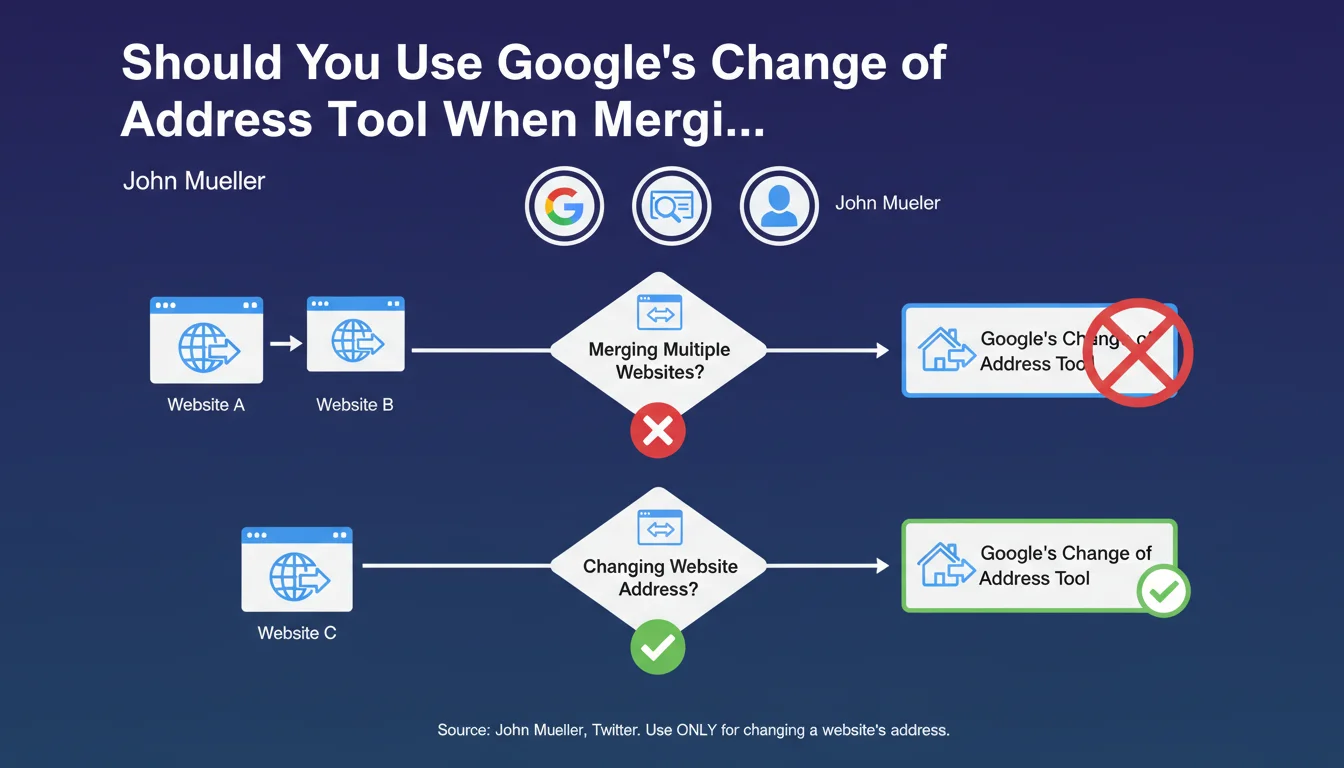
A change of address corresponds to moving a single website from one domain to another, such as moving from old-domain.com to new-domain.com. The content remains essentially identical, only the root URL changes.
A site merger involves consolidating multiple distinct domains into one. For example, merging site-a.com and site-b.com into main-site.com. This operation is much more complex because it involves managing several source domains simultaneously.
Why isn't the change of address tool suitable for mergers?
The change of address tool in Search Console was designed to handle a simple 1-to-1 migration. It informs Google that domain A is becoming domain B completely and permanently.
In the case of a merger, you have multiple source domains (A + B + C) converging toward a single domain (D). The tool cannot process this configuration because it only accepts one source domain/destination domain pair.
What happens technically during a site merger?
During a merger, each site retains its own SEO history, domain authority, and ranking signals. These elements must be transferred individually to the new unified domain.
- Each source domain requires its own 301 redirect strategy
- The ranking signals from each site must be consolidated progressively
- Google treats each domain migration as a distinct process
- The change of address tool can only signal one migration at a time
- The merger requires manual and individualized management of each property in Search Console
SEO Expert opinion
Is this recommendation consistent with real-world observations?
Absolutely. Experience feedback on site mergers confirms that using the change of address tool in this context often generates confusion in indexing. Google may misinterpret the migration structure and lose important signals.
In practice, SEO professionals who have attempted to use this tool during mergers report significant ranking fluctuations and much longer consolidation times. The manual approach remains the most reliable.
What are the real implications of misusing the tool?
Using the change of address tool for a merger can lead to temporary or permanent visibility losses. Google might only transfer authority from one source domain, ignoring the others.
Worse still, this can create contradictory signals in Google's algorithms. The search engine might interpret the situation as several simultaneous poorly configured migrations, significantly slowing down the ranking consolidation process.
In which specific cases does this rule apply strictly?
This directive applies as soon as you have two or more source domains migrating to a single destination domain. Even a small merger of 2 sites requires bypassing the change of address tool.
However, if you perform several successive and independent address changes (domain-a.com to new-a.com, then later domain-b.com to new-b.com), each operation can use the tool separately because these are distinct migrations and not a merger.
Practical impact and recommendations
What procedure should you follow concretely during a site merger?
For each source domain, you must configure individual 301 redirects pointing to the corresponding URLs of the destination domain. Create a precise page-by-page mapping to preserve semantic relevance.
Keep each source domain property active in Search Console for at least 6 to 12 months after the merger. This allows you to track the evolution of authority transfer and detect potential indexing issues.
Definitely do not use the change of address tool. Let Google discover and process the redirects naturally through progressive crawling. This process is slower but much safer for complex mergers.
What mistakes should you absolutely avoid during the process?
Don't delete old Search Console properties prematurely. They remain necessary for monitoring the link equity transfer and identifying 404 errors or redirect problems.
Avoid redirecting all source domains to the homepage of the new site. Each page must point to its most relevant thematic equivalent to preserve relevance signals and topical authority.
- Precisely map each source URL to its optimal destination
- Implement permanent 301 redirects (never 302)
- Keep all Search Console properties active for a minimum of 12 months
- Never activate the change of address tool for a merger
- Monitor index coverage reports daily
- Check position evolution on strategic keywords from each source site
- Document the correspondence between old and new URLs
- Update external backlinks to new URLs when possible
- Test redirects with tools like Screaming Frog before production deployment
How can you ensure the merger proceeds optimally?
Establish a monitoring dashboard integrating organic traffic metrics, rankings, and indexation for each source domain and the destination domain. Pay particular attention to the first 3 months post-merger.
Anticipate a period of volatility of 4 to 6 months during which Google reassesses and consolidates signals. This is normal and expected for operations of this magnitude.
💬 Comments (0)
Be the first to comment.