
Official statement
What you need to understand
What Exactly Is BERT and How Does It Really Work?
BERT (Bidirectional Encoder Representations from Transformers) is a natural language processing model developed by Google. It enables the search engine to better understand the context and nuances of queries, particularly long and conversational queries.
Unlike traditional updates, BERT is not a ranking criterion but rather a comprehension technology. It analyzes the relationship between words in a query to grasp the real intent, notably through bidirectional contextual understanding.
Why Does Google Claim No Technical Modifications Are Necessary?
Google considers BERT as an improvement in understanding rather than a new ranking signal. Therefore, there is no "BERT score" assigned to pages, just as there is no quantifiable EAT score.
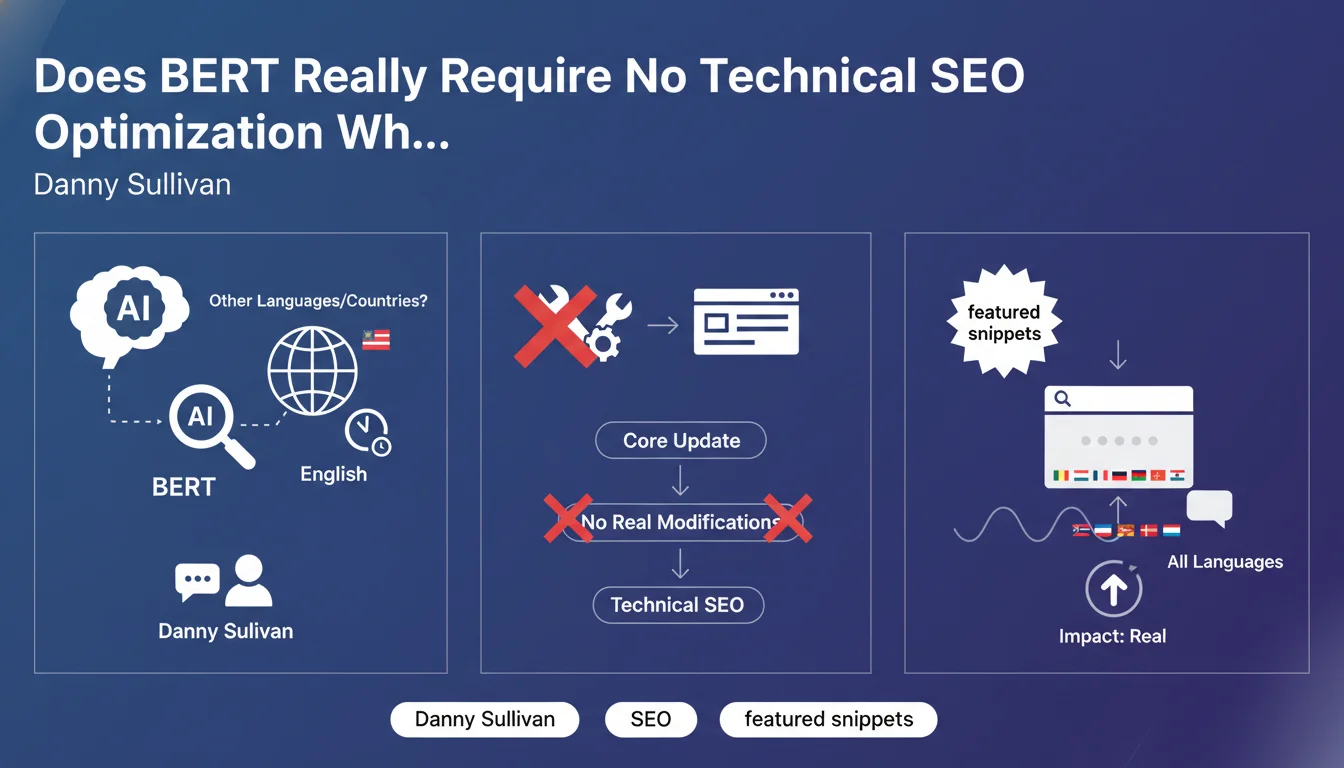
The initial impact was limited to American English for traditional search results, but already applied to featured snippets in all languages, including French. This distinction is important for understanding the progressive rollout of the technology.
What Are the Essential Takeaways About BERT?
- BERT targets long-tail and conversational queries, not short keywords
- There is no specific technical optimization to perform for BERT
- The impact on featured snippets is immediate and multilingual
- BERT improves understanding of prepositions and connecting words in queries
- It's a comprehension technology, not a direct ranking factor
SEO Expert opinion
Is This Statement Consistent With Real-World Observations?
Google's assertion is technically correct but strategically incomplete. Indeed, while BERT doesn't require specific technical modifications, its impact on search results is very real and measurable.
Post-deployment analyses have shown significant fluctuations in SERPs for conversational queries. Sites that benefited from natural and contextual content generally progressed, while those optimized for isolated keywords sometimes declined.
What Important Nuances Should Be Added to This Official Position?
Saying there's "nothing to do" is technically true but strategically misleading. BERT indirectly rewards quality content that precisely answers complex search intents.
The distinction between "no technical modifications" and "no impact on your content strategy" is crucial. BERT changes the game for sites that used keyword stuffing or unnatural content.
In Which Cases Could This "Do Nothing" Approach Be Problematic?
If your site heavily depends on long-tail traffic or conversational queries, the passive approach can cost you rankings. BERT favors content that answers questions in a natural and contextual manner.
Sites with over-optimized content, artificial phrases, or keyword-centric structure may experience a drop in visibility. BERT better detects content created for search engines rather than for humans.
Practical impact and recommendations
What Should You Concretely Do to Adapt to BERT?
Focus on editorial quality and search intent rather than technical optimization. BERT rewards content that naturally answers users' complex questions.
Adopt a conversational approach in your content. Use complete sentences, logical connectors, and natural language that reflects how people actually ask their questions.
Prioritize question-answer formats and structured content that addresses precise search intents. FAQs, detailed guides, and in-depth articles gain relevance with BERT.
What Mistakes Should You Absolutely Avoid With BERT?
Don't continue producing content stuffed with keywords without semantic coherence. BERT understands context and will indirectly penalize these obsolete practices.
Don't ignore long-tail queries on the grounds that their individual volume is low. BERT values precisely these specific queries which, cumulatively, represent a significant portion of traffic.
Don't neglect featured snippets, even if your site isn't in English. BERT's multilingual impact on position zero is immediate and can transform your visibility.
How Can You Verify That Your Content Strategy Is Aligned With BERT?
- Analyze your long-tail queries and identify those that generate qualified traffic
- Verify that your content uses natural and conversational language
- Audit your pages to detect keyword stuffing and artificial phrasing
- Optimize your content for featured snippets with clear and structured answers
- Create FAQ sections that answer your audience's complex questions
- Test your content by asking whether it addresses the real intent behind queries
- Monitor the evolution of your traffic on conversational and long queries
- Enrich your content with relevant semantic context
💬 Comments (0)
Be the first to comment.