
Official statement
What you need to understand
What is PageRank sculpting and why is it controversial?
PageRank sculpting refers to all the techniques aimed at controlling the distribution of link juice within a website. The goal is to concentrate SEO power on strategic pages by limiting flow to less important pages.
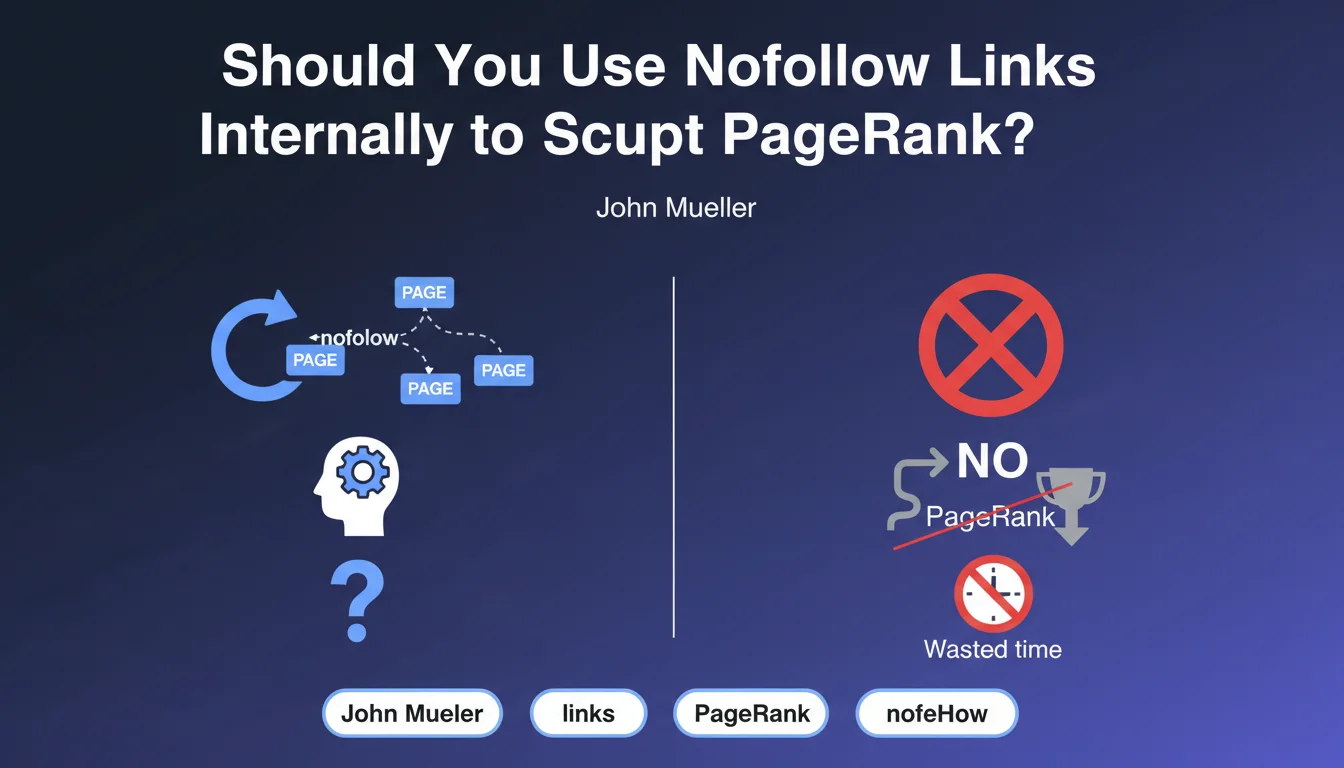
Historically, some SEOs used the nofollow attribute on internal links to block PageRank transfer to certain pages (contact, legal notices, etc.). Google has clearly stated that this practice is now ineffective and represents a waste of time.
How did PageRank sculpting work before and what has changed?
Before 2009, PageRank was divided equally among all links on a page. By adding nofollow to certain links, one could theoretically redirect more juice to the other links. This mechanism was modified by Google.
Today, PageRank is still divided by the total number of links, whether they are nofollow or not. The juice that should have gone to a nofollow link is simply lost and not redistributed to the other links on the page.
Why does Google advise against this approach to internal linking?
Google recommends letting PageRank flow naturally within your site. The algorithm is sophisticated enough to understand which pages are important without artificially imposing this information on it.
Using nofollow internally can even be counterproductive, as it prevents certain pages from receiving link juice, which can harm their indexing and ranking.
- Internal nofollow doesn't redistribute PageRank to other links, it dissipates it
- Google prefers natural and coherent internal linking without artificial manipulation
- PageRank sculpting via nofollow has been considered obsolete since 2009
- Focusing on site architecture and link relevance is more effective
SEO Expert opinion
Is this statement consistent with field observations from SEO professionals?
Absolutely. Tests conducted by the SEO community confirm that using nofollow internally brings no measurable benefit. On the contrary, it can create crawling and indexing problems for certain pages.
Sites that have removed internal nofollows have generally noticed better PageRank distribution and an overall improvement in their crawl budget. The natural approach recommended by Google does indeed prove to be the most effective.
Are there other effective methods to sculpt PageRank?
Yes, but they don't rely on link attributes. True PageRank sculpting operates through site architecture itself: page depth, number of links per page, and especially strategic link positioning.
Effective techniques include: optimizing silo structure, reducing the depth of important pages, limiting the number of links in footer/header, and creating content hubs that naturally redistribute link juice.
In which cases does internal nofollow remain relevant?
Internal nofollow retains a few legitimate use cases, but they don't concern PageRank distribution. It can be useful for internal search results pages, filter or sort pages in e-commerce.
These situations aim to save crawl budget rather than sculpt PageRank. The objective is to prevent Googlebot from wasting time on low-value pages, not to redistribute link juice.
Practical impact and recommendations
What should you do concretely with your current internal links?
Start by auditing your internal linking to identify all nofollow links. Use tools like Screaming Frog or Sitebulb to map all your internal link attributes.
Systematically remove nofollow attributes on main navigation links, contextual links in your content, and all links to pages you want indexed and ranked. Keep it only for the very specific cases mentioned previously.
How can you optimize your architecture for better PageRank distribution?
Focus on reducing click depth for your strategic pages. Ideally, no important page should be more than 3 clicks from the homepage.
Create intelligent contextual linking between your content by naturally connecting pages by topic. The more relevant internal links a page receives, the more it will be considered important by Google.
What mistakes should you avoid in your internal linking strategy?
Don't fall into the trap of anchor text over-optimization. Vary your anchor texts and prioritize naturalness rather than systematic repetition of exact keywords.
Also avoid orphan links (pages with no incoming links) and pages that accumulate too many outgoing links, which dilutes the PageRank they transmit. A balance between 3 and 8 contextual links per page is generally optimal.
- Remove all unnecessary nofollow attributes on internal navigation and content links
- Map site architecture and reduce the depth of important pages
- Create coherent contextual linking between thematically related content
- Limit the number of links in common areas (header, footer, sidebar)
- Identify and fix orphan pages with no incoming links
- Naturally vary link anchors to avoid over-optimization
- Prioritize link quality and relevance over quantity
- Regularly monitor PageRank distribution with analytical tools
💬 Comments (0)
Be the first to comment.