
Official statement
Other statements from this video 4 ▾
- □ Are page titles really the top SEO lever that Google claims they are?
- □ Are FAQ accordions hurting your SEO? Here's what Google really thinks
- □ Does Google's algorithm really recognize authoritative content as easily as it claims?
- □ Why does Google lump certain errors into an 'other' category in Search Console reports?
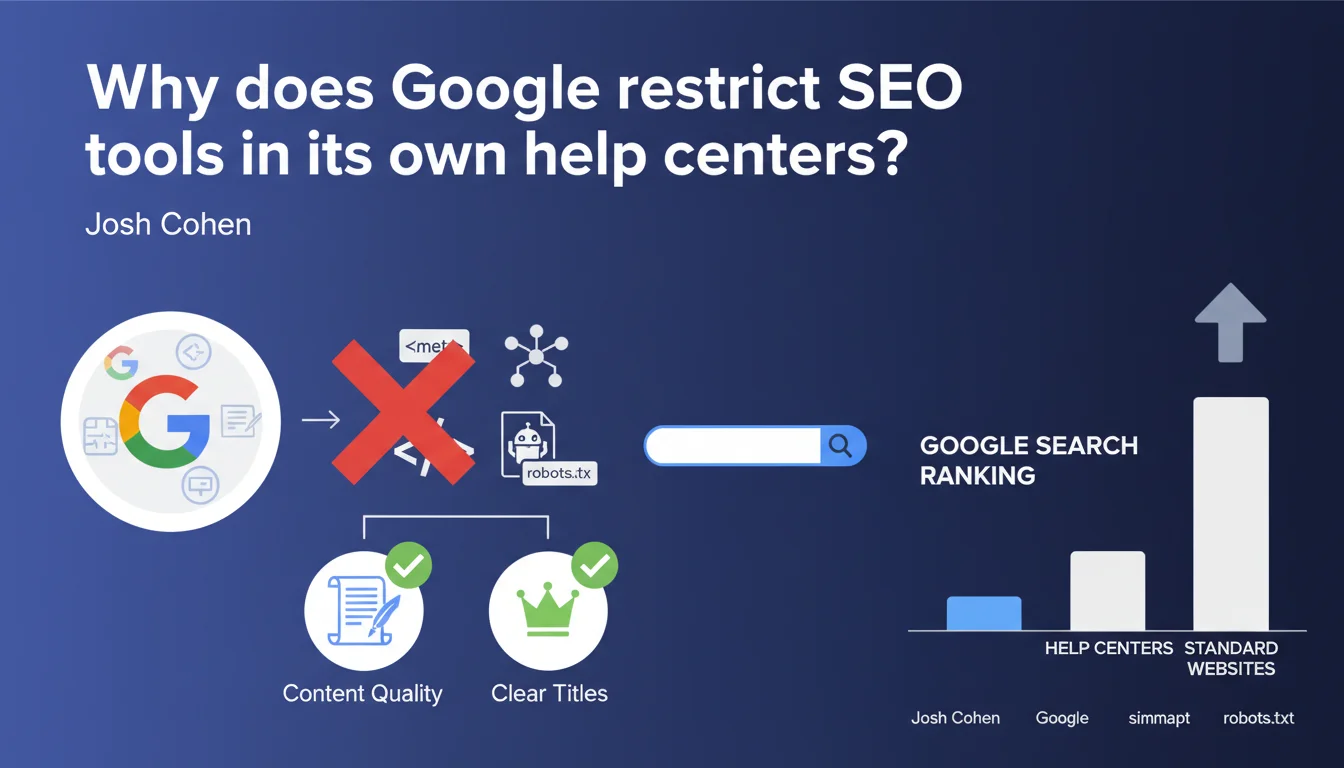
Google confirms that its own help centers cannot use standard SEO tools (custom meta tags, customized sitemaps, robots.txt). The only available levers: content quality and clear titles. A limitation that raises questions about the true importance of technical optimizations that Google nevertheless recommends to webmasters.
What you need to understand
Can't Google eat its own technical soup?
Josh Cohen reveals a little-known constraint: Google help centers operate on infrastructure that doesn't allow implementing classic technical SEO optimizations. No control over custom meta tags, impossible to create adapted sitemaps, no control over the robots.txt file.
This architectural limitation forces teams to focus on only two levers: content quality and clear titles. In other words, Google applies to its own help pages a minimalist approach that contrasts with the wealth of recommendations it distributes to webmasters.
What technical infrastructure explains these restrictions?
Cohen doesn't detail the tech stack responsible for these limitations — likely a proprietary CMS or centralized platform that sacrifices SEO flexibility for scalability and multilingual consistency. Help centers cover dozens of products, hundreds of languages: standardization takes priority over customization.
This situation reveals a classic tension in large organizations: between technical standardization and granular optimization. Internal SEO teams face the same constraints as any practitioner dealing with a rigid system.
What does this mean for Google help centers?
- No ability to add custom meta descriptions to improve CTR in SERPs
- Impossible to manage crawl budget finely via robots.txt or prioritize certain sections via sitemap
- No implementation of custom hreflang tags or optimized canonical tags
- Total dependence on content semantics and title structure for SEO
- An approach that bets everything on editorial content rather than technical optimization
SEO Expert opinion
Does this statement call into question the importance of technical SEO?
Let's be honest: if Google manages to rank its help centers without custom meta tags or optimized sitemaps, that raises questions. But watch out for confirmation bias. Google benefits from exceptional domain authority and massive internal linking — two factors that 99% of sites don't have.
Help centers also aren't pages with high commercial competition. They target informational queries where semantic relevance carries significant weight. In this context, yes, well-structured content with clear titles can suffice. On saturated transactional queries? Much less obvious.
Do the admitted limitations truly reflect what's happening on the ground?
Cohen speaks about what is officially restricted in the help centers interface. But Google teams probably have access to backend levers that this statement passes over in silence: control over loading times, server architecture optimization, prerendering, priority internal indexing.
Saying "we only use content and titles" oversimplifies to an extreme. [To be verified]: isn't Google automatically injecting technical optimizations in the background that editors don't see? Does the platform auto-generate sitemaps, even if not customizable?
What nuances should we add to this statement?
This limitation applies to help centers, not google.com, YouTube, or Maps. Google's flagship products are loaded with advanced technical optimizations. Cohen describes a constraint specific to a type of content with low commercial strategic value.
Furthermore, the admission of these technical limitations indirectly validates that technical SEO matters — otherwise why would Cohen bother specifying that his teams lack access to these tools? It's a signal that in a normal context, these tools deliver measurable value.
Practical impact and recommendations
Should you rethink your SEO priorities after this statement?
No. This statement changes nothing about your priorities if you manage an e-commerce site, a niche blog, or a corporate website. You don't have Google's domain authority, its history, or its internal linking. You need every available lever.
What Cohen confirms is that on informational content with low competition, with already-established authority, content takes priority. But if you're starting out, if you're playing in saturated sectors, or if your DA is stuck under 30, technical optimizations remain decisive for gaining rankings.
What should you concretely do to maximize the impact of content and titles?
- Invest heavily in editorial quality: precisely answer search intent, structure with clear subheadings
- Care for every title tag as if it were the only available lever — it must be descriptive, naturally incorporate the primary keyword, and drive clicks
- Use rigorous heading architecture (H1, H2, H3) to facilitate understanding by crawlers and users
- Optimize semantic internal linking to compensate for the absence of custom sitemaps: contextual links become your crawl guidance tool
- Don't neglect meta descriptions even though Cohen doesn't mention them — Google may ignore them, but they influence CTR when displayed
- Continue using robots.txt and sitemaps on your own sites: just because Google deliberately limits itself doesn't mean you should
How can you verify that your strategy remains balanced?
Regularly audit the distribution of your SEO efforts. If 80% of your time goes into micro-optimizations (hyper-specialized schema markup, canonical tag variation testing) and 20% into content, you may be barking up the wrong tree.
Conversely, if you completely neglect technique under the pretense that "Google doesn't need it," you're leaving rankings on the table. Optimal balance depends on your sector, current authority, and site maturity.
Google help centers operate with strong technical constraints, but this doesn't validate a "content only" approach for the majority of sites. Continue to exploit all available SEO levers — quality content AND technical optimizations.
For complex sites or highly competitive sectors, orchestrating these two dimensions requires pointed expertise and time. If you lack internal resources or if your teams struggle to maintain this balance, turning to a specialized SEO agency can help you accelerate without scattering your efforts. Personalized support helps you prioritize initiatives according to your specific context.
❓ Frequently Asked Questions
Google utilise-t-il vraiment aucun outil SEO technique sur ses centres d'aide ?
Est-ce que cette limitation s'applique à tous les produits Google ?
Faut-il abandonner les optimisations techniques après cette déclaration ?
Pourquoi Google impose-t-il ces restrictions à ses propres équipes ?
Quelle est la leçon principale pour un praticien SEO ?
🎥 From the same video 4
Other SEO insights extracted from this same Google Search Central video · published on 12/01/2023
🎥 Watch the full video on YouTube →
💬 Comments (0)
Be the first to comment.