
Official statement
Other statements from this video 4 ▾
- □ Are FAQ accordions hurting your SEO? Here's what Google really thinks
- □ Does Google's algorithm really recognize authoritative content as easily as it claims?
- □ Why does Google restrict SEO tools in its own help centers?
- □ Why does Google lump certain errors into an 'other' category in Search Console reports?
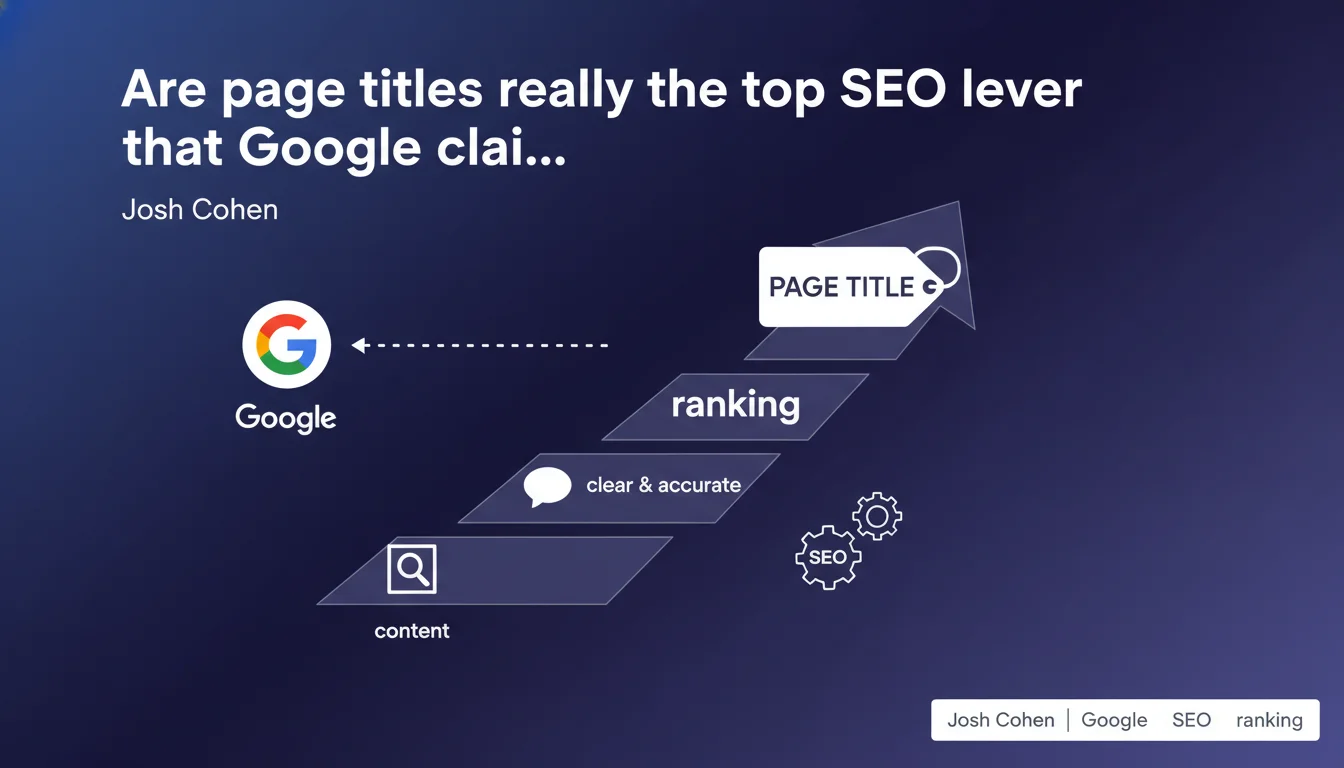
Google states that clear and precise page titles are one of the main SEO levers for improving the search engine ranking of help content. The recommendation emphasizes strict alignment between the displayed title and the actual content of the page. However, this statement remains intentionally vague about the exact weighting of this signal compared to other ranking factors.
What you need to understand
Google highlights page title clarity as a priority SEO factor, particularly for help content — technical documentation, FAQs, tutorials. The algorithm apparently needs the title to precisely reflect the content to assess page relevance against a search query.
Why does Google place such emphasis on titles for help content?
Help content typically addresses very specific informational queries. A user typing "how to reset a WordPress password" expects an exact answer, not a generic page about security. If the title promises one thing and the content delivers another, bounce rate skyrockets and the algorithm picks up the negative signal.
Google therefore wants unambiguous descriptive titles : no clickbait, no vague wording. What it's trying to prevent is user frustration that damages search experience.
What does this statement reveal about the weight of titles in the algorithm?
Cohen speaks of "one of the main SEO tools available" — cautious wording that avoids quantifying exact weight. We know that the title tag remains a strong historical signal, but Google has never communicated precise figures on its impact relative to content, backlinks, or behavioral signals.
What's certain : a poorly calibrated title can reduce organic CTR in SERPs, which in turn degrades ranking. So the title acts as both an on-page signal and an indirect performance lever through user behavior.
What are Google's concrete criteria for "clarity"?
Cohen doesn't detail precise rules, but we can infer from practice that Google values :
- Semantic alignment between the title and main H1/H2 headings on the page
- Inclusion of the primary keyword without over-optimization
- Reasonable length : between 50 and 60 characters to avoid truncation in SERPs
- No duplication of identical titles across multiple site pages
- Explicit wording rather than metaphorical or cryptic
Note: Google now rewrites approximately 60% of titles displayed in SERPs when it judges them poorly calibrated — clear signal that many sites don't meet these basic criteria.
SEO Expert opinion
Is this recommendation consistent with on-the-ground observations?
Yes, broadly speaking. SEO audits regularly show that poorly formulated titles correlate with mediocre organic performance. But beware : correlation is not causation. A perfect title on an empty page won't save anything.
The problem with this statement is that it oversells the title as the "main SEO tool". In reality, the title is mainly a performance multiplier : it amplifies the impact of already solid content, but never compensates for weak content. [To verify] : Google provides no comparative data on the relative weight of the title versus other on-page signals like H1s, internal linking, or subject depth.
What nuances should be added to this recommendation?
Cohen specifically targets help content, not commercial pages. On an e-commerce product sheet, an overly descriptive title can kill CTR against competitors playing on emotion or urgency. You need to adapt your strategy to page type.
Another nuance : Google rewrites titles when it deems them inadequate, but its rewriting criteria remain opaque and inconsistent. Sometimes it replaces a perfectly clear title with a hasty extraction from the H1 or a snippet of text. So even following Cohen's recommendation to the letter, you have no guarantee of full control over what appears in the SERPs.
In what cases does this rule not fully apply?
On very strong brands, the title may play less on descriptive clarity and more on brand recognition. Apple can afford a title like "MacBook Pro" without detailed description because the brand compensates. An unknown site doing the same would be invisible.
For highly technical content (developer documentation, hardware specs), an ultra-precise but longer title may be preferable even if it exceeds 60 characters. Google will truncate, but expert users will appreciate the precision in rich snippets or internal search results.
Practical impact and recommendations
What should you do concretely to optimize page titles?
First, audit all existing titles to identify duplicates, vague titles ("Home", "Page 2") and those that don't match actual content. A crawler like Screaming Frog or Oncrawl will pull this data in minutes.
Next, rewrite each title following this proven formula : Primary keyword + Benefit or specification + Brand (optional). Example: "Reset a WordPress Password in 3 Steps | Your Brand". The keyword at the start of the title captures better attention and signals the algorithm.
Finally, verify that the title tag and H1 are coherent but not identical. You can for example have a shorter title for SERPs and a more explicit H1 on the page itself.
What critical mistakes must you absolutely avoid?
- Duplicate the same title across multiple pages (classic error on pagination or e-commerce filters)
- Use generic titles without keywords ("Welcome", "About")
- Stuff the title with keywords without logic ("Buy running shoes cheap sale discount")
- Consistently exceed 60 characters without valid reason
- Forget to test actual display in SERPs using tools like SERP Simulator
And above all : never promise in the title something the page doesn't deliver. Google detects the gap through behavioral signals (pogosticking, short session time) and penalizes.
How do you verify that titles are properly configured on your site?
Use Google Search Console : the "Performance" tab shows you pages with the most impressions but low CTR — often a sign of unattractive or poorly calibrated title. Then compare what Google actually displays in SERPs versus your HTML title tag.
For large sites, automate title generation using dynamic templates based on page type (product sheet, category, blog post). But always keep manual control over strategic pages — an auto-generated title can lack finesse.
Page title optimization is a structural project that often affects hundreds or thousands of URLs. If your site has complex architecture or you lack time to audit and rewrite each title, calling on a specialized SEO agency can accelerate the process and guarantee strategic consistency at scale. An outside perspective also spots inconsistencies you no longer see when you're too close to the project.
❓ Frequently Asked Questions
Google réécrit-il systématiquement les titres mal formulés ?
Le title tag et le H1 doivent-ils être identiques ?
Combien de caractères maximum pour un titre de page ?
Un titre trop long pénalise-t-il le référencement ?
Faut-il inclure le nom de la marque dans chaque titre ?
🎥 From the same video 4
Other SEO insights extracted from this same Google Search Central video · published on 12/01/2023
🎥 Watch the full video on YouTube →
💬 Comments (0)
Be the first to comment.