
Official statement
Other statements from this video 4 ▾
- □ Les titres de page sont-ils vraiment le levier SEO prioritaire que Google prétend ?
- □ Faut-il abandonner les accordéons FAQ pour éviter de pénaliser son SEO ?
- □ Pourquoi Google bride-t-il les centres d'aide au niveau SEO technique ?
- □ Pourquoi Google regroupe-t-il certaines erreurs en catégorie 'autre' dans la Search Console ?
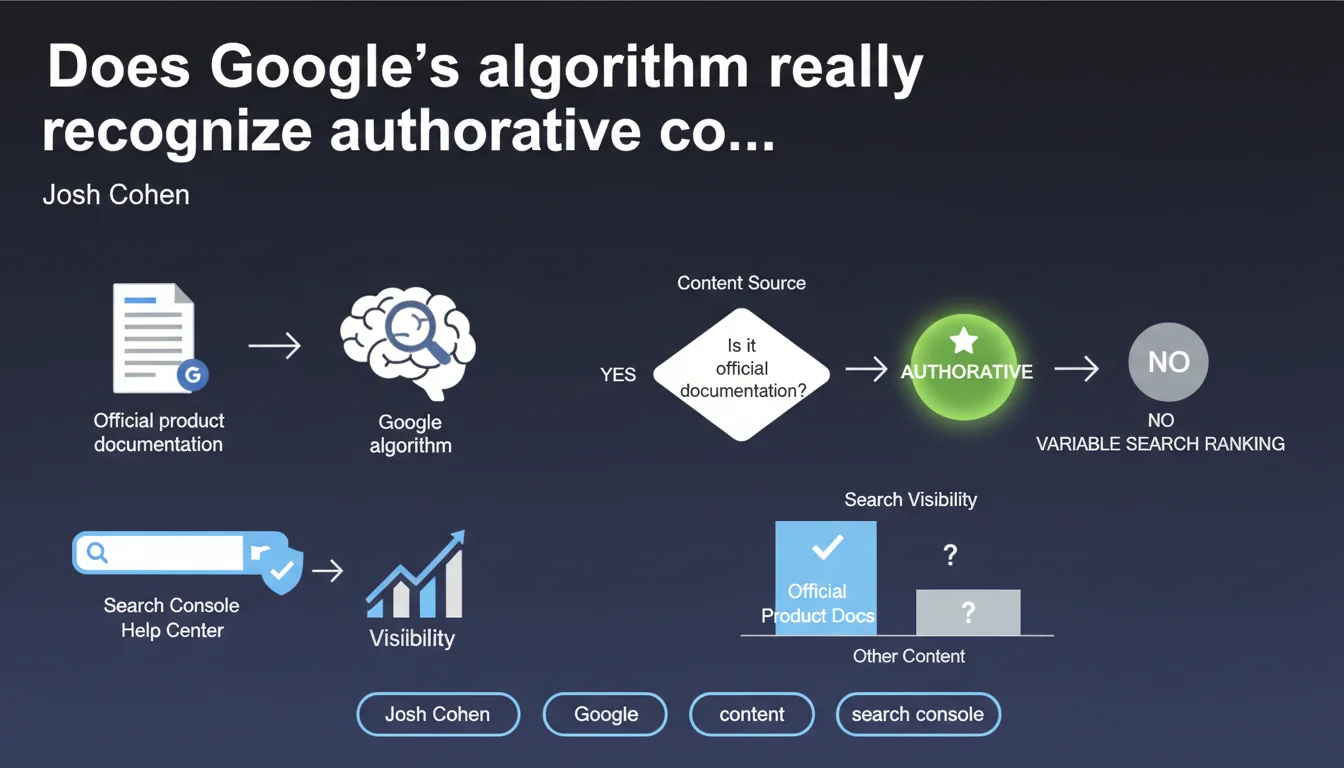
Josh Cohen argues that Google's algorithm effortlessly identifies authoritative content, citing the example of official product documentation. The Search Console Help Center would therefore naturally rank well. However, this statement raises questions about how Google concretely defines "authority" and the cases where this recognition fails.
What you need to understand
What does "authoritative content" really mean to Google?
Cohen discusses the algorithm's ability to identify official sources as inherently authoritative. In concrete terms, this refers to pages produced by a product or service publisher — technical documentation, help centers, official guides.
The Search Console Help Center example illustrates this principle: Google considers its own documentation as the definitive reference for its tool. Logical, but this obvious case masks a far more complex reality for the rest of the web.
How does the algorithm detect this authority?
Cohen remains vague about the technical signals being exploited. We can guess at a mix of factors: official domain, consistency between the entity producing content and the subject matter, content depth, and domain age in this thematic area.
Semantic entities likely play a role: Google links a domain to an organization, then evaluates whether that organization is legitimate to address the subject. But no precise metrics are provided.
- Official product documentation benefits from an implicit algorithmic advantage
- Authority relies on domain/entity/subject consistency, not just backlinks
- Google prioritizes "first-hand" sources when they exist
- In-house help centers have a head start over third-party content
Does this statement apply beyond tech giants?
Cohen uses an easy example: Google's own Help Center. But what about a B2B SME with exhaustive product documentation? Does automatic recognition work as effectively?
The statement suggests yes, but on-the-ground reality indicates that prior domain prominence remains decisive. An unknown startup producing the best documentation on the market won't receive the same immediate treatment as an established player.
SEO Expert opinion
Does this claim match real-world observations?
Partially. Official documentation does perform better than third-party content provided the domain is already recognized as a legitimate player. For new entrants, the algorithm takes time to build this domain/authority association.
We regularly see cases where content aggregators or review sites outrank official documentation, particularly on transactional or comparative queries. Authority alone isn't enough — search intent takes precedence.
What technical signals are missing from this statement?
Cohen mentions neither schema markup, explicit E-E-A-T signals, nor the Knowledge Graph's role in this recognition. [To verify]: Does the algorithm rely on entities pre-registered in its knowledge base, or can it autonomously discover new authorities?
Another notable omission: no mention of user behavior. If users massively click on a competitor rather than official documentation, does the algorithm adjust its notion of authority? The statement suggests purely algorithmic recognition, which seems incomplete.
In what cases does this rule fail?
Sectors where official documentation is deliberately opaque or incomplete: finance, healthcare, pharmaceuticals. Users then seek independent analysis, and Google knows this.
Another limitation: queries where the user explicitly seeks external opinion ("independent review of X", "alternative to Y"). The manufacturer's authority becomes a handicap, and the algorithm values trusted third parties.
Practical impact and recommendations
What should you optimize to be recognized as an authoritative source?
Structure your documentation with precise Schema.org markup: TechArticle, HowTo, FAQPage depending on format. Consolidate your pages under a dedicated section (/support, /docs, /help) with clear architecture.
Strengthen entity signals: complete company page, linked social profiles, consistent mentions of your organization throughout content. Google must be able to clearly link your domain to your activity.
- Create a clearly identifiable documentation/help section in your site architecture
- Implement appropriate schema markup (TechArticle, HowTo, FAQPage) on each content type
- Ensure consistency between organization name/domain/subject matter across all pages
- Produce first-hand content with visible expertise (identified authors, credits, internal sources)
- Gain external mentions linking your brand to your area of expertise (PR, citations)
What mistakes should you avoid when producing "authoritative" content?
Don't dilute your authority by tackling subjects far from your core business. A SaaS publisher producing lifestyle articles will lose thematic consistency.
Avoid generic content copied and pasted across sections. Official documentation must provide unique value impossible for a third party to replicate: internal data, real use cases, exclusive technical details.
How can you verify that your content is recognized as authoritative?
Analyze your rankings on pure informational queries related to your product ("how to configure X", "Y documentation", "Z guide"). If third parties outrank you, automatic recognition isn't working yet.
Use Search Console to identify queries where you appear with rich snippets (detected schemas). This is a proxy for Google properly understanding your authority.
Automatic recognition of authoritative content exists, but relies on multi-signal consistency: architecture, markup, entity, and thematic history. New players must build this legitimacy progressively.
Implementing these optimizations requires pointed technical expertise and strategic brand positioning vision. Facing the complexity of these challenges — between semantic structuring, entity management, and producing differentiated content — guidance from a specialized SEO agency can prove decisive in accelerating this recognition and avoiding costly credibility mistakes.
❓ Frequently Asked Questions
Un site récent peut-il être reconnu comme autoritaire rapidement ?
Les backlinks restent-ils importants pour l'autorité selon cette déclaration ?
Faut-il bloquer les contenus tiers pour que Google privilégie la documentation officielle ?
Le Knowledge Graph joue-t-il un rôle dans cette reconnaissance d'autorité ?
Comment gérer l'autorité sur des sujets où plusieurs acteurs sont légitimes ?
🎥 From the same video 4
Other SEO insights extracted from this same Google Search Central video · published on 12/01/2023
🎥 Watch the full video on YouTube →
💬 Comments (0)
Be the first to comment.