
Official statement
What you need to understand
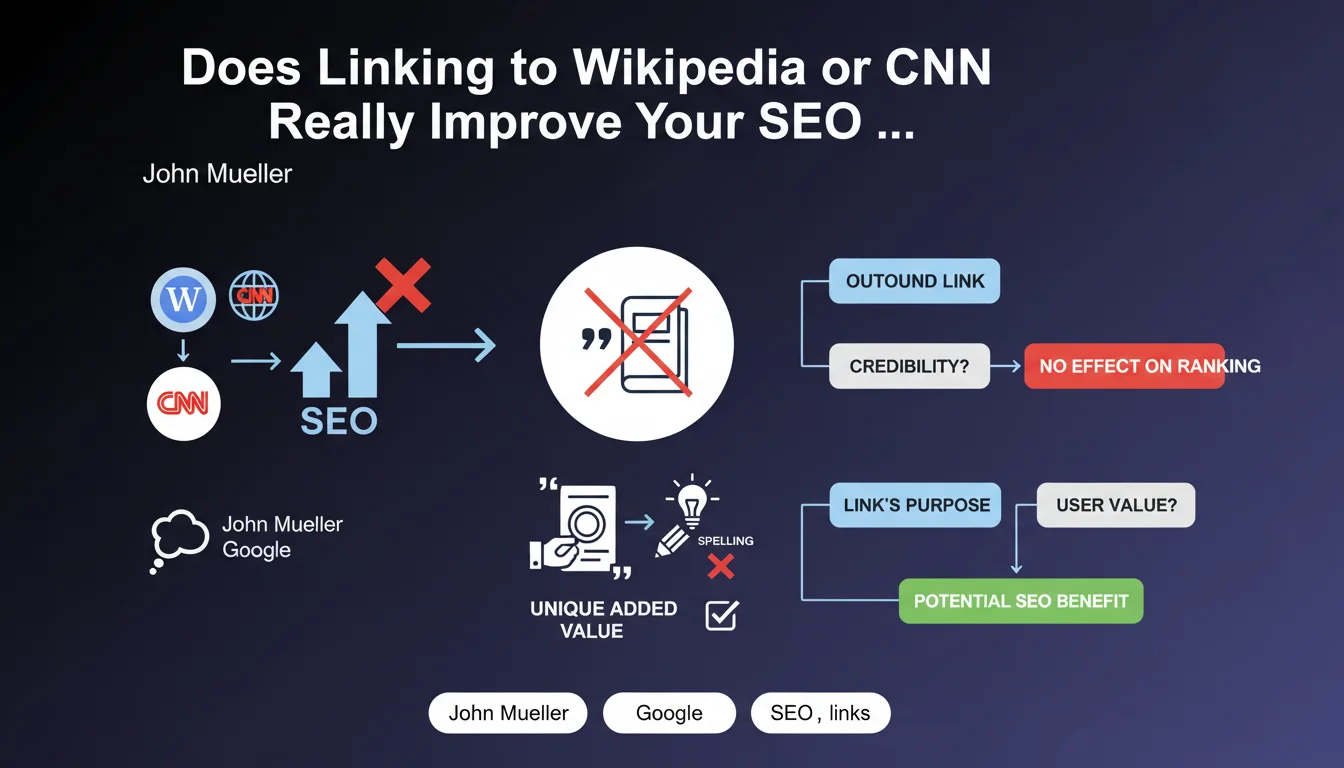
This statement from John Mueller debunks a persistent misconception in the SEO community: the belief that adding outbound links to authoritative sites would automatically improve a site's credibility in Google's eyes.
The analogy used is telling: citing a dictionary doesn't correct your spelling mistakes. In other words, pointing to recognized references doesn't magically transfer their authority to your content nor compensate for its potential weaknesses.
Google evaluates your content on its own intrinsic quality, not on the sites you cite. The presence of outbound links to CNN or Wikipedia is neither a positive ranking signal nor a tactic to gain algorithmic legitimacy.
- Outbound links to authoritative sites are not a ranking factor
- The only question to ask: does this link provide real value to the user?
- Relevance and usefulness for the reader should guide your linking decisions
- Google evaluates your content quality independently of the sites you cite
SEO Expert opinion
Google's position is completely consistent with the algorithm's evolution toward evaluating intrinsic content quality. In practice, we indeed observe that well-positioned sites don't share particular patterns regarding their outbound links to authorities.
However, an important nuance: while outbound links aren't a direct ranking factor, they indirectly contribute to user experience. Well-sourced content with relevant references generates positive behavioral signals (time on site, bounce rate). These metrics potentially influence SEO.
In certain sectors like YMYL (Your Money Your Life), citing recognized medical or scientific sources remains essential to demonstrate your editorial rigor, even if it's not a technical ranking factor.
Practical impact and recommendations
- Stop systematically adding links to Wikipedia or authoritative sites hoping to improve your SEO
- Evaluate each outbound link with this question: does it provide useful complementary information to my reader?
- Favor primary sources and relevant references that genuinely enrich your content
- Don't remove existing outbound links if they're relevant, that's not the objective of this statement
- Focus your efforts on the intrinsic quality of your content rather than external linking tactics
- Document your claims with credible sources in sensitive topics (health, finance) for E-E-A-T, without seeking direct SEO benefits
- Adopt a natural approach: an outbound link should fit organically within your editorial argument
Implementing an optimal content strategy requires juggling numerous parameters: editorial quality, semantic structure, search intent, real authority signals. Faced with the growing complexity of ranking criteria and constant evolution of guidelines, engaging a specialized SEO agency can prove judicious to benefit from personalized support and avoid false leads that consume time without tangible results.
💬 Comments (0)
Be the first to comment.