
Official statement
Other statements from this video 21 ▾
- □ Is it true that Google really indexes all JavaScript content, or do we still need traditional HTML?
- □ Why do JavaScript and meta robots tags create an indexing nightmare?
- □ What causes conflicts between your canonical tags in raw HTML and rendered output?
- □ Is it true that publishing more content leads to better rankings?
- □ Are your internal links secretly sabotaging your crawl budget?
- □ Why is JSON-LD dominating all other structured data formats?
- □ Does JavaScript modified structured data really create conflicting signals?
- □ Do rich snippets really enhance the adoption of structured data?
- □ Is HTTPS really essential for leveraging HTTP/2 and boosting performance?
- □ Is it true that mobile-first indexing is really completed and what risks do you still face?
- □ Why are Core Web Vitals a disaster on mobile despite the mobile-first approach?
- □ Does Google really index all client-side rendered content through JavaScript?
- □ Can JavaScript really change a noindex meta robots tag after the fact?
- □ What happens when conflicting canonical tags in raw and rendered HTML block your page indexing?
- □ Is it really necessary to produce more content to rank higher?
- □ Why does Google recommend using rel='ugc' and rel='sponsored' if they offer no direct benefits to publishers?
- □ How does JavaScript manipulation of your structured data impact your SERP visibility?
- □ Should you really remove aggregate ratings from your homepage?
- □ How does Google's visibility enhance the adoption of structured data?
- □ Why has HTTPS become essential for speeding up your web pages?
- □ Why has mobile-desktop parity become a critical issue for your organic visibility?
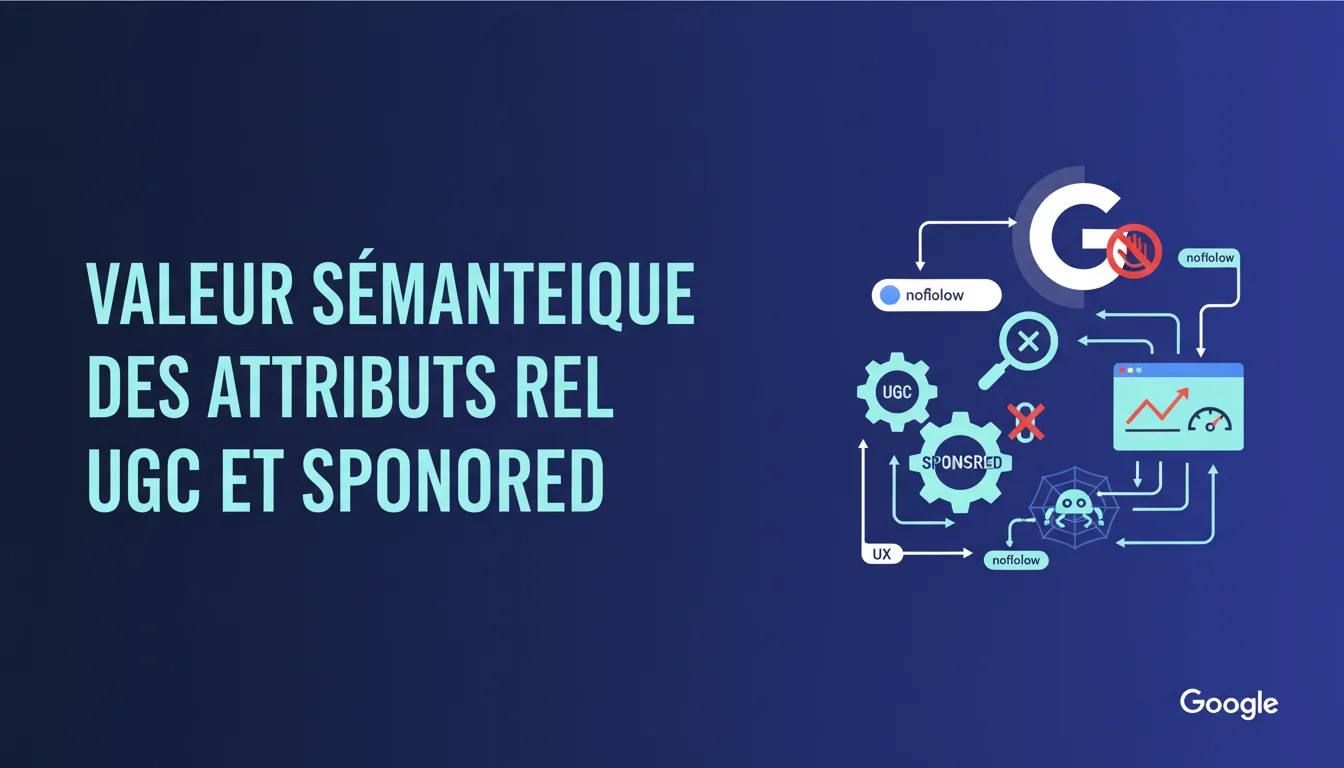
Google states that ugc and sponsored do not provide more PageRank value than nofollow, but they enrich the semantic understanding of a link for their algorithms. Essentially, these attributes allow Google to better qualify the nature of a link (user content vs. commercial partnership). The recommendation is clear: use them, even if the direct benefit is not measurable from the publisher's side.
What you need to understand
Why does Google promote these attributes if they don’t improve PageRank?
The statement is clear: rel='ugc' and rel='sponsored' do not offer any additional benefits in terms of passing PageRank compared to traditional nofollow. All three attributes block the flow of link juice in the same way. But here’s the crucial point: Google isn't trying to give you a free ranking boost. These attributes primarily serve to enhance its semantic understanding of the web. When you mark a link as ugc, you explicitly indicate that this content comes from a user (comment, forum, profile). With sponsored, you indicate a commercial relationship. This distinction helps Google to refine its trust models, detect spam patterns, and better evaluate the editorial quality of a site. Basically, you make its job easier — and that’s precisely why it recommends using them. From a technical PageRank perspective, there is no difference. All three block the transmission of link juice. It’s the semantic layer that changes. The nofollow is a generic directive: "don’t follow this link, I don’t endorse it". It’s vague. The ugc (User Generated Content) specifies: "this link comes from a user, not from my editorial team". The sponsored indicates: "this link is here because there has been a commercial transaction". Google can thus differentiate a legitimate sponsored link from an editorial nofollow link or a link posted by a spammer in the comments. This semantic granularity feeds its spam detection algorithms and linking pattern analysis. Yes, and it is even recommended in certain cases. You can write rel="nofollow ugc" or rel="nofollow sponsored". Google interprets the nofollow as the primary directive, and the secondary attribute as an additional semantic signal. This can be useful if you want to be doubly explicit: "this link does not transmit juice AND it comes from a user". In practice, using ugc or sponsored alone is usually sufficient — Google knows that these attributes imply a nofollow behavior by default.What is the real difference between ugc, sponsored, and nofollow?
Can these attributes be combined with nofollow?
SEO Expert opinion
Is this recommendation consistent with observed practices in the field?
In essence, yes. Google has always pushed for more transparency regarding the nature of links. The introduction of ugc and sponsored in 2019 was already in line with this logic. Since then, we have observed that sites that correctly mark their sponsored links tend to avoid manual actions. However, we must be honest: no public study proves a measurable positive impact of using ugc or sponsored on ranking. Google says "we recommend it", but provides no concrete data on how these signals actually change the algorithms. [To be verified]: does Google actively penalize sites that do not use these attributes on UGC or sponsored? Nothing confirms that. The main risk is not a direct penalty, but an erroneous interpretation of your linking pattern. If you have thousands of outgoing links without a clear attribute, Google may analyze them as editorial when they actually come from comments or partnerships. The result: your site may be perceived as participating in an unnatural linking scheme, even inadvertently. A manual action for artificial outgoing links still happens regularly — and it’s hard to contest if you have never marked your sponsored links. Another scenario: UGC platforms (forums, directories, profile sites) that do not mark their links as ugc may see their trust profile degrade. Not necessarily a frontal penalty, but a gradual loss of value transmitted by the legitimate editorial links present on the site. If the link is purely editorial, don’t touch it. A link that you place willingly in an article because the resource is relevant, without any commercial counterpart, and not coming from a user — this link remains a classic dofollow. Don’t overuse ugc or sponsored out of excessive caution. An editorial link mistakenly marked as sponsored sends a contradictory signal. Google may interpret this as an attempt to disguise a real sponsored link — and that works against you. Lastly, a nuance: on certain small sites, the maintenance cost of manually tagging thousands of old comments or outgoing links may not be worth it. Let’s be pragmatic. If you are launching a redesign or a new platform, integrate ugc and sponsored from the start. On a legacy site with 10 years of comments? Prioritize areas with high outgoing link volume and ignore dead pages.What are the risks of NOT using them?
In what cases should one refrain from using these attributes?
Practical impact and recommendations
How to implement ugc and sponsored on an existing site?
First reflex: audit your template models. Most modern CMS (WordPress, Drupal, etc.) already generate rel="nofollow" on comments. This should be replaced with rel="ugc" in the comment template. For sponsored links, there are two approaches. If you manage your partnerships manually within articles, you need to educate the editorial team to use rel="sponsored" when inserting links. If it's automated (banners, partner widgets), modify the module code to add the attribute by default. On WordPress, plugins like Yoast or RankMath now allow adding ugc automatically to comments. Check the settings. For custom setups, a PHP script that scans and replaces old nofollow in UGC areas will do the trick — but test in staging first. The classic mistake: mass replacing ALL nofollow with ugc or sponsored indiscriminately. If you used nofollow on editorial links for precaution (external links to lesser-known sites), do not convert them to sponsored — that would be incorrect. Another trap: forgetting links in user profiles. On forums, marketplaces, review sites, these links are pure UGC. If they are dofollow or generic nofollow, change them to ugc. Finally, do not combine ugc and sponsored on the same link unless in a rare case. A link is either generated by a user or commercial. Both at once makes no semantic sense — and sends a confusing signal to Google. Crawl your site with Screaming Frog or Sitebulb. Export all outgoing links with their rel attributes. Filter by type of page (articles vs. comments vs. partner pages). Check that the attributes correspond to the nature of the content. Use the link inspector in Search Console for a few representative URLs. Google shows you how it sees the links — this is the best reality check. Also monitor for manual actions in the weeks that follow. An incorrect implementation (sponsored on editorial links, or lack of sponsored on real paid content) can trigger a manual review if the volume is significant.What mistakes to avoid during migration?
How to check if the implementation is correct?
❓ Frequently Asked Questions
Est-ce que rel='ugc' et rel='sponsored' transmettent du PageRank ?
Peut-on combiner rel='nofollow' avec ugc ou sponsored ?
Que se passe-t-il si je ne marque pas mes liens sponsorisés avec rel='sponsored' ?
Faut-il convertir tous les anciens nofollow en ugc ou sponsored ?
Les attributs ugc et sponsored ont-ils un impact positif sur le SEO ?
🎥 From the same video 21
Other SEO insights extracted from this same Google Search Central video · published on 15/04/2021
🎥 Watch the full video on YouTube →
💬 Comments (0)
Be the first to comment.