
Official statement
What you need to understand
Why does seasonal content pose a particular SEO challenge?
Seasonal content represents a specific use case in SEO. Events like Christmas, Valentine's Day or summer sales return every year, but their content needs to be updated.
Google must have time to crawl, index and evaluate these pages before the relevant period. Without sufficient anticipation, your content risks arriving too late in search results.
What are the two possible approaches according to Google?
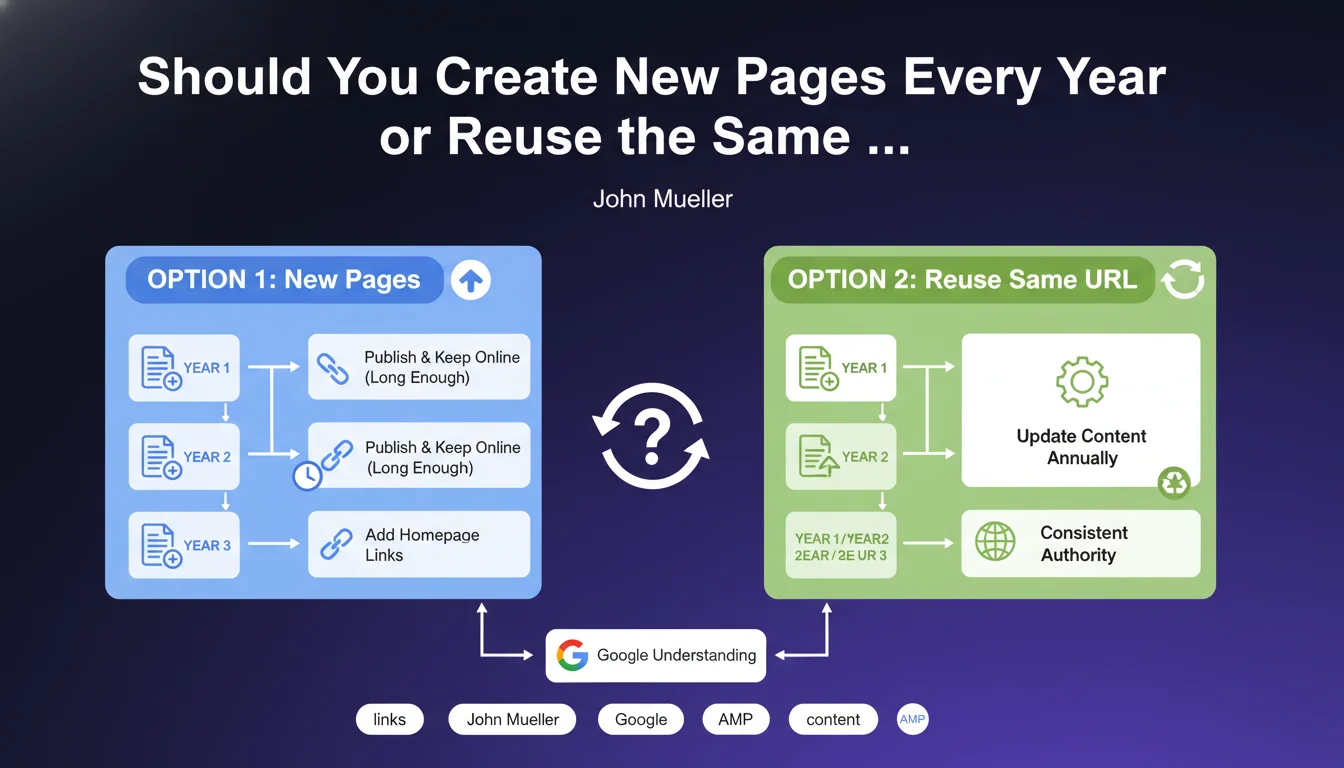
The first approach consists of creating new URLs each year (example: /christmas-2024/, /christmas-2025/). This method allows you to maintain a history but requires leaving the pages online long enough.
The second approach uses a single, permanent URL whose content changes according to the seasons (example: /special-offers/). This URL can successively display different promotions throughout the year.
In both cases, Google confirms that the critical element is the publication timeline: the content must be accessible long enough before the event for the algorithms to analyze it correctly.
- Both strategies (new URLs or single URL) are viable according to Google
- Indexation time is the determining factor in both cases
- Links from the homepage reinforce discoverability
- Content must remain accessible long enough for algorithmic analysis
What timing is recommended for publishing seasonal content?
Google doesn't provide a precise figure, but field experience suggests a minimum lead time of one month before the targeted event. This timing allows the search engine to crawl the pages, analyze their relevance and position them.
Beyond simple crawling, Google must evaluate the content quality, its relevance to seasonal queries and its comparative authority against the competition. This process takes time.
SEO Expert opinion
Is this apparent flexibility from Google really good news?
John Mueller's response seems indeed very open: "whatever you do, it works". But this flexibility hides significant strategic complexity.
In reality, each approach has distinct advantages and disadvantages that Google doesn't detail. The choice between single URL or multiple URLs must depend on your specific context, not on a generalized statement.
What strategic nuances should be considered for each approach?
The multiple URLs approach presents a major advantage: it allows you to optimize each page for specific queries including the year ("christmas gifts 2025"). It also builds a content history that can strengthen topical authority.
On the other hand, it dilutes PageRank across multiple URLs and requires 301 redirects each year to avoid 404 errors. Technical management quickly becomes complex.
The single URL approach concentrates authority on one page and simplifies link management. But it poses an algorithmic problem: how does Google interpret drastic content changes on the same URL?
In which cases should you favor one strategy over the other?
Favor multiple URLs if your seasonal content is substantial, unique each year, and you have the resources to manage a solid technical architecture with redirects and internal linking.
Opt for a single URL if your seasonal content is simple, repetitive in structure, and you lack technical resources. This approach is particularly suitable for small e-commerce sites with standardized promotional offers.
An often overlooked criterion: search intent. If users specifically search for "christmas 2025", dated URLs will perform better. If queries are generic ("christmas gift ideas"), a permanent URL suffices.
Practical impact and recommendations
What should you concretely do to optimize your seasonal content?
Whatever your strategic choice, start by establishing an anticipated editorial calendar. Publish your seasonal content at least 6 to 8 weeks before the target period to give Google the necessary time.
Create powerful internal links from your homepage and main category pages. These navigation signals indicate to Google that this content is a priority and relevant for your site.
If you opt for annual multiple URLs, implement a systematic 301 redirect strategy. The URL from year N-1 must redirect to the URL from year N, thus preserving the accumulated link equity.
What critical mistakes must you absolutely avoid?
Never publish your seasonal content at the last minute. A lead time of less than 3 weeks is insufficient for optimal positioning. Your competition that anticipates better will systematically outrank you.
Don't use duplicate content between years. If you reuse a structure, substantially modify the text, images and offers. Google penalizes nearly identical pages on different URLs.
Avoid brutally deleting your seasonal content immediately after the event. Keep it online with a post-event update ("offers ended, see you next year") for at least 2 weeks before any action.
How do you implement a high-performing seasonal strategy over the long term?
Document your approach in an internal procedures guide. Note publication dates, SEO performance of each seasonal campaign, and progressively adjust your timing year after year.
Specifically track crawl metrics in Search Console: crawl frequency of seasonal pages, delay between publication and indexation, any errors. This data will guide your future optimizations.
- Publish seasonal content at least 6 to 8 weeks before the targeted event
- Create internal links from the homepage to seasonal pages
- Implement 301 redirects if you use multiple annual URLs
- Avoid duplicate content between different years
- Keep pages online at least 2 weeks after the event
- Monitor performance in Search Console to optimize timing
- Create substantially different and higher quality content each year
- Anticipate search trends with Google Trends to adjust the calendar
💬 Comments (0)
Be the first to comment.