
Official statement
What you need to understand
What's the difference between lying and being imprecise?
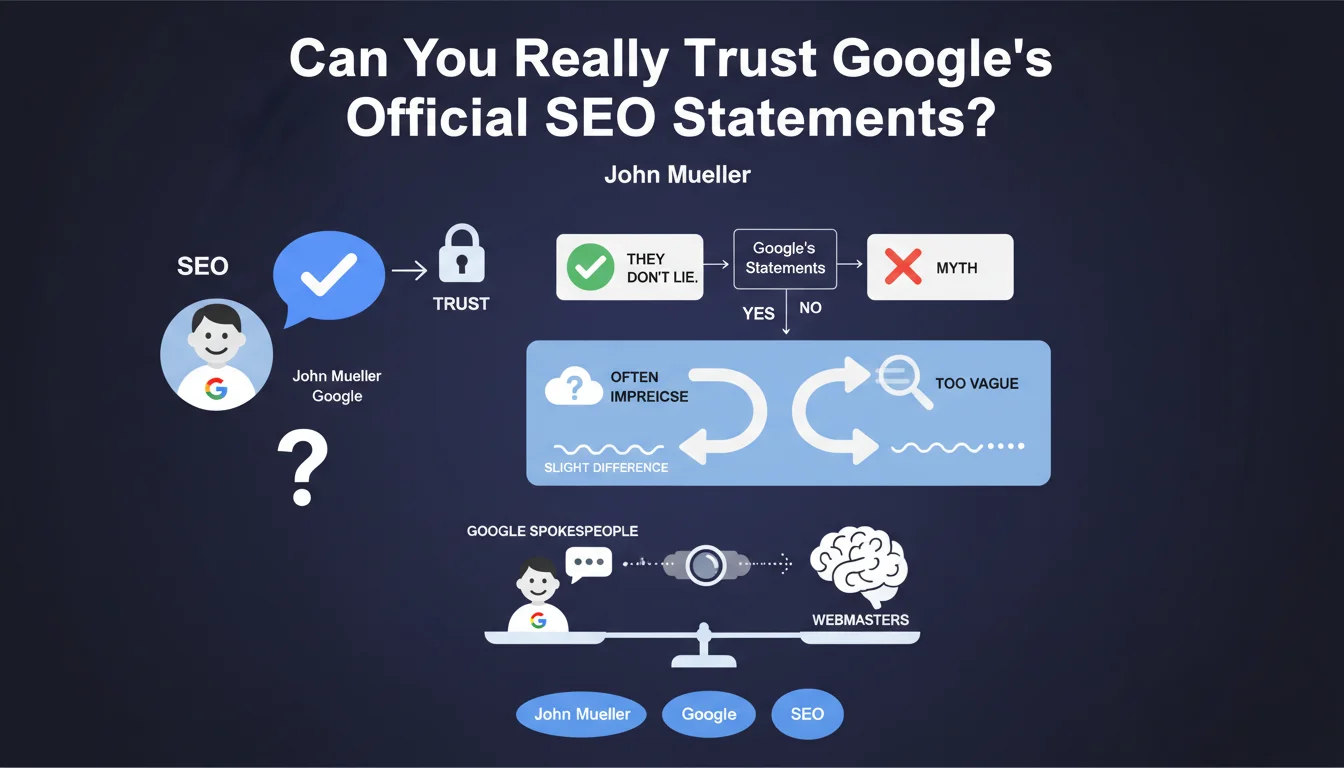
John Mueller and Gary Illyes, Google's official spokespeople, claim they never lie to webmasters. This statement raises a fundamental question: does the absence of lies mean total transparency?
The reality is more nuanced. Google representatives don't provide false information, but their answers often remain deliberately vague or incomplete. This imprecision isn't a lie, but it limits the operational scope of their advice.
Why does Google deliberately remain imprecise?
Google has strategic reasons for not revealing all the details of its algorithm. The first is to prevent manipulation of its search results by malicious actors.
The second reason concerns the very complexity of the algorithm. With hundreds of signals interacting with each other, a detailed explanation would often be too technical and difficult to apply. Imprecision then becomes a form of simplification.
How should you interpret Google's official communications?
Google's statements should be considered as general guidelines rather than precise instructions. They define the philosophy and broad principles, but rarely the technical details.
For an SEO practitioner, this means you must cross-reference sources: combine official statements with empirical testing, case studies, and observation of actual results in the SERPs.
- Google spokespeople don't lie, but often remain deliberately vague
- This imprecision protects the algorithm against manipulation and simplifies complex concepts
- Official statements provide philosophical guidance more than technical instructions
- The complete truth requires combining official sources with empirical observations
SEO Expert opinion
Is this statement consistent with practices observed in the field?
After 15 years of experience, I can confirm that Google indeed doesn't lie. However, the gap between their statements and operational reality sometimes remains significant.
For example, Google states that links are no longer a major ranking factor. Yet testing shows that a solid backlink profile remains decisive in competitive sectors. This isn't a lie, but a simplification that ignores the nuances.
Similarly, Google insists that quality content is sufficient. In practice, excellent content without technical optimization often struggles to rank against average content that's technically impeccable.
What nuances should be added to this official position?
The main nuance concerns the difference between what Google ideally values and what its algorithm actually rewards. Google wants to promote quality content, but its algorithm relies on measurable signals that don't always capture this quality.
You must also distinguish advice intended for small webmasters from that relevant to enterprise sites. Google's simplifications work well for a personal blog, but are insufficient for a 50,000-page e-commerce site.
When should you take official communications with a grain of salt?
Google's statements should be relativized when they concern strategic elements of the algorithm. For example, on topics like the exact importance of loading time or the precise impact of Core Web Vitals, the answers remain fuzzy.
Similarly, when Google says a factor "isn't important," it often means it's less important than others, not that you should ignore it completely. In a competitive environment, all factors matter.
Practical impact and recommendations
How can you effectively use Google's official statements?
Consider Google's communications as a guiding framework that defines the general philosophy. Use them to validate your major strategic directions, but not to make precise tactical decisions.
Adopt a cross-validation approach: when Google makes a statement, test it on your projects or observe the results in your sector. Empirical data complements and clarifies the official discourse.
Create a system for documenting and analyzing official statements. Note who said what, in what context, and compare with your observations. Certain patterns emerge over time.
What mistakes should you avoid when interpreting Google communications?
The first mistake is taking every statement literally without nuance. Google communicates to a broad audience, with highly varied levels of SEO sophistication.
The second mistake is completely ignoring official statements on the grounds that they're vague. They contain valuable clues about future directions and Google's priorities.
Also avoid over-optimizing in reaction to an isolated statement. Strategic changes should be gradual and based on a global understanding, not on a phrase taken out of context.
What strategy should you adopt to optimize your SEO in this context?
Develop a balanced approach that combines respect for official guidelines and operational pragmatism. Follow Google's broad principles while remaining attentive to actual performance signals.
Invest in continuous SEO monitoring: follow official spokespeople, but also case studies, professional analyses, and measurement tools. The truth lies in the convergence of these sources.
- Regularly follow official statements from John Mueller, Gary Illyes, and other Google spokespeople
- Implement A/B testing to empirically validate official recommendations on your site
- Document gaps between official discourse and observed results in your sector
- Favor a holistic SEO approach rather than focusing on isolated factors
- Balance technical optimization, content quality, and domain authority
- Never make major strategic decisions based solely on an isolated statement
- Systematically cross-reference sources: official, empirical, and experience feedback
- Adapt your interpretation of guidelines according to your specific context and level of competition
💬 Comments (0)
Be the first to comment.