
Official statement
What you need to understand
Crawl budget refers to the number of pages that Googlebot will explore on your site within a given timeframe. This resource is not unlimited: Google allocates a certain exploration quota to each site.
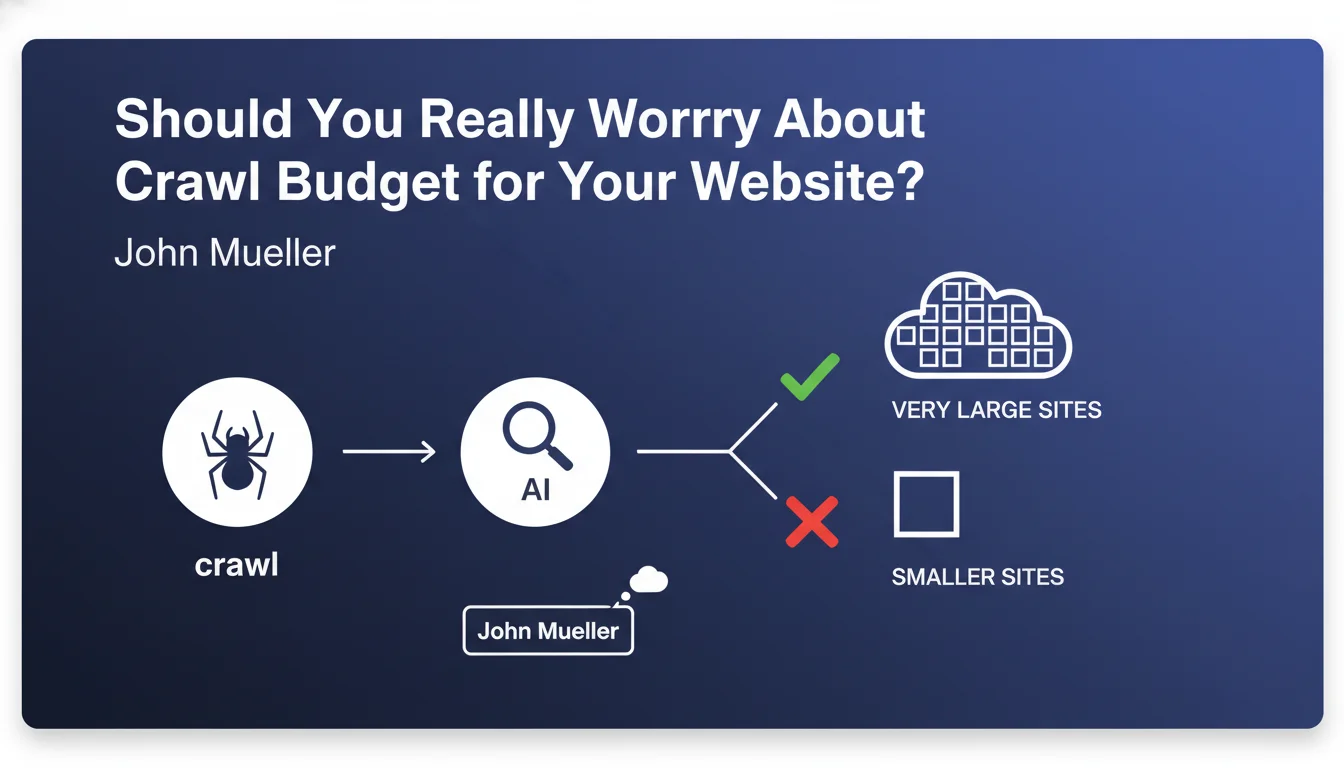
According to this official statement, the majority of webmasters place excessive importance on this notion. For small and medium-sized sites, it simply isn't a limiting factor.
The real crawl budget issue only concerns very large sites with several thousand pages or more. Below this threshold, if your site is technically sound, Google will manage to explore all your content without difficulty.
- Sites with a few dozen or hundred pages don't need to worry about crawl budget
- The question becomes relevant beyond several thousand pages
- For sites with tens of thousands of pages, it's a critical issue
- A technically well-designed site naturally facilitates exploration
SEO Expert opinion
This position is perfectly consistent with field observations. Too many SEO consultants invoke crawl budget to justify optimizations on sites that absolutely don't need them.
However, some nuances are necessary. A 500-page site can indeed experience indexing problems if its technical structure is deficient: excessive loading times, frequent server errors, or overly deep siloed architecture. In these cases, it's not so much the crawl budget that's problematic, but the overall technical quality.
For media sites, news platforms, or marketplaces exceeding 10,000 pages, ignoring crawl budget would be a major strategic mistake. Optimization then becomes an essential performance lever to ensure rapid indexing of new content.
Practical impact and recommendations
- Sites under 1,000 pages: Don't waste time on crawl budget optimization, focus on content quality and user experience
- Prioritize the essentials: Ensure your site loads quickly, doesn't contain major technical errors, and has a logical architecture
- Avoid false priorities: Don't invest in expensive crawl budget audits if your site has a few hundred pages
- Sites with 1,000 to 10,000 pages: Start monitoring exploration statistics in Search Console and identify potential waste (URL parameters, duplicate content)
- Sites with over 10,000 pages: Crawl budget optimization becomes critical - block unnecessary URLs via robots.txt, optimize your internal linking, carefully manage facets and filters
- E-commerce with facets: Even with a modest catalog, implement strict management of filter URLs via canonical or noindex to avoid combinatorial explosion
- Ongoing monitoring: For large sites, establish regular tracking of crawl rate and download time in Search Console
Advanced crawl budget optimization on large platforms requires specialized technical expertise and in-depth server log analysis. These audits demand specialized skills and professional tools that are often expensive. If your site reaches this scale and you're experiencing indexing issues, support from an SEO agency experienced in complex architectures can prove decisive in precisely identifying bottlenecks and deploying fixes tailored to your specific infrastructure.
💬 Comments (0)
Be the first to comment.