
Official statement
What you need to understand
What Is the Speakable Structured Data Markup and Why Did Google Create It?
The Speakable tag is a schema.org structured data type specifically designed to identify the most relevant text portions to be read aloud by Google voice assistants. It allows content creators to mark up the optimal excerpts for voice reading on Google Home and other connected speakers.
Google developed this tag in the context of voice search, which is experiencing exponential growth. The objective is to offer users a quality voice experience by intelligently selecting the most informative and orally comprehensible passages.
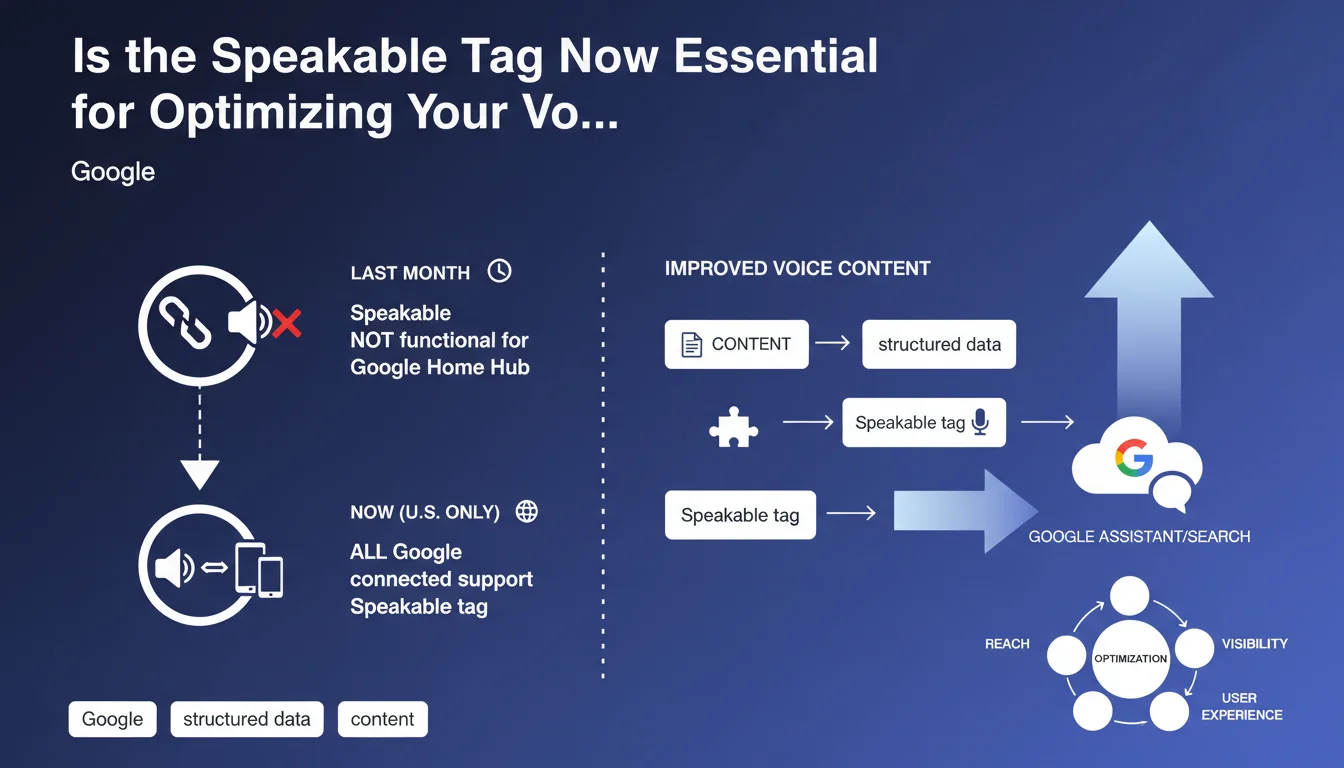
What Technical Issue Did Google Resolve Concerning Google Home Hub?
A technical malfunction initially prevented Google Home Hub from correctly recognizing and utilizing the Speakable tag. This anomaly was identified and publicly reported by Google itself, demonstrating a certain level of transparency.
The issue is now fixed, and all Google connected speakers in the United States support this tag. This update ensures consistency across Google's voice device ecosystem.
Is This Feature Available in France and Europe?
For now, Speakable tag support remains limited to the United States. No official announcement has been made regarding deployment in Europe or France, which legitimately frustrates francophone SEO professionals.
This geographical restriction follows Google's typical pattern of testing new features on the American market before potential international expansion. The wait therefore continues for European markets.
- Speakable identifies excerpts optimized for voice reading
- The technical bug on Google Home Hub has been resolved in the United States
- The feature remains unavailable in Europe and France currently
- This tag is part of Google's strategy for voice search
- Only American English-speaking markets benefit from it at present
SEO Expert opinion
Is This Geographical Limitation Consistent with Google's Usual Strategy?
Absolutely. Google follows its classic deployment pattern: initial testing on the American English-speaking market, technical adjustments, then progressive expansion to other geographical areas. This cautious approach minimizes risks and allows for technology refinement.
Nevertheless, this strategy creates a competitive asymmetry between markets. American sites can already optimize their content for voice search via Speakable, while European sites wait with no visibility on the deployment timeline.
Should You Already Implement the Speakable Tag on a French-Language Site?
This is a delicate strategic question. On one hand, implementing Speakable now on a French site generates no immediate benefit since Google doesn't yet utilize it in France. The development effort won't be profitable in the short term.
On the other hand, anticipating this evolution by preparing your technical architecture can constitute a competitive advantage. When Google activates Speakable in France, sites already equipped will be immediately operational, potentially with a shorter indexation delay.
How Important Is Voice Search Really for SEO in 2024?
Voice search represents a growing share of queries, particularly on mobile and via connected speakers. However, its real impact on organic traffic remains relatively modest compared to traditional text searches. Its immediate importance should not be overestimated.
Voice optimization should be viewed as a strategic complement, not as an absolute priority. SEO fundamentals (quality content, technical performance, authority) remain far more impactful on a site's overall visibility.
Practical impact and recommendations
What Should You Do Concretely If You're Targeting the American Market?
If your site addresses the American English-speaking market, implementing the Speakable tag becomes relevant. Identify quality informational content likely to be read aloud: news articles, tutorials, definitions, practical guides.
Use the schema.org Speakable markup to frame passages of 20 to 30 seconds of reading (approximately 2 to 3 complete sentences). These excerpts must be understandable in isolation, without depending on surrounding context.
- Verify that your CMS supports adding custom structured data
- Select the most qualitative and informative editorial content
- Mark up excerpts of 2-3 autonomous and comprehensible sentences
- Test implementation via Google's markup validator
- Monitor performance in Google Search Console (Enhancements section)
What Mistakes Should You Avoid When Implementing Speakable?
The main error consists of marking up passages not relevant for voice reading: navigation menus, legal notices, promotional content. Speakable must exclusively point to high-quality informative editorial content.
Also avoid marking up sentences that are too long or complex. Voice reading requires simple syntactic constructions, fluid when spoken aloud, without parentheses or overly nested structures. Prioritize clarity and conciseness.
Don't excessively multiply Speakable sections on the same page. Google recommends limiting markup to truly essential passages, generally 1 to 3 sections maximum per article.
How Can You Prepare for Future Deployment in France and Europe?
For French-language sites, adopt a posture of active observation. Monitor official Google announcements concerning Speakable's geographical expansion. Subscribe to alerts from official Google Search Central channels.
In the meantime, focus on optimizing your featured snippets and classic rich results, which share common characteristics with Speakable: concise, informative, well-structured content that precisely answers users' questions.
- Maintain active monitoring of Google announcements regarding Speakable
- First optimize existing structured data (FAQ, HowTo, Article)
- Work on editorial quality and the structure of informational content
- Prepare technical documentation to quickly implement Speakable
- Train editorial teams in writing adapted for spoken delivery
💬 Comments (0)
Be the first to comment.