
Official statement
What you need to understand
What is the true purpose of Google's Quality Raters guide?
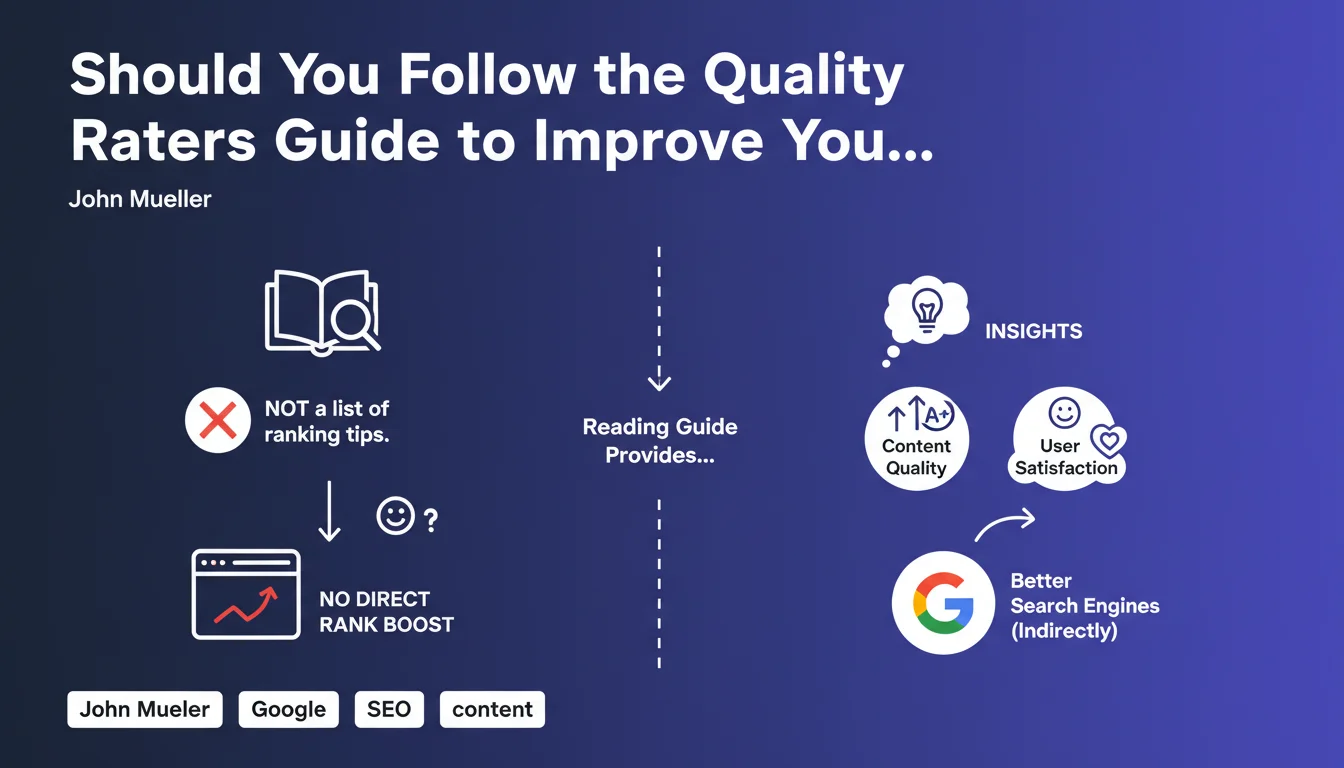
The Quality Raters guide is not an SEO optimization manual. It's a training document intended for human evaluators who analyze the quality of search results.
These evaluators don't directly modify Google rankings, but their feedback helps improve the algorithms. The guide therefore reflects Google's vision of what constitutes quality content.
Why does this guide matter for SEO professionals?
Even though it doesn't contain direct technical advice, this document reveals the quality criteria that Google seeks to promote. It offers deep insight into the E-A-T concept (Expertise, Authoritativeness, Trustworthiness).
Reading this guide helps you understand how Google evaluates content quality and user experience. It's a valuable resource for aligning your strategy with the algorithm's expectations.
What are the limitations of this document for SEO optimization?
The guide provides no technical advice on meta tags, HTML structure, or technical aspects of SEO. It focuses exclusively on qualitative page evaluation.
You won't find information about title length, URL optimization, or loading times. Its usefulness remains conceptual rather than tactical.
- Training document for evaluators, not a direct SEO guide
- Reveals quality criteria valued by Google
- Explains the E-A-T concept and its applications in detail
- Contains no specific technical recommendations
- Useful for understanding Google's philosophy, not for tactical optimizations
SEO Expert opinion
Is this statement consistent with what we observe in practice?
Absolutely. SEO practitioners who have studied the guide confirm that it contains no magic formula for rankings. Its content is indeed quite theoretical and descriptive.
However, sites that apply the quality principles described in this guide generally achieve better organic results. The correlation exists, even if the guide doesn't provide direct instructions.
The common mistake is looking for technical recipes where Google presents a philosophical vision of quality. The two approaches are complementary, not interchangeable.
What important nuance should be added to this statement?
Saying the guide doesn't help with rankings is technically true, but reductive. Understanding how Google defines quality directly influences your content strategy.
The concepts of E-A-T, reputation, and user satisfaction detailed within have become pillars of algorithmic updates. Ignoring this document would be a strategic mistake.
In which cases does this guide provide real added value?
The guide is particularly useful for YMYL sites (Your Money Your Life): health, finance, legal. These sensitive topics are scrutinized with reinforced E-A-T criteria.
It also helps audit the editorial quality of a site by applying a Google evaluator's perspective. It's an excellent tool for training your content teams on quality standards.
For e-commerce sites or general blogs, its usefulness remains more limited. Basic principles suffice without requiring in-depth study of the complete document.
Practical impact and recommendations
How can you concretely use the Quality Raters guide in your SEO strategy?
Use the guide as a quality benchmark to audit your existing content. Ask yourself the same questions as an evaluator: does the content demonstrate genuine expertise?
Train your editorial teams on E-A-T concepts by having them read relevant sections. This elevates production quality without requiring technical SEO expertise.
Focus on sections describing high and low quality content. These concrete examples help you identify weaknesses on your own site.
What mistakes should you avoid when interpreting this document?
Don't look for a checklist of technical criteria. The guide doesn't function as an optimization specification with precise thresholds.
Avoid artificially over-optimizing for E-A-T criteria. Google detects attempts to manipulate authority signals like fake expert biographies or excessive mentions of qualifications.
Don't neglect technical SEO aspects in favor of exclusively reading the guide. Content quality and technical performance are two inseparable pillars.
What approach should you adopt to effectively integrate these teachings?
Create a qualitative evaluation grid inspired by the guide to regularly audit your content. Include criteria like demonstration of expertise, transparency of sources, and user satisfaction.
Invest in expert content creation rather than volume. One in-depth, authoritative article is worth more than ten superficial pieces of content, even when technically well-optimized.
- Read at minimum the sections on E-A-T and examples of high/low quality content
- Audit your YMYL pages using the guide's criteria as a reference
- Train your writers on the quality standards described in the document
- Create an internal evaluation grid inspired by Quality Raters criteria
- Strengthen authentic expertise signals: detailed biographies, proof of qualifications, transparency
- Balance the qualitative approach (guide) with technical approach (classic SEO optimizations)
- Don't neglect technical SEO under the pretext of focusing solely on quality
💬 Comments (0)
Be the first to comment.