
Official statement
What you need to understand
What's the Real Difference Between Information Quality and Web Value?
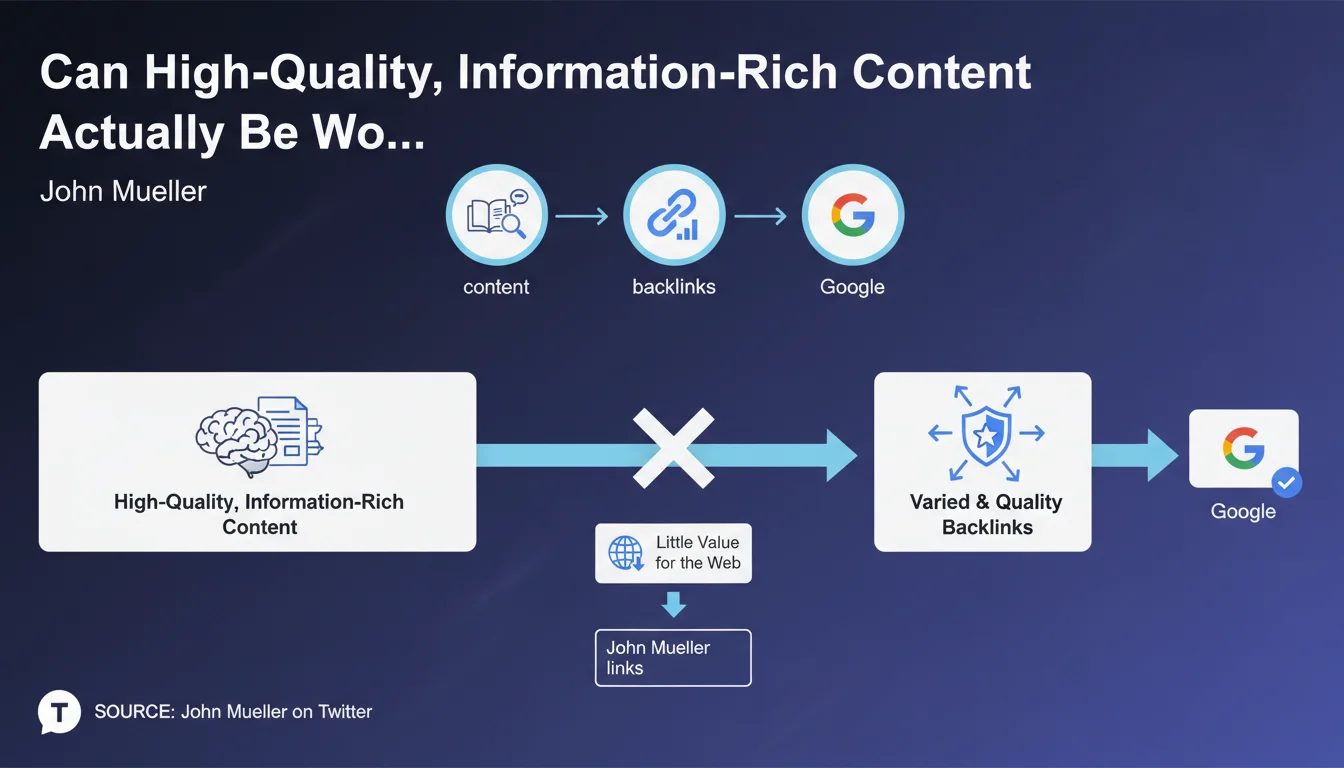
John Mueller establishes a fundamental distinction: content can be technically complete and informative without actually bringing real value to the web. This statement challenges the quantitative approach to content that consists of producing exhaustive articles packed with information.
Value for the web depends on uniqueness, the perspective provided, and the ability to meet an unmet need. Yet another comprehensive guide on a topic already covered a thousand times brings no value, even if it contains 5000 words of accurate information.
Why Is Google Making This Distinction Now?
This statement aligns with the logic of the Helpful Content Update and the evolution toward E-E-A-T. Google seeks to value content that brings a unique contribution to the informational ecosystem, not simply a well-formatted rehash.
The algorithm is evolving to detect generic content, even well-written, and favor those that demonstrate real experience, an original angle, or distinctive expertise.
How Does Google Actually Evaluate This "Web Value"?
Behavioral signals play a key role: time spent, bounce rate, natural shares, citations by other sites. Content that brings real value naturally generates engagement and spontaneous backlinks.
Google also analyzes differentiation from existing content: do you provide exclusive data, an original methodology, personal experience feedback? It's this singularity that creates value.
- Information ≠ Value: the quantity of information doesn't guarantee usefulness
- Web value relies on uniqueness and distinctive contribution
- Natural backlinks remain a strong indicator of real value
- Google favors content that fills an informational gap
- User experience and engagement are signals of value
SEO Expert opinion
Does This Statement Align with Practices Observed in the Field?
Absolutely. Since 2022, we've observed that generic encyclopedic content is massively losing ground to shorter but more differentiating content. Sites that merely compile public information without added value see their traffic stagnate or decline.
Niche sites with proven expertise now outperform content aggregators. A 1500-word article with a unique perspective and quality backlinks will systematically beat a 5000-word guide redundant with the top 10.
What Important Nuances Should We Add to This Statement?
The notion of "value for the web" is contextual and thematic. In certain highly specialized technical niches, exhaustive content can indeed bring value if it consolidates scattered or hard-to-access information.
The search intent context is crucial. For a complex informational query, long and structured content may be relevant. For a transactional or navigational query, concise and actionable content will be more valued.
When Does Information Quantity Still Remain an Asset?
For high-stakes commercial queries (finance, health, legal), Google still favors in-depth content that demonstrates expertise and authority. Length then becomes a signal of seriousness and competence.
Hub-type pillar content also benefits from an exhaustive approach, provided it serves as a unique reference that's regularly updated. Comprehensiveness then becomes added value if accompanied by maintenance and updates.
Practical impact and recommendations
What Should You Actually Do to Create Content with Web Value?
Abandon the logic of "content for content's sake". Before each creation, ask yourself: what am I bringing that the top 10 Google results don't already provide? If the answer is "nothing", don't publish or change your angle.
Favor content based on real experience: case studies, proprietary data, field experience feedback, tested methodologies. These elements are inherently unique and create distinctive value.
Invest in differentiating formats: original infographics, explanatory videos, interactive tools, calculators. Value isn't limited to text.
What Critical Mistakes Should You Absolutely Avoid?
Don't fall into the trap of "Frankenstein" content that aggregates information from 10 different sources without its own perspective. Google increasingly detects these soulless compilations, especially with the rise of AI content.
Avoid targeting already saturated keywords with generic content. Better to position yourself on specific angles with less volume but a real differentiation opportunity.
How Do You Audit and Optimize Your Existing Content According to This Principle?
Analyze your content with this grid: Does it bring something unique? Has it generated natural backlinks? What is its actual engagement rate? If the answers are negative, consider a complete overhaul with a differentiating angle or consolidation.
Prioritize content that has natural linkability potential: original studies, exclusive methodological guides, specialized expertise content. These are what create lasting value.
- Identify unique angles before any content production
- Favor experience and proprietary data as sources of differentiation
- Audit existing content according to "web value" vs "simple information" criteria
- Consolidate or delete redundant content without added value
- Invest in rich and interactive formats to stand out
- Measure actual engagement and natural backlinks as value indicators
- Avoid mass production in favor of differentiating quality
- Integrate a unique perspective or expertise into each piece of content
Mueller's statement marks a strategic turning point: the race for exhaustive content is over. The challenge is no longer to produce the most comprehensive guide, but to create distinctive value that users can't find anywhere else.
This approach requires a profound overhaul of editorial strategies: detailed competitive analysis, identification of unique angles, exploitation of real expertise, creation of innovative formats. The complexity of this transformation and the expertise required to identify these differentiation opportunities can justify support from a specialized SEO agency, capable of auditing your existing content and defining a truly distinctive editorial strategy adapted to your market.
💬 Comments (0)
Be the first to comment.