
Official statement
Other statements from this video 5 ▾
- □ Does Google Really Use Identical Algorithms Everywhere in the World?
- □ Why does Google test algorithm updates in specific countries or languages before rolling them out worldwide?
- □ Does Google really deploy algorithm updates in English first, or does it depend on the specific language?
- □ Does Google really announce all of its progressive rollouts by geographic region?
- □ Does Google really deploy updates simultaneously across every country and language?
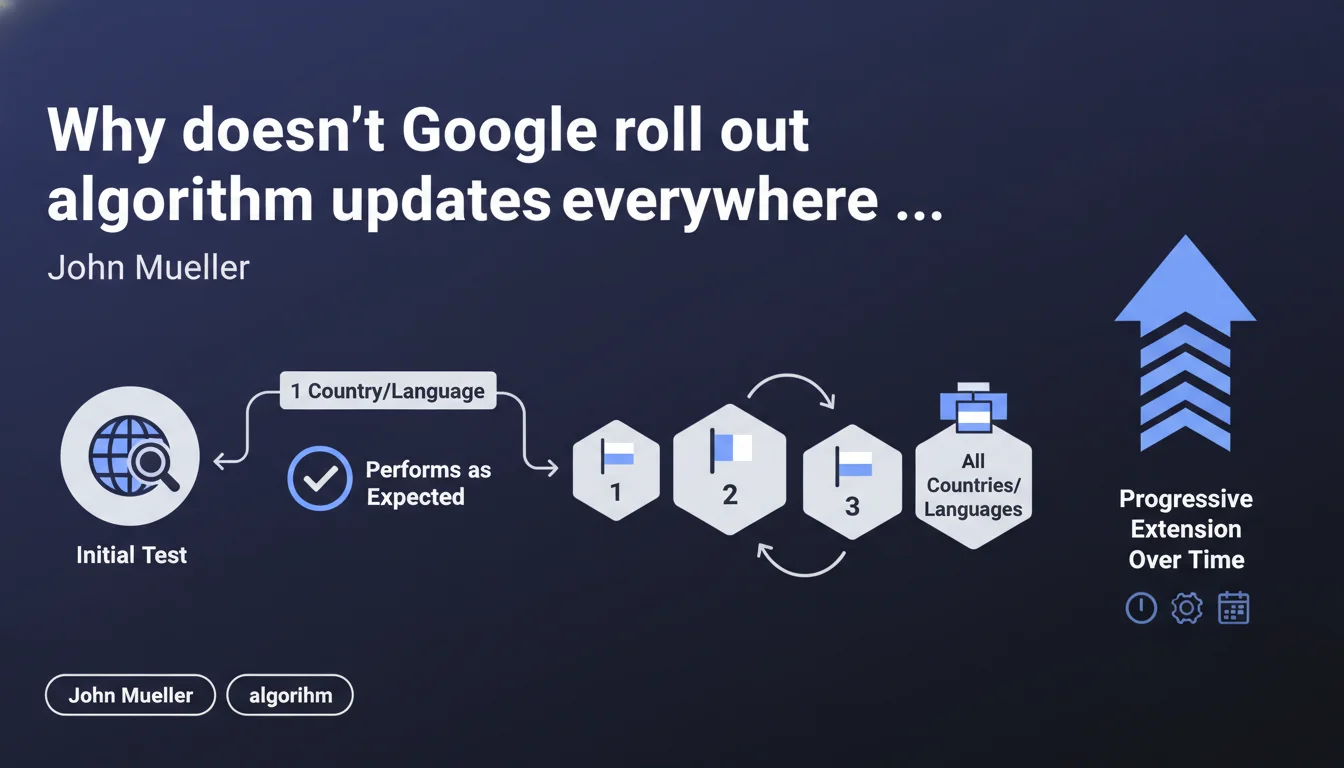
Google first tests its algorithms in a pilot country or language, then gradually expands them to other regions once validated. This rollout is not simultaneous: some markets receive updates before others, creating performance gaps between geographical zones.
What you need to understand
Why does Google adopt this gradual approach?
Sequential rollout limits risk. Testing an algorithm on a restricted market allows teams to identify bugs and unintended side effects before broad deployment. If an update degrades result quality in a given language, the impact remains contained.
This method also reflects linguistic and cultural complexity. An algorithm that works in US English won't necessarily produce relevant results in Japanese or Arabic without specific adjustments.
What does this mean for a multilingual website?
If your site targets multiple countries, expect staggered ranking variations across time. A French version may be affected by a Core Update while the German version remains stable for several weeks.
This phenomenon explains why some professionals observe asynchronous fluctuations between their language versions. It's not a bug — it's Google's deployment schedule.
Do all algorithms follow this pattern?
Most do. Core Updates, spam adjustments, and semantic understanding improvements typically go through a regional testing phase.
Algorithms related to technical infrastructure (crawl, indexing) tend to roll out more uniformly, but even then, differences persist depending on the datacenters used.
- Progressive extension: algorithms are not activated everywhere simultaneously
- Pilot market: often an English-speaking country (US, UK) or a major language
- Time gaps: several weeks may separate two geographical zones
- Specific adjustments: certain parameters are calibrated by language/culture
SEO Expert opinion
Is this statement consistent with real-world observations?
Absolutely. Professionals managing multi-country sites regularly observe ranking shifts between language versions during Core Updates. A .fr site might lose 20% of visibility while its .de counterpart stays stable, then recover two weeks later.
What Mueller doesn't specify is which country serves as the initial test. Officially, Google never communicates this, but empirical data suggests priority given to English-speaking markets, particularly the United States. [To verify]: impossible to formally confirm whether all algorithms follow the same geographical pattern.
What gaps remain in this explanation?
Mueller discusses "progressive" extension but provides no timeframe estimates. Are we talking days, weeks, or months? This imprecision complicates strategic planning.
Another point: the concept of "validation" remains unclear. Does Google validate only technical stability, or also qualitative result relevance? If an algorithm degrades quality in English but the system remains stable, is it still deployed elsewhere?
When does this rollout fail?
Sometimes Google interrupts or slows a rollout if feedback is negative. This happened with certain product updates where result quality degraded in specific languages.
It also happens that niche or low-search-volume markets are excluded from an algorithm entirely, due to insufficient training data. Minor regional languages may remain on older versions for months.
Practical impact and recommendations
How can you anticipate these geographical shifts?
If you manage a multi-country site, monitor fluctuations by language version separately. Don't rely solely on a global overview: segment your analytics and rank tracking by country/language in your tools.
Prepare to explain to clients or stakeholders why the Spanish version drops while the English version climbs. It's not necessarily a content or local technical issue — it might just be the timing of algorithmic deployment.
Should you adapt your SEO strategy based on your geographical zone?
Yes, especially for competitor analysis. If you're in France and observe that a UK competitor experienced an update three weeks ago, you can anticipate the effects on your own market.
Conversely, don't panic immediately if a language version underperforms. Wait a few days to see if other markets follow the same pattern — this may indicate an algorithmic rollout rather than a problem specific to your site.
What mistakes should you avoid during a multi-country rollout?
Don't synchronize major SEO changes with known algorithmic deployment periods. If you launch a technical overhaul while a Core Update rolls out progressively, you'll never be able to isolate the causes of traffic variations.
Also avoid replicating the exact same content strategy across languages without cultural adaptation. Google's algorithms increasingly integrate local contextual signals — what works in English may fall flat in German.
- Segment SEO monitoring by country and language
- Document the dates when fluctuations are observed by market
- Create specific alerts for each language version
- Compare ranking patterns between markets to identify algorithmic rollouts
- Adapt content to cultural and linguistic specificities
- Don't launch major technical changes during algorithmic rollout periods
- Train local teams on SEO specifics for their market
❓ Frequently Asked Questions
Combien de temps entre le test initial et le déploiement global d'un algorithme ?
Peut-on savoir quel pays sert de marché test pour un algorithme donné ?
Un algorithme validé dans un pays peut-il être annulé dans un autre ?
Les sites monolingues subissent-ils aussi ces décalages ?
Comment distinguer un déploiement algorithmique d'un problème technique sur mon site ?
🎥 From the same video 5
Other SEO insights extracted from this same Google Search Central video · published on 14/06/2022
🎥 Watch the full video on YouTube →
💬 Comments (0)
Be the first to comment.