
Official statement
Other statements from this video 5 ▾
- □ Les algorithmes Google sont-ils vraiment identiques partout dans le monde ?
- □ Google déploie-t-il ses algorithmes d'abord en anglais ou dans quelle langue ?
- □ Google annonce-t-il vraiment tous ses déploiements progressifs par zone géographique ?
- □ Comment Google déploie-t-il ses algorithmes d'un pays à l'autre ?
- □ Les mises à jour Google se déploient-elles vraiment partout en même temps ?
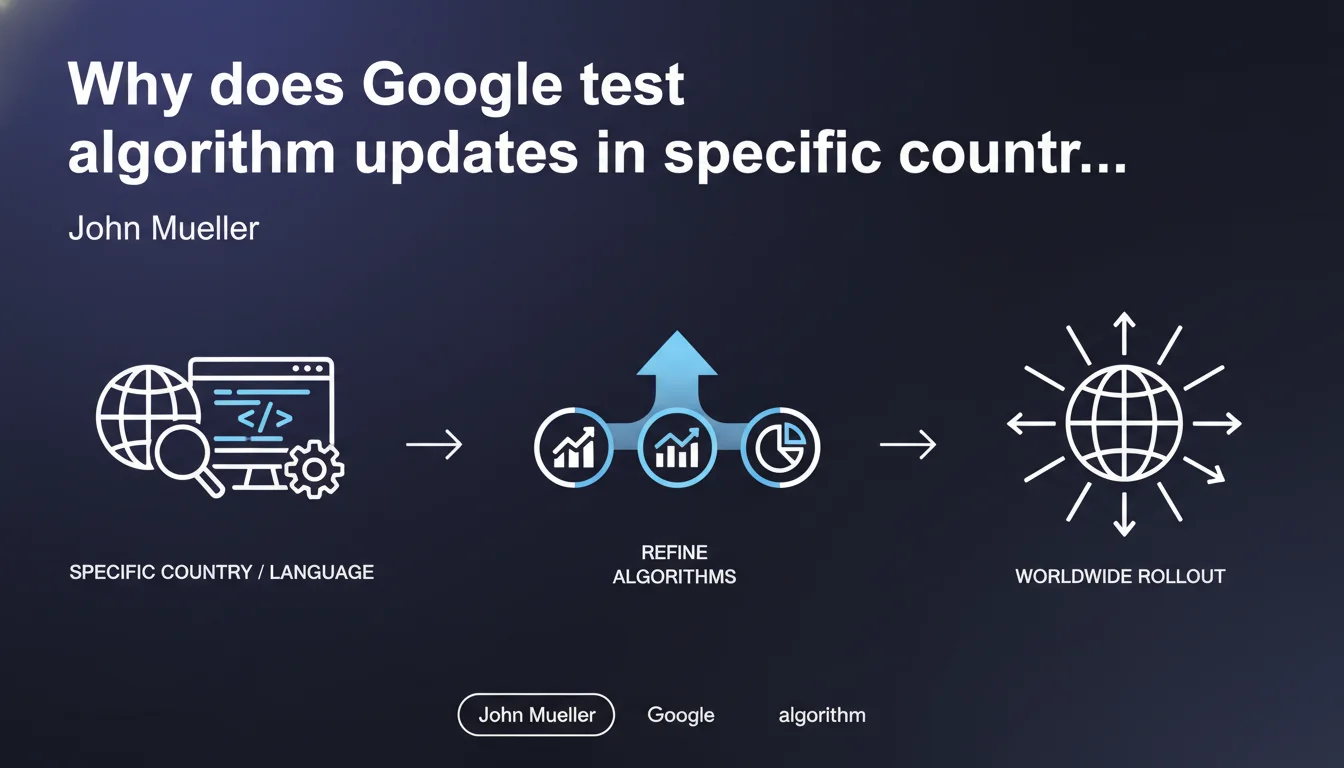
Google sometimes selects a specific country or language to deploy an algorithmic update before a global rollout. This approach allows engineers to refine algorithms on a controlled sample before generalizing the change. Sites in these test zones may experience ranking fluctuations before other markets.
What you need to understand
Why doesn't Google roll out all its updates simultaneously everywhere?
The answer is pragmatic: minimize the risk of massive unintended consequences. Deploying an algorithmic change across the entire global index represents a considerable technical and business risk.
By testing first on a specific geographic or linguistic market, Google can observe how the algorithm behaves under controlled real-world conditions. If something goes wrong — false positives, over-optimization, unforeseen impacts on certain sectors — the team can adjust before exposing billions of queries.
How does Google choose the pilot country or language?
Mueller provides no specific criteria. We can assume Google favors markets that are representative but not critical: diverse enough to test the algorithm properly, but not so strategically important (the United States, for example) that a mistake would cost too much.
Some observers have noted test rollouts in Australia, English-speaking Canada, or less competitive languages. Nothing official, but consistent with a cautious approach.
What does this mean for a multilingual or multi-country site?
If your site operates across multiple markets, you could experience asynchronous ranking fluctuations. A French version stays stable while an English US version experiences volatility, then the reverse a few weeks later.
This is disruptive from an analytical perspective: it's difficult to isolate the effect of a local optimization if Google is precisely testing a new algorithm on that specific market.
- Google deploys certain updates in geographic or linguistic phases
- Objective: refine the algorithm before worldwide generalization
- Sites in test zones experience fluctuations before others
- No public criteria for choosing pilot markets
- For multi-country sites, this complicates the analysis of algorithmic impacts
SEO Expert opinion
Is this statement consistent with real-world observations?
Yes, largely. SEO professionals have regularly observed time lags in update rollouts. Some markets see their rankings shift 2-3 weeks before others.
What's murkier is the complete lack of transparency on selection criteria. Google never warns that a market will be a test subject. We discover it after the fact by comparing volatility trackers by country. [To verify]: no official tool signals that a rollout is in local test phase.
What are the limitations of this approach for SEO practitioners?
The major problem: analytical uncertainty. If your site loses 20% of organic traffic on a specific market, is it due to an update in test phase, a targeted penalty, or a local technical issue?
Impossible to determine without official confirmation from Google — which will probably never come. This opacity makes post-update diagnostics complex, especially for international sites that must prioritize their corrective actions.
In what cases does this logic not apply?
Mueller mentions "certain" updates, not all. Major Core Updates appear to be rolled out more synchronously worldwide, even though the impact varies by niche and language.
Conversely, minor tweaks — natural language understanding improvements, local relevance refinements, E-E-A-T signal modifications — could very well be silently tested on one market before generalization. Let's be honest: Google doesn't communicate about 95% of its daily algorithmic adjustments.
Practical impact and recommendations
What should you do concretely if your market is in test phase?
First, don't panic. A temporary drop during testing can correct itself when the final adjusted rollout happens. Document everything: ranking screenshots, Analytics exports by country, volatility tracker captures.
Next, compare with other markets where you operate. If France drops but Germany and Spain stay stable, you have a strong indicator that it's a localized rollout, not a structural problem with your site.
How to adapt your multi-country SEO strategy?
Stop treating all your markets as a homogeneous block. Segment your analyses by language and country in your dashboards. A unified monitoring tool masks these temporal lags.
Build a calendar of observed fluctuations by market. If Australia consistently moves 2-3 weeks before the US, you have an early warning signal for your American optimizations.
What mistakes should you avoid in this context?
Don't over-optimize in response to a fluctuation isolated to a single market. Wait to see if it's widespread or temporary. Changing your content strategy based on a temporary algorithmic test can hurt you when the final rollout happens.
Also avoid blindly duplicating what works on a stable market to a market in test phase. Ranking signals can be temporarily skewed during adjustment.
- Document every fluctuation precisely by market and language
- Systematically compare your different markets to isolate localized effects
- Don't radically change your strategy based on isolated volatility
- Build a history of rollout patterns to anticipate future tests
- Segment your Analytics and Search Console dashboards by country/language
- Wait 3-4 weeks before concluding that a drop is permanent
❓ Frequently Asked Questions
Google annonce-t-il publiquement quand un marché est en phase test pour une mise à jour ?
Combien de temps dure généralement une phase test avant déploiement mondial ?
Un site peut-il être pénalisé sur un marché test puis épargné lors du déploiement global ?
Dois-je optimiser différemment mes versions linguistiques si certaines sont en phase test ?
Les mises à jour Core Web Vitals sont-elles aussi déployées progressivement par pays ?
🎥 From the same video 5
Other SEO insights extracted from this same Google Search Central video · published on 14/06/2022
🎥 Watch the full video on YouTube →
💬 Comments (0)
Be the first to comment.