
Official statement
Other statements from this video 5 ▾
- □ Does Google Really Use Identical Algorithms Everywhere in the World?
- □ Why does Google test algorithm updates in specific countries or languages before rolling them out worldwide?
- □ Does Google really deploy algorithm updates in English first, or does it depend on the specific language?
- □ Does Google really announce all of its progressive rollouts by geographic region?
- □ Why doesn't Google roll out algorithm updates everywhere at the same time?
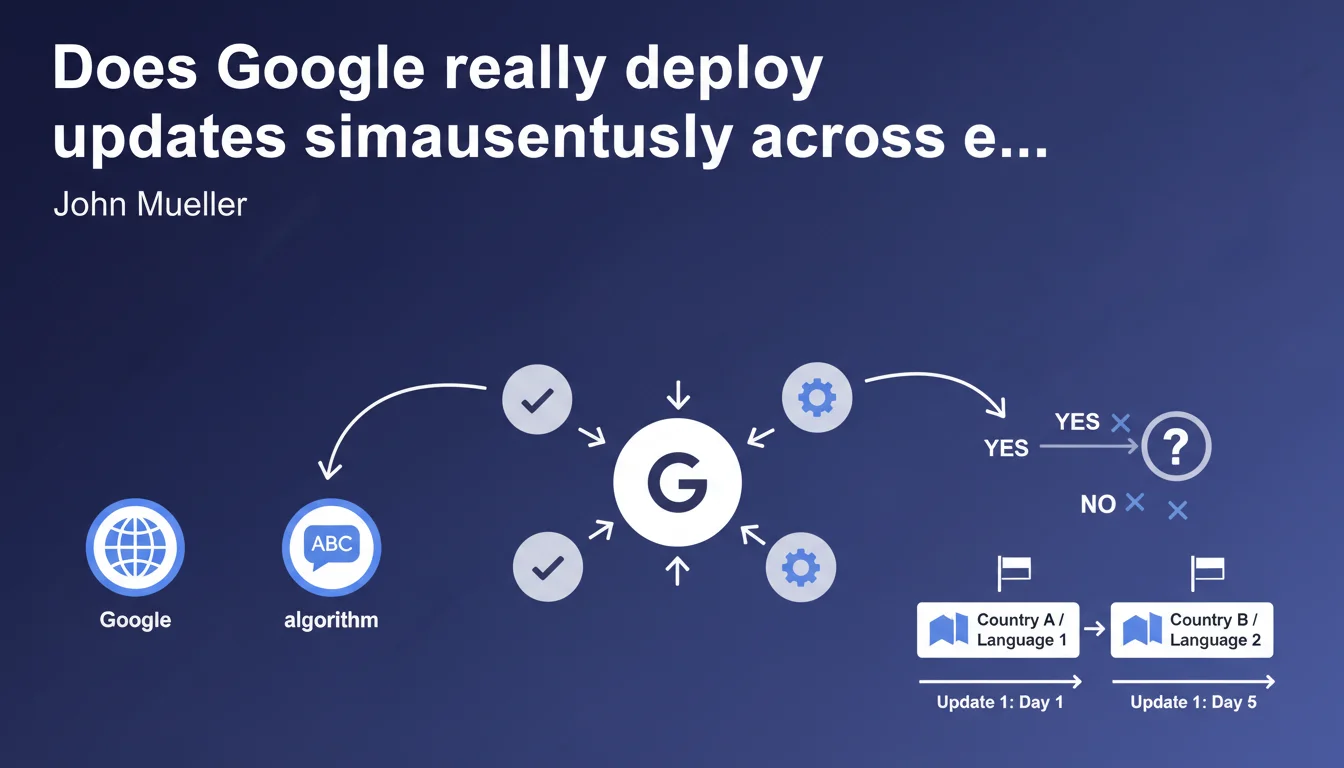
Google acknowledges that its major updates do not roll out simultaneously across all countries and languages. While global uniformity remains the goal, real-world evidence shows significant geographic and linguistic variations. For multilingual or international sites, relying on a single rollout date is impossible.
What you need to understand
Why can't Google deploy updates everywhere at the same time?
Google's infrastructure is distributed globally, with data centers spread across multiple continents. Deploying a major algorithmic change requires updating millions of servers progressively.
Beyond the purely technical dimension, certain regions require specific adjustments. Quality signals vary across markets: what works for evaluating content relevance in American English doesn't necessarily apply the same way to Japanese or Arabic.
Does this variability affect all updates or only certain ones?
Mueller explicitly discusses major algorithmic changes — typically Core Updates, helpful content updates, or rewrites of specific algorithms like Penguin in its day.
The daily micro-adjustments Google applies continuously probably follow different logic. But for updates that make headlines and massively impact SERPs, staggered rollout is the norm, not the exception.
What are the concrete consequences for an international site?
A site present across multiple markets can see its rankings fluctuate asynchronously. Your .fr version might be impacted 48 hours before your .de version, or vice versa.
This reality seriously complicates post-update monitoring. You can't conclude « the update is done » based on a single market. Professionals managing multi-country operations must monitor each language version independently.
- Deployment of major updates varies by country and language
- Google aims for global uniformity but doesn't always achieve it simultaneously
- Multilingual sites experience time-staggered impacts
- No guarantee of perfect synchronization between markets
- Post-update monitoring requires geolocalized tracking
SEO Expert opinion
Does this statement match real-world observations?
Absolutely. SEO practitioners managing international portfolios see it at every Core Update: impacts arrive in scattered order. A site might lose 30% of organic traffic in France on a Tuesday, then see its Spanish version drop the following Thursday.
What Mueller doesn't say — and this is where it gets interesting — is whether this variability is intentional or inevitable. Is it purely a technical constraint, or does Google deliberately test on certain markets before global rollout? [Needs verification]
What nuances does this claim obscure?
Mueller remains intentionally vague about the criteria determining deployment order. Are certain markets prioritized? Do languages with the highest search volume go first? No concrete data on that.
Another gray area: the notion of « deployment complete ». When Google announces an update is finished, does it really mean all markets and languages are up to date? Experience suggests not, but Google never provides geographic granularity in official communications.
In what cases does this rule not apply?
Manual penalties obviously don't follow this pattern. They're applied individually, site by site, independent of geographic logic.
Minor daily adjustments Google makes continuously likely follow different deployment logic. Some may be near-instant and global, others not. But Google never communicates about these micro-updates, so impossible to draw clear rules from them.
Practical impact and recommendations
How to adapt your monitoring for asynchronous rollouts?
First rule: absolutely segment your dashboards by country and language. A global KPI like « total organic traffic » becomes useless when half your markets are impacted and the other half isn't yet.
Set up geolocalized alerts in Google Analytics 4 or your rank tracking tool. You need to detect movements market by market, not through a global average that smooths everything out.
Extend your post-update observation window. If Google announces a rollout lasts 2 weeks, give yourself at least 3 weeks before drawing final conclusions — especially if you operate on secondary markets that often go last.
What mistakes should you avoid during a major update?
Don't panic if your U.S. .com site plummets while your .fr stays stable. This isn't necessarily a sign you did something specifically wrong on the U.S. market — it might just mean the update hasn't hit France yet.
Conversely, don't rest easy if a market stays unaffected in the first few days. The impact could arrive several days later. Wait until the official end of the rollout before validating that a market escaped impact.
- Separate analytics by country/language in your dashboards
- Configure geolocalized ranking alerts
- Extend observation period post-update (3+ weeks)
- Compare markets against each other to identify patterns
- Never aggregate multi-country data during a rollout
- Document actual impact dates by market for each update
❓ Frequently Asked Questions
Combien de temps peut durer le décalage entre deux marchés lors d'une Core Update ?
Les marchés anglophones sont-ils toujours impactés en premier ?
Peut-on exploiter ce décalage pour anticiper l'impact sur d'autres marchés ?
Google annonce-t-il publiquement quand un marché spécifique est impacté ?
Un site monolingue échappe-t-il à cette complexité ?
🎥 From the same video 5
Other SEO insights extracted from this same Google Search Central video · published on 14/06/2022
🎥 Watch the full video on YouTube →
💬 Comments (0)
Be the first to comment.