
Official statement
Other statements from this video 5 ▾
- □ Les algorithmes Google sont-ils vraiment identiques partout dans le monde ?
- □ Pourquoi Google déploie-t-il certaines mises à jour algorithme par pays ou langue d'abord ?
- □ Google annonce-t-il vraiment tous ses déploiements progressifs par zone géographique ?
- □ Comment Google déploie-t-il ses algorithmes d'un pays à l'autre ?
- □ Les mises à jour Google se déploient-elles vraiment partout en même temps ?
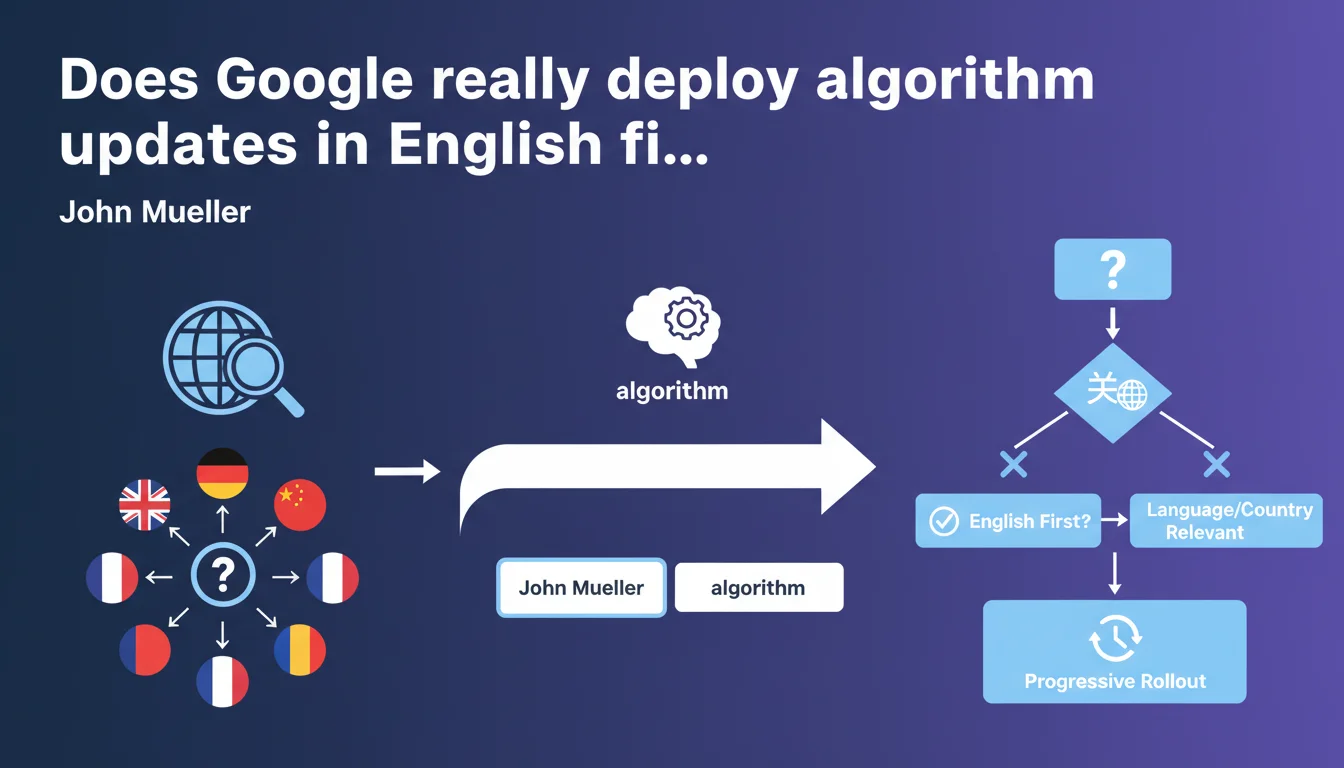
Google does not systematically prioritize algorithm updates in English. The choice of initial language or country during a progressive rollout depends on the specific nature of the algorithm and its relevance to a given market. A change affecting local semantic understanding will be tested in the most relevant language to validate its effectiveness.
What you need to understand
Why does this statement challenge a common misconception?
For years, the international SEO community has assumed that Google tests its algorithms first on the English-speaking market, particularly in the United States. This assumption seemed logical: it's the largest market, technical documentation is in English, and historically the first signs of fluctuations often appeared in English-language forums.
Except Mueller says the opposite here. The choice of the initial market is not a constant, but a variable dependent on the algorithm in question. If an update aims to improve understanding of Japanese search queries or the interpretation of complex multilingual content, why would Google test it in English first?
What determines the initial language or country for rollout?
Algorithmic relevance. If a change concerns local semantic understanding, the quality of results for geolocated queries, or the processing of languages with complex grammatical structures, Google will prioritize the most representative market.
Concretely: an update focused on detecting spam in Cyrillic will make more sense if tested in Russian. An algorithm refining understanding of French voice search queries will likely be deployed first in France or French-speaking Canada.
What does this approach change for SEO professionals outside English-speaking markets?
It means you can no longer rely solely on tracking tools based on US fluctuations. A European or Asian market can experience a major rollout before the United States, without English-language forums noticing immediately.
The synchronization of rollouts is not guaranteed. A multilingual site can see its French traffic impacted several days before its English traffic, or vice versa.
- Google adapts its tests to the linguistic and geographic context of each algorithm
- Non-English-speaking markets may be affected first depending on the nature of the update
- The time gap between markets complicates analysis of global SERP fluctuations
- The "US first" hypothesis no longer holds true for all updates
SEO Expert opinion
Is this statement consistent with field observations?
Yes and no. Some recent rollouts do show varied geographic patterns during progressive deployments. Italian, German, and Japanese SEO professionals have sometimes reported major fluctuations before Anglo-Saxon tools detected anything.
But—and this is where it gets tricky—we lack structured data to validate this claim on a large scale. Monitoring tools overwhelmingly favor English-language SERPs, creating a reverse confirmation bias. If an update affects Brazil or Korea first, who documents it with the same rigor as a fluctuation on Google.com?
What nuance should be added to this statement?
Mueller talks about "relevance for the algorithm in question," but doesn't specify how Google determines this relevance. Is it based on the volume of affected queries? On the maturity of the data corpus in a given language? On technical criteria related to machine learning?
[To verify] The lack of transparency on these criteria makes this statement difficult to exploit tactically. We know it's not always English, but we can't predict which market will be affected first for a given update.
Another limitation: does this approach apply to all categories of updates? Core Updates, Spam Updates, Helpful Content—do they all have differentiated rollout strategies? Or only certain types of algorithms?
In what cases might this rule not apply?
Very technical updates—for example those affecting crawl, indexing, or JavaScript rendering—probably don't have a "relevant language." They affect infrastructure, not semantic content. In these cases, we can assume the rollout follows other logic, possibly by data center or traffic volume.
Practical impact and recommendations
How to adapt your SEO monitoring strategy to this reality?
First step: diversify your monitoring sources. If your business relies on French, German, or Spanish-speaking markets, don't rely solely on tools calibrated to Google.com. Configure local rank trackers for each language.
Second point: participate in or consult local SEO communities. English-language forums won't always be first to report fluctuations if the rollout starts elsewhere. A Spanish SEO active on Twitter can detect an update 48 hours before it reaches the United Kingdom.
What mistakes should you avoid during multi-market rollouts?
Don't synchronize your analyses. If you notice a traffic drop on your French version, don't immediately conclude there's a local technical issue. Check if other French-language sites are affected—it could be a targeted rollout.
Another trap: assuming an update observed in the US will behave identically in Europe. Algorithms adapt to linguistic and behavioral specifics. An aggressive spam penalty in English can be softer in French if detection patterns differ.
What specifically needs to be implemented?
- Configure rank tracking tools for each targeted language/country, not just English
- Follow local SEO Twitter accounts and forums in your priority markets
- Analyze SERP fluctuations by market during global traffic drops
- Document time gaps observed between linguistic versions of your site
- Never extrapolate a US analysis to all your markets without local validation
❓ Frequently Asked Questions
Google déploie-t-il toujours ses algorithmes de manière progressive ?
Comment savoir si une mise à jour touche d'abord mon marché linguistique ?
Un Core Update peut-il affecter différemment deux versions linguistiques du même site ?
Dois-je attendre qu'une mise à jour soit déployée partout avant d'analyser son impact ?
🎥 From the same video 5
Other SEO insights extracted from this same Google Search Central video · published on 14/06/2022
🎥 Watch the full video on YouTube →
💬 Comments (0)
Be the first to comment.