
Official statement
What you need to understand
What is Google's official position on URL language?
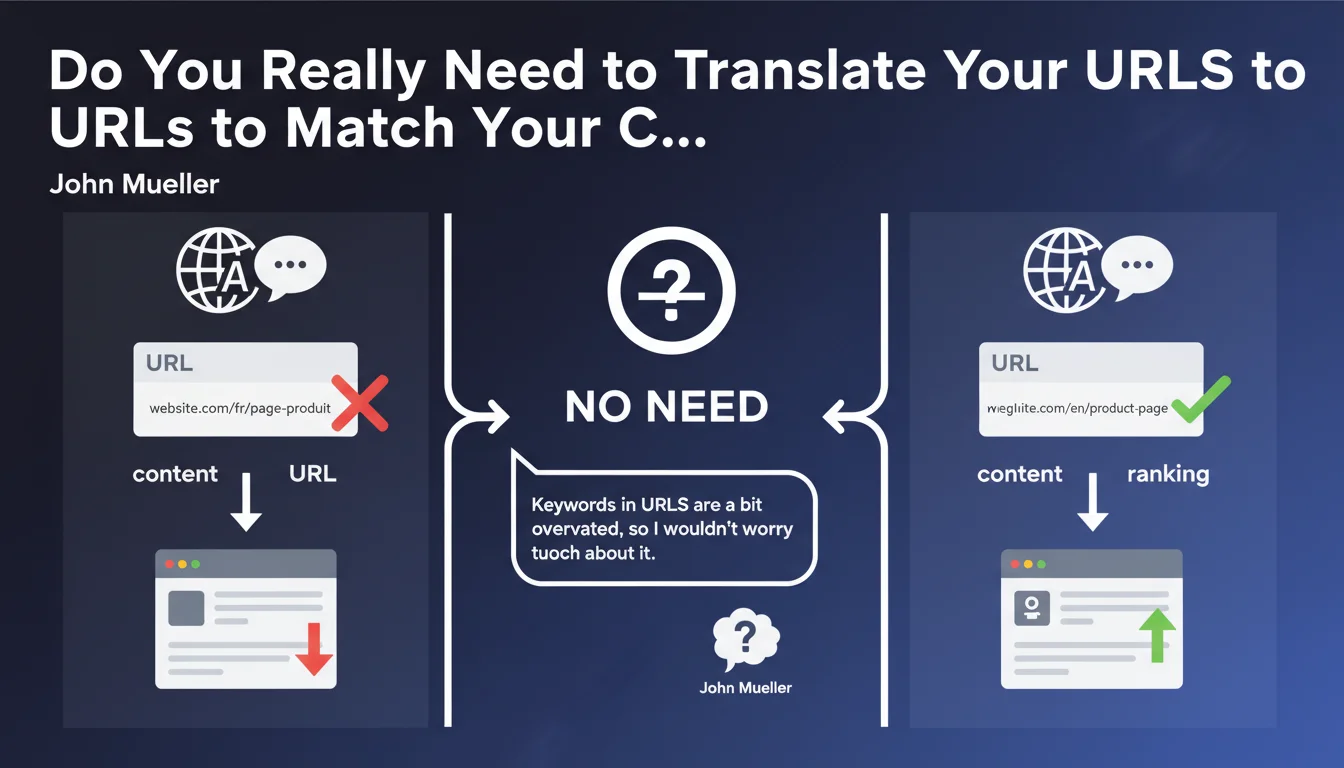
Google, through John Mueller, clearly states that there is no obligation to align the URL language with the page content language. This statement challenges a widespread belief in the SEO community that translated URLs are an important ranking factor.
Mueller explicitly states that keywords in URLs are overrated and that he wouldn't be particularly concerned about them. This assertion suggests that Google's algorithm gives relatively little weight to this element in its relevance calculations.
Why does this clarification matter for multilingual sites?
For international and multilingual sites, this statement considerably simplifies technical management. It means that a site can maintain a uniform URL structure in a single language, even if its content is available in multiple languages.
This reduces the risks of technical errors related to special characters, accents, or encoding issues that can arise with URLs in different languages, particularly for languages using non-Latin alphabets.
What are the key takeaways from this statement?
- No SEO penalty if the URL is in a different language than the content
- Keywords in the URL have limited algorithmic weight in rankings
- The site's structural consistency takes precedence over URL translation
- This flexibility facilitates technical management of multilingual sites
- Google understands page content independently of the URL used
SEO Expert opinion
Does this statement align with real-world SEO observations?
My 15 years of experience indeed confirm that the weight of keywords in URLs is marginal. I've observed numerous sites ranking excellently with generic URLs (numeric IDs, codes) as long as the content and other SEO signals were optimized.
However, this algorithmic reality shouldn't overshadow other dimensions. Translated URLs provide indirect benefits that, cumulatively, can influence the site's overall SEO performance.
What important nuances should be added to this recommendation?
While Google doesn't require translated URLs, several peripheral factors favor them. The click-through rate (CTR) in SERPs can be impacted: a French URL is more reassuring and understandable for a French-speaking user.
The most underestimated aspect concerns natural link building. When a URL is copy-pasted as link anchor text (a very common practice), a URL containing relevant keywords in the target language naturally generates optimized anchor text.
In which cases does this rule require deeper consideration?
For e-commerce sites with numerous categories and products, descriptive URLs in the local language significantly improve navigation and social sharing. The URL becomes a reassurance element for the user.
Editorial sites and blogs particularly benefit from translated URLs because they are frequently shared on social networks and forums. An explicit URL generates more trust and encourages clicks, even outside search engines.
Practical impact and recommendations
What should you actually do for your multilingual URLs?
Adopt a pragmatic and consistent approach. If you're starting a new multilingual project, favor URLs translated into the content language to maximize user experience, even though it's not algorithmically mandatory.
For an existing site with English URLs and content in other languages, definitely don't undertake a massive migration. The risk of traffic loss and required resources don't justify the operation given the limited direct SEO gain.
Instead, focus on optimizing real ranking factors: content quality, user experience, technical performance, and link profile. These elements will have a measurably greater impact.
What critical mistakes must you absolutely avoid?
Never create duplicate content by offering the same page with multiple URL versions (translated and non-translated). This would dilute your authority and create canonicalization problems.
Avoid URLs with poorly encoded special characters. If you opt for translated URLs, ensure they're properly formatted (use of hyphens, accent handling in URL-encoding).
- Maintain a consistent structure across the entire multilingual site
- Properly implement hreflang tags to indicate language versions
- Prioritize clarity and readability of URLs for the end user
- Avoid URL changes without appropriate 301 redirects
- Test URL display in SERPs for each target market
How can you validate your multilingual URL strategy?
Analyze user behavior through your analytics: bounce rate, time on page, and conversion rate by language version. These metrics will tell you whether your URL structure is negatively impacting the experience.
Monitor your backlink profile: identify how your URLs are naturally used as link anchors. If you notice many generic, poorly optimized anchors, translated URLs could improve this profile.
💬 Comments (0)
Be the first to comment.