
Official statement
What you need to understand
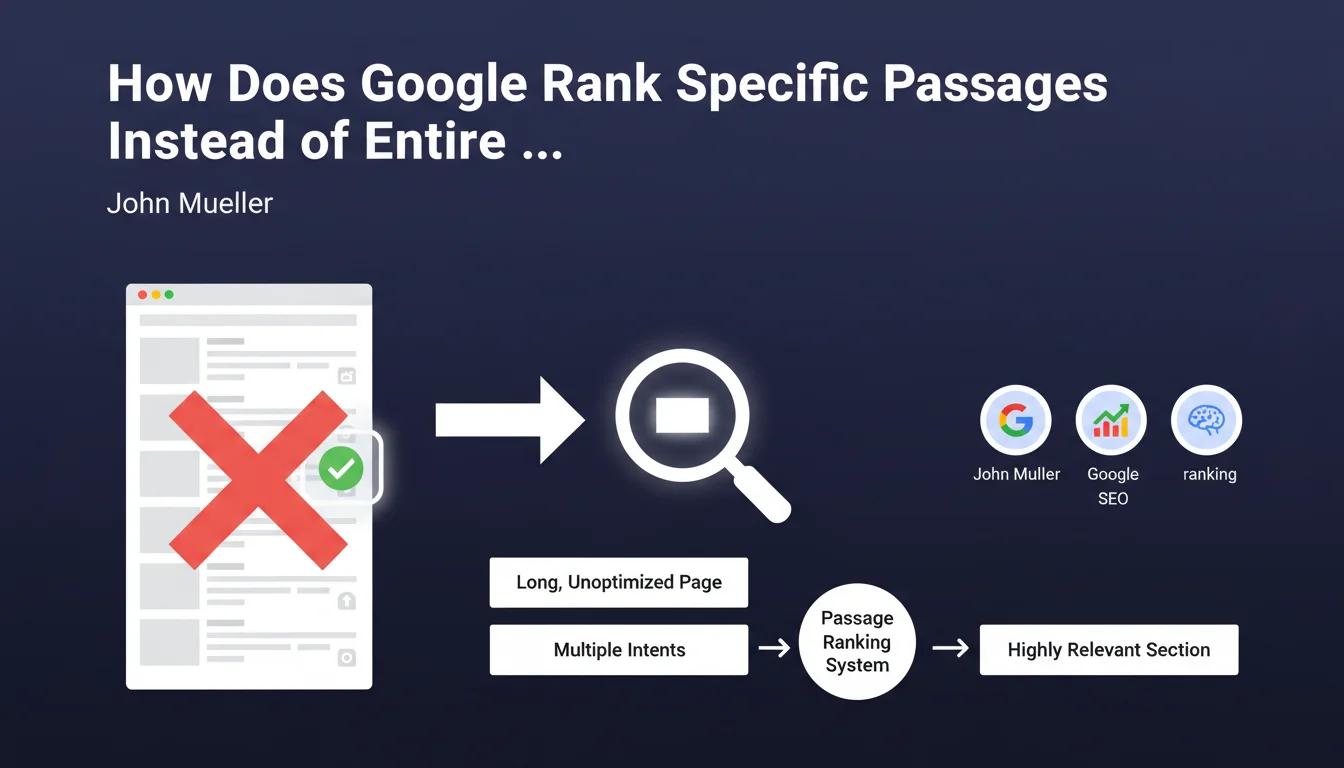
Passage Ranking represents a major evolution in how Google analyzes and ranks web content. Rather than evaluating only a page as a whole, the algorithm is now capable of identifying and extracting specific sections that are particularly relevant to a given query.
This system primarily comes into play on long, poorly optimized pages that cover multiple topics or search intents within the same content. Google can then recognize that a specific part of the page perfectly answers the user's intent, even if the rest of the content is less relevant.
Concretely, Google can decide to rank an entire page in a high position solely because of the quality and relevance of a specific passage, thus ignoring other less relevant sections of that same page.
- Google now analyzes pages at the level of individual passages, not just at the global level
- Long multi-thematic pages can benefit from this system
- A highly relevant passage can compensate for less optimized overall content
- The algorithm identifies and values sections that precisely answer the search intent
SEO Expert opinion
This statement confirms a trend observed for several years: Google is becoming increasingly contextual and granular in its content analysis. Passage Ranking fits perfectly into the logic of modern algorithms based on natural language processing and artificial intelligence.
In practice, we indeed observe that relatively long and scattered pages can rank for very specific queries, where previously only dedicated and ultra-targeted pages could have ranked. This notably explains why certain encyclopedic content or comprehensive guides perform well on niche queries.
Be careful, however, not to conclude that rigorous SEO optimization becomes useless. While Passage Ranking offers a second chance to long content, a well-structured, focused, and optimized page always remains preferable. This system primarily functions as a safety net for quality but imperfectly organized content.
Practical impact and recommendations
To take advantage of Passage Ranking while maintaining SEO best practices, here are the concrete actions to implement:
- Structure your long content with clear Hn headings: use a coherent semantic hierarchy (H2, H3, H4) to delineate each thematic section
- Create autonomous and complete sections: each passage should be able to exhaustively answer a specific search intent
- Optimize each section like a mini-article: include relevant semantic vocabulary, secondary keywords, and substantial content in each part
- Use HTML anchors and identifiers: facilitate passage indexing with clean section IDs
- Maintain global thematic consistency: even if Google can extract passages, the overall relevance of the page remains an important factor
- Always prioritize dedicated pages for your main queries: Passage Ranking does not replace a targeted and structured content strategy
- Analyze your performance by section: identify which passages generate traffic via Search Console and Featured Snippets
- Don't overuse catch-all content: deliberately creating scattered pages is not a viable long-term strategy
In summary: Passage Ranking values long and rich content provided it contains clearly structured and highly relevant sections. Meticulously structure your content, even long-form, to maximize your chances.
Implementing a content strategy optimized for Passage Ranking requires in-depth technical expertise in information architecture, semantic markup, and search intent analysis. If you want to effectively structure your long content while maintaining overall SEO consistency, support from a specialized SEO agency can help you precisely identify high-potential passage opportunities and optimize their visibility professionally.
💬 Comments (0)
Be the first to comment.