
Official statement
What you need to understand
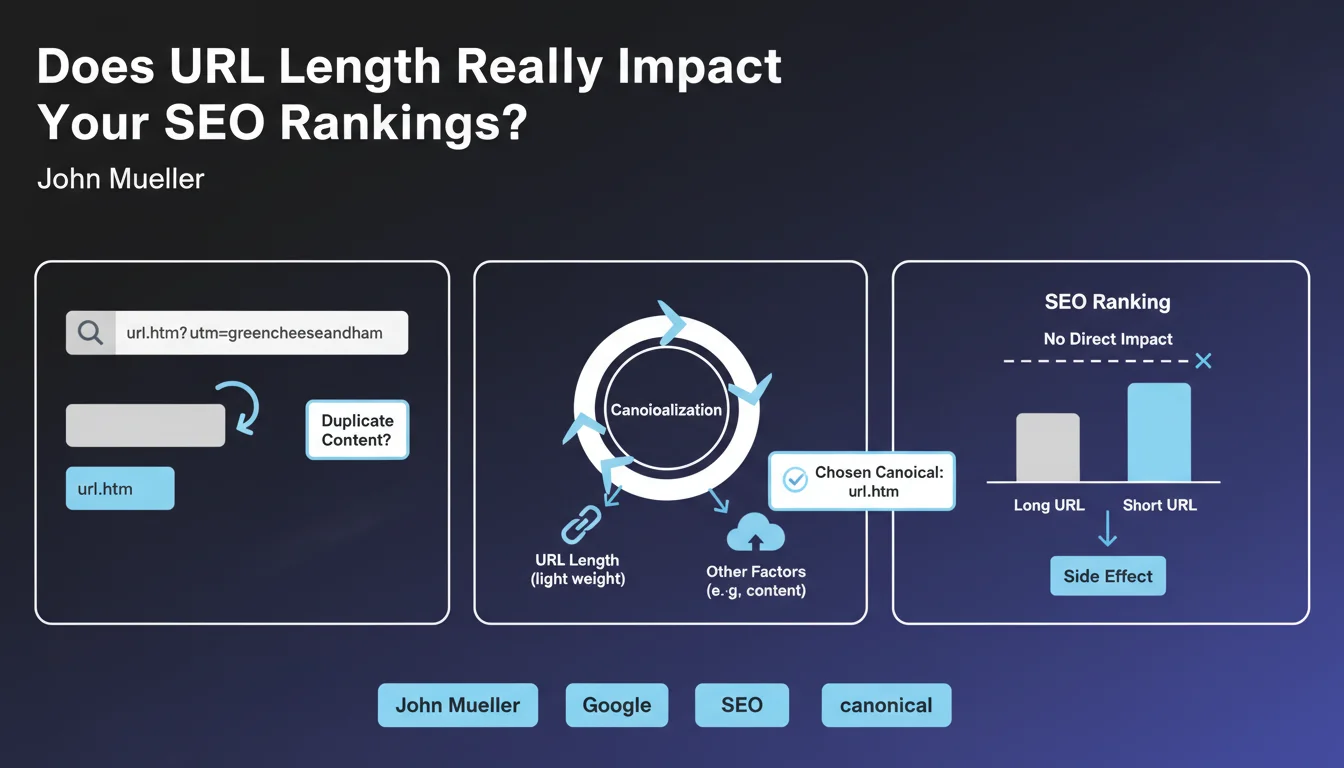
Google has confirmed that URL length is indeed used as a ranking signal, but with an important nuance: this criterion has an ultra-light weight in the algorithm.
This factor primarily comes into play during the canonicalization process, meaning when Google detects multiple versions of the same page (duplicate content) and must choose which URL to display in search results.
Specifically, between two identical URLs like example.com/article.htm and example.com/article.htm?utm=source123, Google will naturally favor the shorter version, provided all other signals are equivalent.
- URL length is not a direct ranking factor for page positioning
- It only serves during the selection of the canonical version between duplicate pages
- Its weight is qualified as "ultra-light", therefore negligible in the majority of cases
- Short URLs are not inherently better for SEO, it's a side effect of the canonicalization process
SEO Expert opinion
This statement perfectly aligns with the field observations of SEO professionals. We regularly observe that pages with long URLs rank excellently, while short URLs can have mediocre performance.
The essential nuance here concerns the application context: this signal only becomes relevant when Google is hesitating between multiple versions of the same page. In 99% of daily SEO situations, URL length will therefore have no measurable impact on your performance.
The priority remains creating descriptive, coherent, and user-friendly URLs, even if it involves a few extra characters. Readability and content comprehension take precedence over raw length.
Practical impact and recommendations
The main takeaway: never sacrifice the clarity of your URLs for reduced length. Focus on the fundamentals of good URL structure rather than character count.
- Prioritize readability: create descriptive URLs that give a clear idea of the page content
- Integrate relevant keywords into your URLs rather than shortening them artificially
- Avoid unnecessary parameters: remove tracking parameters (UTM) from canonical versions of your pages
- Use the canonical tag to explicitly indicate your preferred version rather than relying on URL length
- Streamline your structure: eliminate superfluous directories, but keep those that provide hierarchical clarity
- Don't implement redirects solely to shorten URLs that are already performing well
- Maintain consistency: apply a uniform naming logic across your entire site
- Audit your duplicate content: identify situations where multiple URLs display the same content and consolidate them
Implementing an optimal URL architecture requires a global vision of your digital ecosystem, particularly on large-scale sites where canonicalization issues can become complex.
For large-scale projects or during technical redesigns, support from a specialized SEO agency helps avoid costly mistakes and sustainably structure your site architecture according to best practices, taking into account your industry specifics and business objectives.
💬 Comments (0)
Be the first to comment.