
Official statement
What you need to understand
Why Is Google Abandoning Pagination Tags?
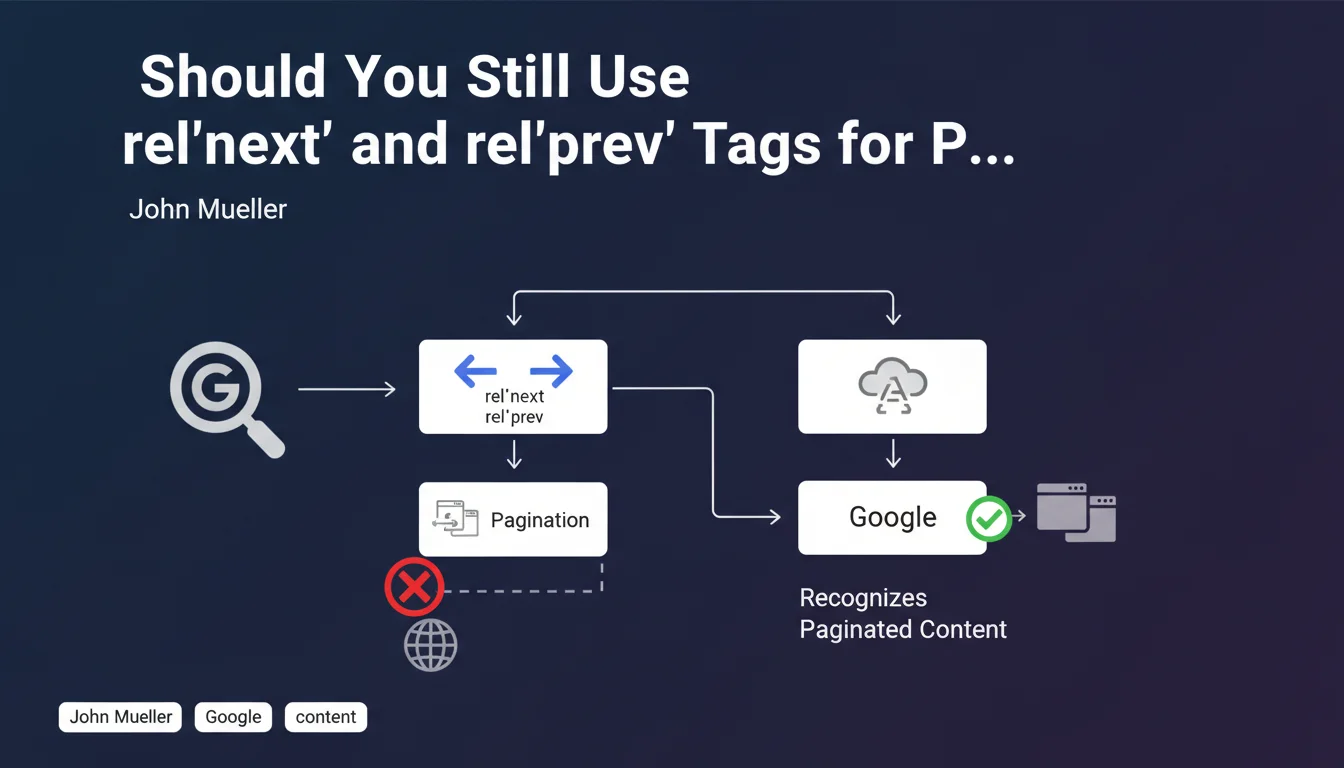
Google announced through John Mueller that the rel='next' and rel='prev' tags were no longer necessary to understand the structure of paginated content. This evolution marks a turning point in pagination management.
The search engine now relies on its own algorithms to automatically detect series of pages linked together. This contextual analysis capability makes these directives, which had been used for years, obsolete.
What Did These Tags Mean for SEO?
The rel='next' and rel='prev' tags allowed webmasters to indicate to Google that a series of pages formed a coherent whole. They helped the engine understand the relationship between pages in the same sequence.
These tags were particularly useful for avoiding duplicate content issues and consolidating SEO signals across the entire paginated series rather than on isolated pages.
What Are the Key Takeaways from This Announcement?
- Google no longer takes into account rel='next' and rel='prev' tags since this statement
- The engine now identifies pagination structures automatically without external help
- This evolution simplifies the HTML code of sites with paginated content
- Webmasters can remove these tags without negative impact on their rankings
- Google's communication on this subject has been confusing in the past, hence the importance of this clarification
SEO Expert opinion
Is This Statement Consistent with Observed Practices?
From a field perspective, this announcement confirms what many SEO experts were already observing: the absence of these tags had not negatively impacted rankings for several months. Google had visibly already stopped using them before the official announcement.
However, Google's confusing communication on this subject for two years sowed doubt within the SEO community. This hesitation likely reflects an internal technical transition at Google, where algorithms gradually evolved to make these tags unnecessary.
What Important Nuances Should Be Considered?
While Google no longer needs these tags, this doesn't mean that pagination management becomes trivial. Your URL structure, internal link consistency, and linking quality remain essential for proper crawling.
Pagination still poses SEO challenges: limited crawl budget on large series, risks of thin content on certain pages, or dilution of SEO equity. Abandoning these tags doesn't solve these structural issues.
In What Contexts Could This Approach Be Problematic?
For sites with complex pagination architectures (multiple filters, dynamic sorting, varied URL parameters), Google may struggle to automatically identify the structure. In these cases, other signals become crucial.
E-commerce sites with thousands of paginated category pages must particularly refine their internal link structure and URL patterns so that Google correctly understands the content organization.
Practical impact and recommendations
What Should You Actually Do on Your Site?
If your site still uses rel='next' and rel='prev' tags, you can remove them without concern. This removal will lighten your HTML code and marginally reduce page loading time.
Focus instead on the fundamentals: a clear URL structure, coherent internal linking between paginated pages, and intuitive navigation. These elements help both users and Googlebot.
For new projects, stop wasting time implementing these tags. Instead, invest your resources in content optimization and user experience on your paginated pages.
What Critical Mistakes Should You Avoid with Pagination?
The biggest mistake would be believing that abandoning these tags means Google perfectly handles all pagination. Some configurations remain problematic: URLs with too many parameters, overly similar content between pages, or complete absence of links to deep pages.
Also avoid blocking access to paginated pages via robots.txt or excluding them from the XML sitemap. Google needs to crawl them to understand your structure, even without next/prev tags.
Don't multiply contradictory directives either: for example, putting a noindex on certain paginated pages while hoping Google understands the complete sequence creates unnecessary confusion.
How Can You Audit and Optimize Your Current Pagination?
- Audit your templates to remove rel='next' and rel='prev' tags if present
- Verify that your paginated pages have a consistent and predictable URL structure
- Check in Search Console that all your important pages are properly indexed
- Analyze your crawl budget to identify potential overconsumption on low-value paginated pages
- Ensure each paginated page offers unique and sufficient content, not just a minimal list of items
- Test navigation between pages to guarantee that internal links work correctly
- Evaluate the opportunity to use infinite scrolling or a 'Load more' system rather than classic pagination depending on your context
- Document your pagination strategy to ensure consistency during future site evolutions
💬 Comments (0)
Be the first to comment.