
Official statement
What you need to understand
What is the specific role of a homepage in SEO?
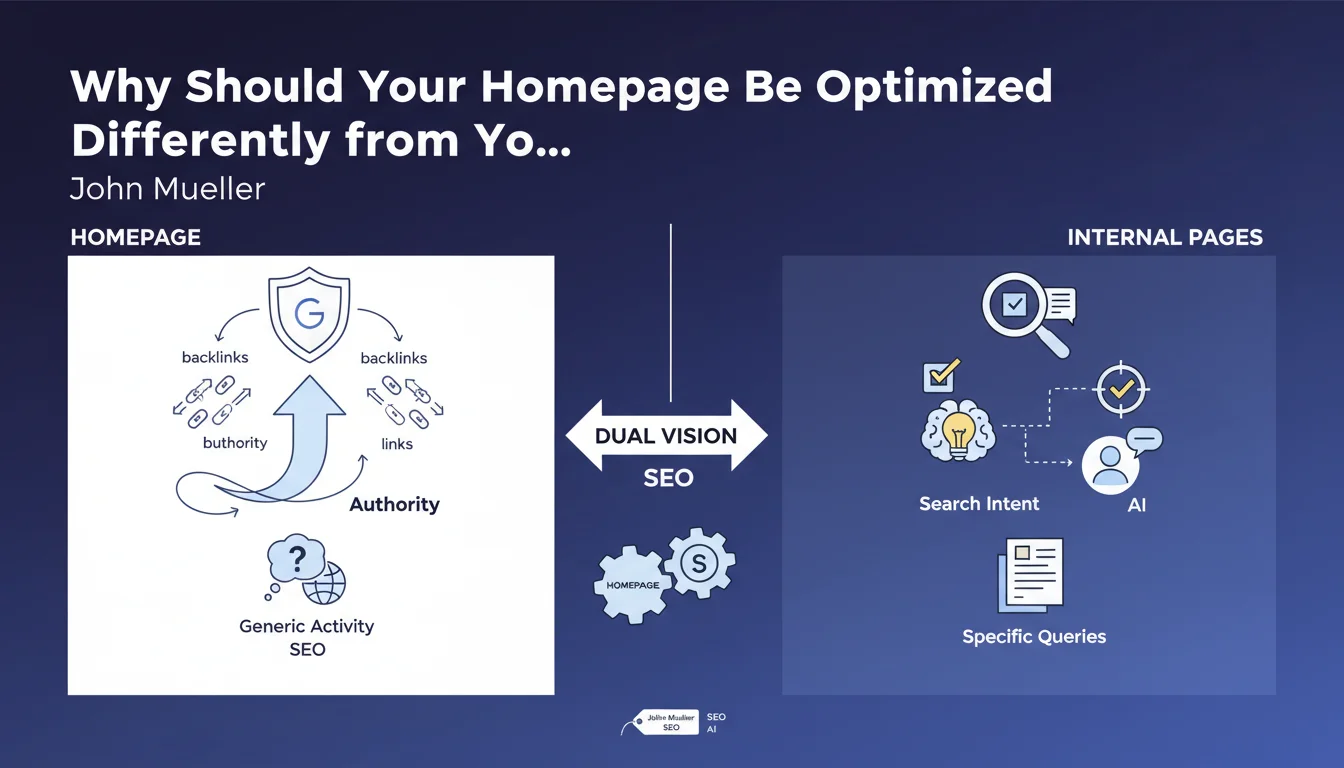
The homepage should not be optimized like a product or service page. Its primary objective is to describe the generic activity of the site as a whole.
Even though it naturally receives the most external backlinks and therefore has the best authority, it should not target specific queries. Its role is to clearly explain what the company or site does.
How does Google differentiate between the homepage and internal pages?
Google relies heavily on internal linking to understand a site's architecture and semantics. Link anchors, their context, and the surrounding text are essential signals.
An internal page must precisely answer a specific search intent. The home serves as a generalist entry point, while deep pages address targeted topics.
What are the risks of poor homepage optimization?
A poorly optimized homepage can create a phenomenon of SEO cannibalization. Google might then rank the home instead of a more relevant internal page.
This problem occurs when the homepage lacks explanatory static text about the main activity, or when it targets overly specific keywords instead of remaining generalist.
- The homepage should describe the overall activity, not specific services
- Internal linking (links, anchors, context) is crucial for Google
- A poor home strategy can cannibalize internal pages
- Static text on the homepage is indispensable
SEO Expert opinion
Is this statement consistent with practices observed in the field?
Absolutely. I regularly observe sites where the homepage monopolizes positions that should go to more relevant internal pages. This is particularly common among SMEs and e-commerce sites.
The problem often stems from over-optimization of the home on transactional keywords. Agencies think they're doing the right thing by exploiting the homepage's natural authority, but inadvertently create cannibalization.
What important nuances should be added to this recommendation?
For single-product sites or personal brands, the distinction is less clear. The homepage CAN be optimized for a specific query if that's the very essence of the site.
The importance of internal linking confirmed by Mueller is critical. Anchors should be descriptive and varied, not generic like "click here". The text around the link matters just as much as the anchor itself.
In what cases does this rule not strictly apply?
For ultra-specialized niche sites, the homepage can legitimately target a precise query. If your entire site addresses a single topic, the home/internal pages separation is less relevant.
Dedicated landing pages for specific campaigns are a special case. They can be aggressively optimized for precise queries, as they fall outside the site's classic architecture.
Practical impact and recommendations
What should you audit as a priority on your current site?
First check whether your homepage contains static text clearly explaining your main activity. This text must be visible, not hidden at the bottom of the page after carousels.
Then analyze your Google rankings: if your homepage ranks for precise queries that should go to internal pages, you have a cannibalization problem.
How should you properly restructure your internal linking?
Use descriptive and varied anchors in your internal links. Avoid repetitive generic anchors like "learn more" that provide no semantic signal to Google.
The context around the link matters enormously. Place your links in semantically rich sentences, not isolated in menus or buttons without context.
Organize your architecture into thematic silos. Each section of the site should have its pillar page, connected to the home by a clear and contextual link, then distributing authority to sub-pages.
What concrete actions should be implemented immediately?
- Add 200-300 words of static text on the homepage describing the overall activity
- Audit current rankings to identify home vs internal page cannibalization
- Rewrite internal link anchors with descriptive and varied formulations
- Verify that each important page receives at least 2-3 contextualized internal links
- Create a silo structure with thematic pillar pages
- Avoid over-optimizing the homepage on specific transactional keywords
- Test the linking with tools like Screaming Frog to visualize PageRank distribution
The differentiation between generalist homepage and specialized internal pages is fundamental for a healthy SEO architecture. Internal linking isn't just about links: the anchors, their context, and overall semantic coherence are major signals for Google.
These optimizations require a comprehensive strategic vision of informational and technical architecture. Restructuring existing linking can prove complex, especially on large sites with migration challenges. In this context, support from a specialized SEO agency helps avoid costly mistakes and implement a sustainable strategy aligned with Google's recommendations.
💬 Comments (0)
Be the first to comment.