
Official statement
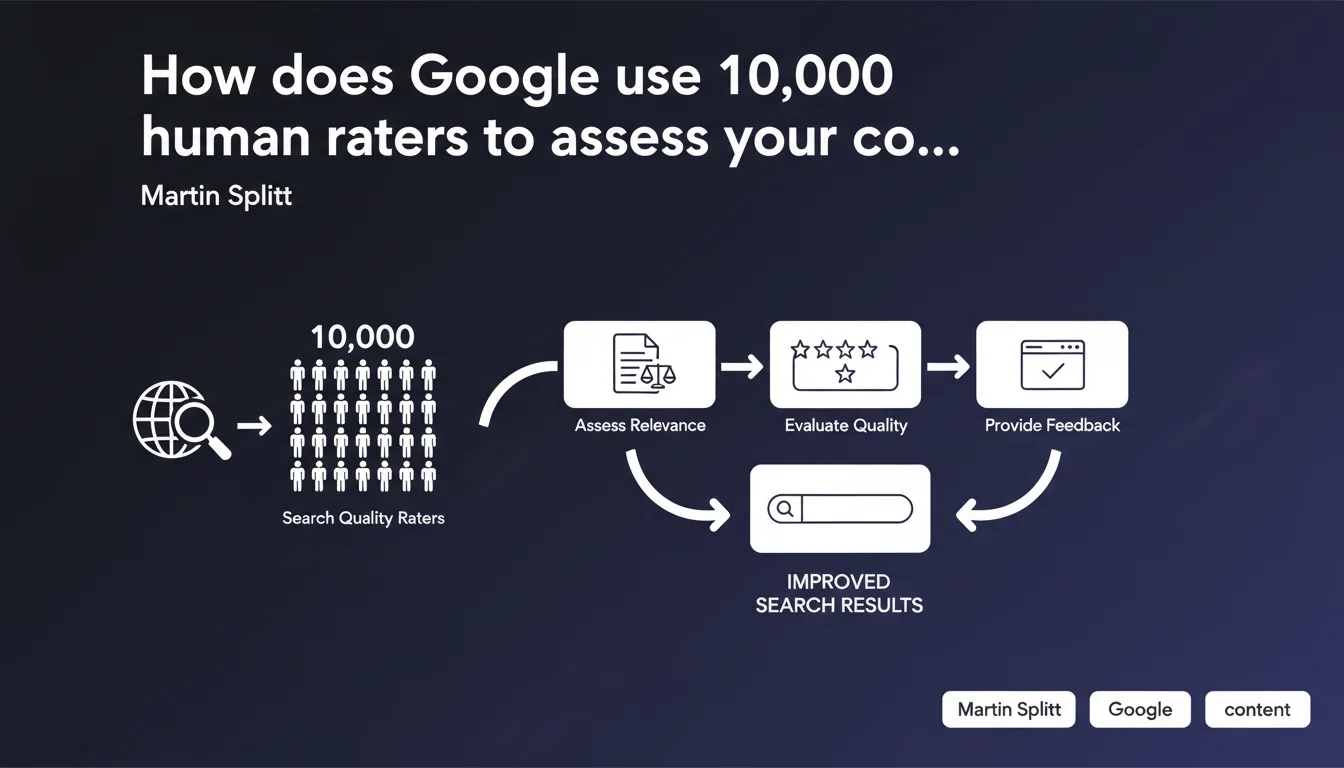
Google employs over 10,000 Quality Raters distributed worldwide to manually evaluate the quality of search results. These raters don't directly modify rankings, but their feedback trains and validates algorithms. Understanding their evaluation framework (the Search Quality Rater Guidelines) becomes strategically important to align your content with the quality criteria Google seeks to reproduce algorithmically.
What you need to understand
Who are these 10,000 raters and what do they actually do?
Quality Raters are contractors hired by Google through external service providers like Appen, Lionbridge, or RaterLabs. They work remotely in different countries and languages, evaluating thousands of queries daily according to strict protocols.
Their mission? Assign quality scores to pages displayed in search results. They judge relevance, reliability, and expertise of content — essentially everything that comprises the E-E-A-T acronym. But let's be clear: these raters never directly touch your site's ranking.
If their ratings don't influence rankings, what's the point?
This is where it gets interesting. Quality Raters' feedback serves to train Google's machine learning algorithms. When an algorithm proposes a new ranking model, Google compares its results against human evaluations to measure the quality of the improvement.
In other words: Raters define the ground truth that algorithms attempt to reproduce at scale. If your pages tick the boxes of Rater criteria, you're aligned with what Google is trying to automate.
Why is the figure of 10,000 raters significant?
This volume demonstrates Google's massive investment in human quality evaluation. With 10,000+ people judging results daily, Google accumulates a colossal dataset to refine its models.
It also means the sampling covers significant geographic, linguistic, and cultural diversity. Raters' guidelines are adapted locally, which explains why E-E-A-T criteria can vary across markets.
- Quality Raters manually evaluate search result quality based on Search Quality Rater Guidelines
- Their feedback doesn't directly modify rankings, but trains ranking algorithms
- 10,000+ evaluators = massive ground truth defining what Google considers quality
- Rater guidelines are public and accessible — an invaluable SEO roadmap
SEO Expert opinion
Is this statement consistent with what we observe in practice?
Yes, and it's actually one of the few Google communications that leaves no gray areas. The Search Quality Rater Guidelines (170+ pages) have been public for years, and their content aligns perfectly with ranking criteria observed empirically.
When Google says Raters don't directly influence rankings, that's technically true — but it's also semantic nuance. Their evaluations shape the models that, in turn, rank pages. It's like saying an architect doesn't build a house: technically correct, but they design every detail.
What are the limitations of this human evaluation system?
Subjective bias. Even with 10,000 raters and detailed guidelines, human interpretation remains variable. One rater might judge that content lacks expertise where another finds it sufficient.
Google mitigates this bias by cross-checking evaluations from multiple raters per query, but variability exists. This is also why algorithms remain the final layer: they seek robust patterns that emerge despite individual evaluation noise.
[To verify] Google never communicates about inter-rater reliability. We don't know how much two raters agree on the same page — and that matters, because if the spread is too wide, the ground truth becomes blurry.
Should you optimize specifically for Quality Raters?
No, because you never optimize for Raters — you optimize according to the same criteria they use. The distinction is essential. Raters apply a reading framework that reflects what Google wants to see in its results.
If you structure your content to maximize E-E-A-T, visible authorship, cited sources, depth of expertise — you align your site with Google's definition of quality. Raters probably won't see your pages, but algorithms trained on their feedback will scan them.
Practical impact and recommendations
What should you concretely do to align your content with Rater criteria?
First step: download and read the Search Quality Rater Guidelines. This document is a goldmine — it details exactly how Google defines quality content, page by page, query by query.
Next, audit your key pages with the E-E-A-T framework in mind. Ask yourself the questions a Rater would ask: who wrote this content? Why should I trust them? Are sources cited? Does the author display verifiable credentials?
Concretely, this involves editorial and technical adjustments:
- Add detailed author bios with links to external profiles (LinkedIn, publications, etc.)
- Cite primary sources and link to authoritative references
- Clearly display publication and update dates
- Structure content with logical headings, clear definitions, visual hierarchy
- Avoid superficial content that paraphrases without adding value
- Monitor Rater guidelines with each update to anticipate criteria evolution
What critical mistakes should you absolutely avoid?
Don't fall into the cosmetic optimization trap. Adding a generic author bio or a few external links isn't enough if the content itself lacks depth.
Raters are trained to spot low-quality signals: mass-generated content, doubtful expertise, absence of original research. If your page looks like an aggregate of what already exists elsewhere, it won't pass the test — even with polished formatting.
Another common mistake: ignoring YMYL (Your Money Your Life) criteria. If your site touches health, finance, law, E-E-A-T standards are multiplied. Content that would pass in a lifestyle niche will be judged insufficient in YMYL.
How can you verify your site meets Rater standards?
You can simulate a Rater evaluation internally. Take one of your key pages, open the guidelines, and rate it according to the defined criteria. Be ruthless — raters are.
If you identify recurring weaknesses (lack of authorship, unclear sources, overly superficial content), prioritize corrections on your strategic pages. The goal isn't perfection across 100% of your site, but alignment on content that drives traffic and conversions.
❓ Frequently Asked Questions
Les Quality Raters peuvent-ils pénaliser directement mon site ?
Où puis-je consulter les Search Quality Rater Guidelines ?
E-E-A-T est-il un facteur de ranking direct ?
Combien de fois par an les guidelines Raters sont-elles mises à jour ?
Un site peut-il être évalué sans le savoir par un Quality Rater ?
🎥 From the same video 3
Other SEO insights extracted from this same Google Search Central video · published on 26/07/2022
🎥 Watch the full video on YouTube →
💬 Comments (0)
Be the first to comment.