
Official statement
What you need to understand
What is Google's official position on toxic links?
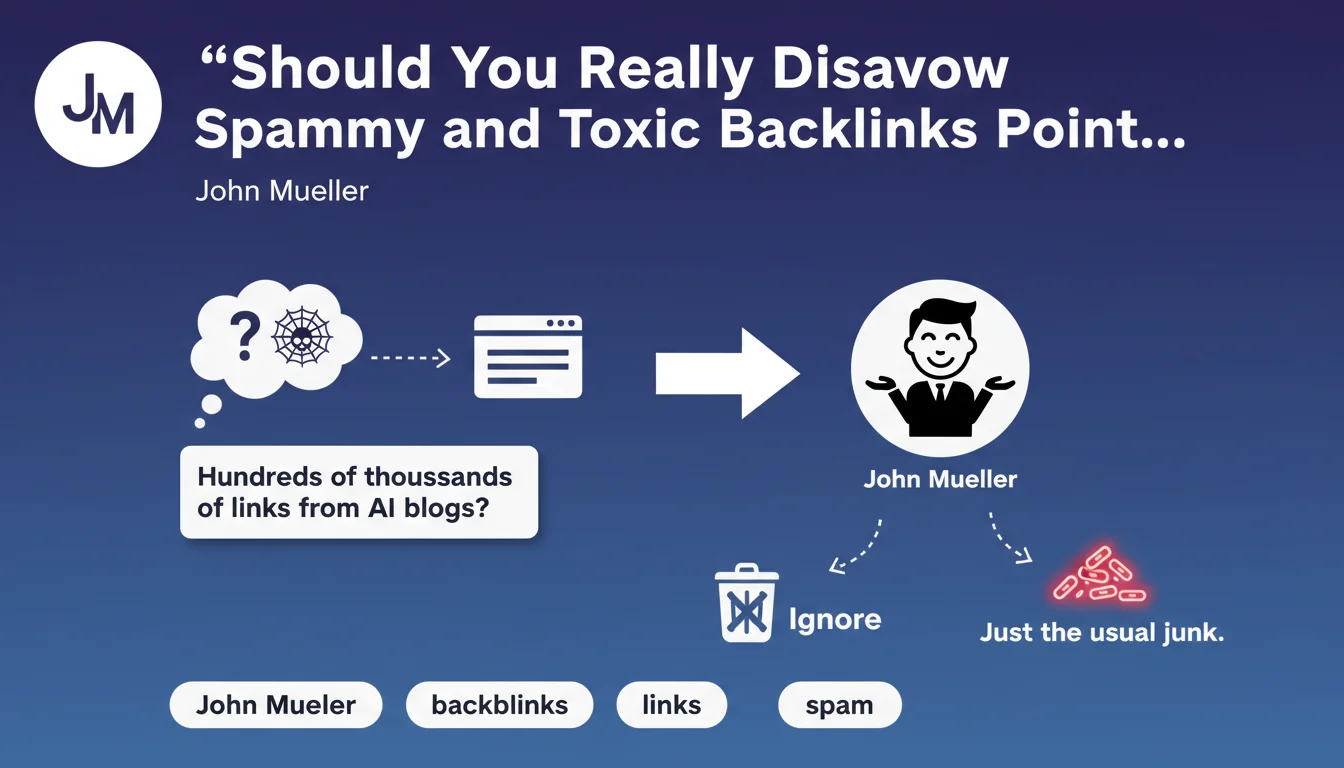
Google now recommends not using the disavow tool for spammy or toxic links. John Mueller, Google's spokesperson, states that these links can simply be ignored, as Google automatically detects and neutralizes them.
This position marks a significant evolution in backlink management. Google indicates that its algorithm is mature enough to identify and ignore low-quality links without manual intervention from the site owner.
Why does Google consider these links harmless?
According to Google, whether links come from AI-generated content or traditional spam, the nature of the content matters little. What counts is the overall quality: if it's low-value content, Google identifies it and transmits no positive or negative signal through these links.
Google's algorithms have significantly advanced since the Penguin era. They now analyze the context and relevance of links rather than simply counting their number.
What was the context behind this statement?
A site owner had discovered hundreds of thousands of automated backlinks from artificially generated blog articles. This situation, which might have caused concern a few years ago, is now considered commonplace by Google.
- Google automatically ignores links from spam or low-quality content
- The disavow tool is no longer necessary in most cases
- The distinction between AI spam and traditional spam is irrelevant to the algorithm
- Sites victimized by negative SEO are generally not penalized
- Focusing efforts on acquiring quality links remains the best strategy
SEO Expert opinion
Is this statement consistent with real-world observations?
My experience across hundreds of projects largely confirms this position. I've observed numerous cases where sites with heavily polluted link profiles suffered no visible penalties. Google does indeed seem capable of sorting things out.
However, Google's capability is neither absolute nor instantaneous. On recent sites with little history or in heavily spammed niches, I've found that massive volumes of toxic links can temporarily create algorithmic confusion.
What important nuances should be added to this advice?
Mueller's statement deserves several clarifications. First, it primarily concerns links clearly identifiable as spam. More sophisticated ambiguous or manipulative links can still pose problems.
Second, this approach assumes complete trust in Google's algorithms. However, in case of manual action (rare but existing), disavowal remains relevant. Additionally, if your site has historically practiced aggressive link building, preventive cleanup may be wise before a migration or strategic change.
When should you still consider disavowing?
Certain situations still justify using the disavow tool. If you've actively practiced buying links in the past and want to clean up your profile, proactive disavowal may be prudent.
Similarly, in case of massive and targeted negative SEO (thousands of links with over-optimized exact-match anchors in a short time), documenting a disavow can serve as protection. Finally, when acquiring a site, auditing and cleaning the inherited link profile is good practice.
Practical impact and recommendations
What should you actually do when facing toxic links?
The first action is to not panic. Monitor your rankings and organic traffic rather than reacting immediately to discovering questionable links. If your performance remains stable, no action is necessary.
Focus your resources on acquiring authentic quality links: press relations, linkable content, relevant partnerships. These positive signals will have infinitely more impact than obsessive profile cleaning.
Use Search Console to monitor manual actions. This is the only reliable indicator of a problem requiring intervention. Without notification, assume Google is handling the situation.
What common mistakes should you absolutely avoid?
The main mistake is disavowing out of excessive caution. I've seen sites lose rankings after disavowing too broadly, accidentally including legitimate links in the disavow file.
Another mistake: spending disproportionate time analyzing toxic links at the expense of content creation and positive link building. The return on investment for this activity has become almost zero.
Finally, don't blindly trust toxicity scores from SEO tools. These metrics are estimates that don't necessarily reflect Google's view and can generate unnecessary anxiety.
How should you structure your backlink strategy in this new context?
Adopt a proactive rather than defensive approach. Invest 95% of your time in acquiring quality links and only 5% in monitoring your profile.
Establish simple monthly monitoring: check Search Console for manual actions, track the overall evolution of your referring domains, and analyze organic performance. This is sufficient to detect a real problem.
- Don't use the disavow tool except for verified manual actions or documented problematic history
- Monitor Search Console monthly for manual action notifications
- Prioritize acquiring quality links through content and relationship strategies
- Document your link profile when acquiring sites or projects with unknown history
- Invest in backlink analysis tools to understand your profile, not to disavow massively
- Maintain a healthy ratio between natural editorial links and other types of links
- Train your teams to recognize real warning signs rather than reacting to every suspicious link
💬 Comments (0)
Be the first to comment.