
Official statement
What you need to understand
What exactly is Near Duplicate Content according to Google?
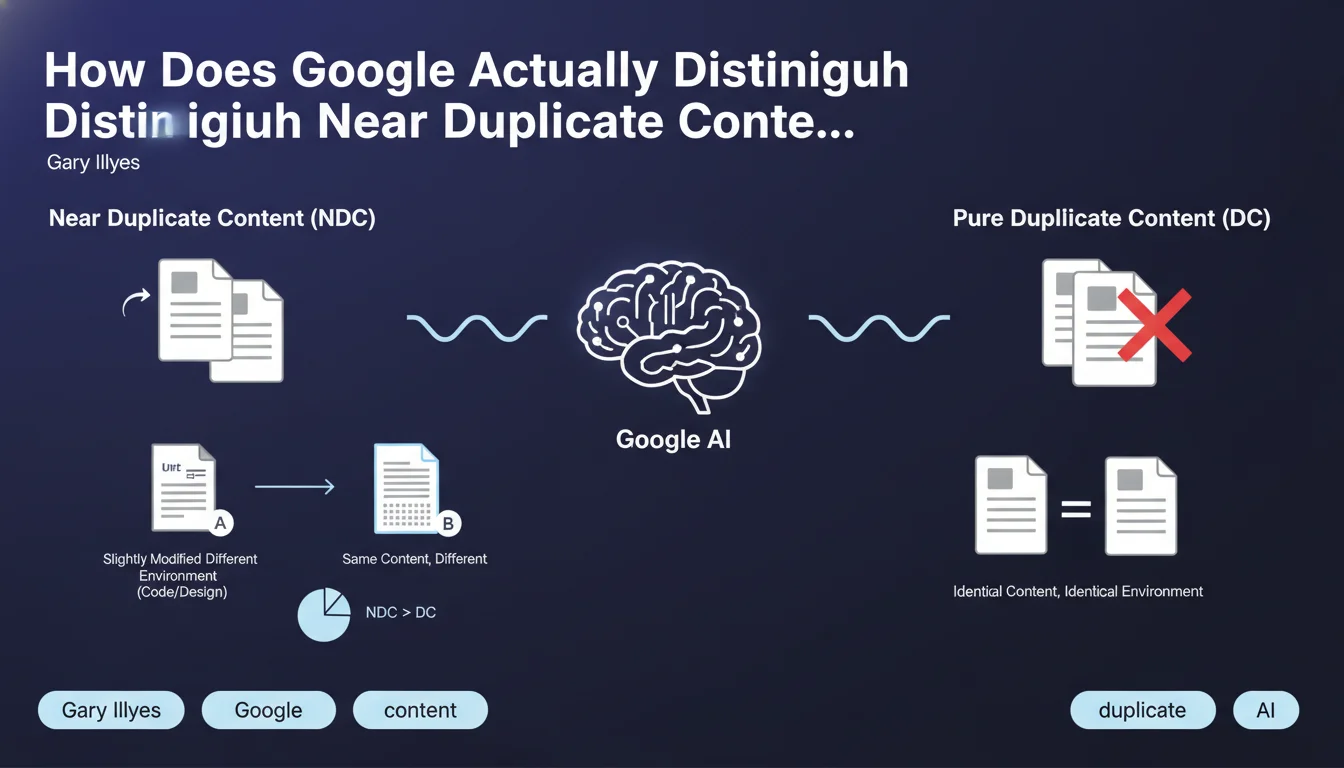
Near Duplicate Content (NDC) represents content that is not strictly identical, but similar enough to be considered a variation of existing content. Google identifies two main forms of NDC.
The first form concerns slightly modified content: an article rewritten with some wording changes, reorganized paragraphs, or minor additions. The second form involves the same content in a different technical environment: same text but with a distinct HTML structure, graphic design, or template.
According to Gary Illyes, NDC is much more widespread on the Web than pure and hard duplicate content. This reality reflects common practices: content syndication, regional variations, or versions adapted for different platforms.
- NDC represents the majority of duplicated content on the Internet
- Two main forms: slight textual modification or different technical environment
- Google has developed sophisticated algorithms to detect these variations
- NDC is not necessarily penalizing if it's justified and well managed
Why does Google make this important distinction?
This distinction allows Google to treat legitimate situations differently from manipulation attempts. An e-commerce site that varies its product pages by color or size creates NDC, but for valid commercial reasons.
Google seeks to identify the intention behind the duplication. NDC can result from technical constraints, user needs, or legitimate editorial strategies, unlike pure duplicate content often created to manipulate search rankings.
What's the real difference from classic duplicate content?
Pure duplicate content refers to strictly identical content, copy-pasted without any modification. This is typically the case with content scraping or complete republication without authorization.
NDC involves sufficient variation to not be identical, but insufficient to be considered truly unique. This gray area is technically more complex for search engines to analyze and requires advanced semantic similarity detection algorithms.
SEO Expert opinion
Does this approach align with real-world observations?
Indeed, analysis of millions of pages shows that NDC is omnipresent across all sectors. E-commerce, media, and corporate sites massively generate NDC, often without being aware of it.
Content analysis tools regularly reveal similarity rates of 70 to 90% between certain pages on the same site. This reality completely confirms Gary Illyes' vision: pure and hard duplicate is actually quite rare compared to subtle variations.
Historical Panda penalties primarily targeted sites with massive NDC without added value, rather than simple technical duplicate content.
What strategic nuances should be considered?
Not all NDC is created equal. NDC created to address different search intents (buying guide vs. product page) can be perfectly legitimate and perform well in SEO.
The issue lies in the signal-to-noise ratio: a site with 80% NDC and 20% unique content sends a signal of low added value. Conversely, a site with 80% unique content can afford 20% technical NDC without negative impact.
When does NDC actually become problematic?
NDC becomes problematic when it creates ranking cannibalization. If Google must choose between 15 very similar pages, none will benefit from all the available authority, thus diluting your ranking potential.
At-risk situations include: pagination pages without canonicalization, search filters generating indexable URLs, product variations without differentiation, or press releases republished identically on dozens of partner sites.
The real danger lies in the absence of strategy: creating NDC through technical negligence rather than thoughtful editorial choice systematically weakens SEO performance.
Practical impact and recommendations
How can you audit NDC on your site?
Start by using similarity detection tools like Siteliner, Screaming Frog with the content comparison option, or more advanced solutions like Oncrawl. These tools identify pages with high similarity rates.
Then analyze your templates and structures. Often, 60% of identical content comes from repetitive elements: menus, sidebars, footers. Focus the audit on the unique main content of each page.
Examine particularly the risk areas: e-commerce categories, blog archives, internal search results pages, geographic location pages. These are the main sources of uncontrolled NDC.
- Crawl the entire site with a professional tool
- Identify clusters of pages with +70% similarity
- Calculate the unique content / shared content ratio per page
- Map the sources of NDC (technical vs. editorial)
- Prioritize strategic pages for analysis
What corrective actions should you implement?
For technical NDC, implement canonical tags pointing to the main version. This consolidates SEO signals without removing pages useful for user experience.
For editorial NDC, enrich the content with differentiating elements: specific customer testimonials, local data, complementary videos, adapted FAQs. The goal is to reach at least 40% unique content per page.
Use strategic noindex for low-value pages: secondary filters, intermediate paginations, minor variants. Keep them accessible for users but remove them from Google's index.
- Canonical on technical variations (URL parameters, sessions, etc.)
- Editorial rewriting of similar strategic pages
- Noindex on utility pages with low differentiation
- Page consolidation when differentiation is impossible
- Implementation of anti-NDC editorial governance
How can you prevent future NDC creation?
Establish clear editorial rules: minimum number of unique words per page, mandatory differentiation for new categories, validation before publishing similar content.
Configure your CMS and technical tools to prevent automatic indexing of at-risk pages: search parameters, multiple filters, user sessions. Preventive configuration avoids 80% of technical NDC problems.
Train your teams in differentiated content creation. NDC often results from a lack of understanding of SEO issues by writers and developers.
💬 Comments (0)
Be the first to comment.