
Official statement
What you need to understand
What exactly does Google say about buying links?
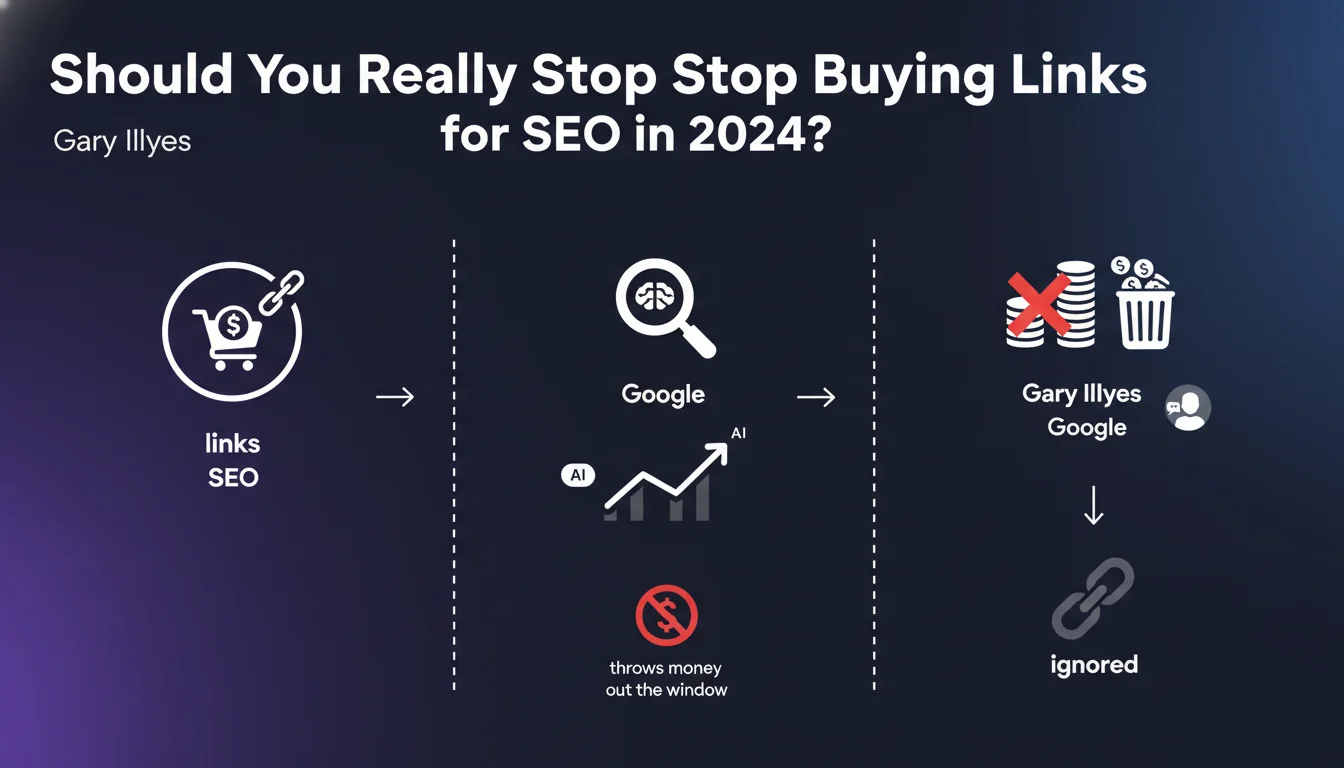
At the SMX Advanced conference, Gary Illyes was categorical: buying links is equivalent to throwing money out the window. This official statement confirms that Google considers this practice ineffective.
According to Google, algorithms now detect these purchased links with increased precision, including on high-authority sites. The official position is clear: these links are simply ignored by the algorithm, without triggering a manual penalty.
Why does Google claim it no longer penalizes these links?
The messaging has evolved since the era of Penguin penalties. Today, Google prefers to communicate about an approach of neutralization rather than sanction.
This strategy aims to discourage link buying by making it useless rather than creating fear. If purchased links bring no benefit, why spend money?
What are the key takeaways from this statement?
- Improved detection: algorithms identify artificial links better and better, even on reputable sites
- No announced penalty: Google claims to ignore these links rather than sanction sites
- Economic inefficiency: investment in buying links no longer generates positive returns
- Constant evolution: detection capabilities continuously improve through machine learning
- Clear signal: Google publicly discourages this practice by declaring it obsolete
SEO Expert opinion
Is this statement completely consistent with observed reality?
After 15 years of observation, I notice a gap between official messaging and effective practices. If all purchased links were truly ignored, many sites wouldn't maintain their positions through these strategies.
The reality is more nuanced: Google does indeed detect many low-quality links, particularly those from automated platforms or obvious networks. But links purchased intelligently and discreetly often continue to work.
The term "ignore" is also misleading. In some cases, Google can indeed devalue a site if it detects a clearly artificial link profile, even without visible manual action.
What essential nuances should be added to this messaging?
The quality of the purchased link makes all the difference. A contextual link on a thematic site with real traffic isn't detectable in the same way as a footer link on a site dedicated to selling links.
Google cannot distinguish with certainty a natural editorial link from an intelligently negotiated link. The boundary is blurred between legitimate business partnership, sponsorship, and pure link buying.
In what contexts does this rule actually apply?
Obvious and large-scale links are indeed detected and neutralized: poorly constructed PBN networks, automated purchasing platforms, mass links from low-quality directories.
On the other hand, sophisticated strategies remain difficult to detect: individually negotiated links on quality editorial sites, legitimate business partnerships with discreet mention, sponsorship of relevant thematic content.
Google's real message is: if you buy links, they must be indistinguishable from natural links, which requires significant investment and a qualitative rather than quantitative approach.
Practical impact and recommendations
What should you do concretely with this information?
Prioritize a natural link-building strategy based on creating valuable content, digital press relations, and authentic partnerships. This is the most sustainable approach.
If you've already purchased links, analyze your backlink profile to identify potentially problematic links. Links from sites without traffic, off-topic, or with suspicious patterns should be monitored.
Redirect your budget toward alternative strategies: content marketing, digital PR, creation of linkable assets (studies, free tools, infographics), quality guest blogging on relevant media.
What critical mistakes must you absolutely avoid?
Don't fall into the trap of automated purchasing platforms that promise hundreds of links quickly. These networks are easily identifiable by Google and completely ineffective.
Avoid over-optimized anchors on purchased links. A link profile with too many exact match anchors is an immediate red flag for detection algorithms.
Don't concentrate your efforts on low editorial value sites. A link from a real media outlet with an audience is worth more than 50 links from ghost blogs.
How can you verify and secure your link strategy?
- Audit your backlink profile with tools like Ahrefs, Majestic, or SEMrush to identify suspicious links
- Verify that your links come from sites with real organic traffic and coherent thematics
- Analyze your anchor diversity: a natural profile contains mainly brands and URLs
- Monitor acquisition velocity: growth that's too rapid is a warning signal
- Prioritize links from pages with quality editorial content, not "partner" pages
- Document your legitimate partnerships to be able to justify certain links if necessary
- Use the rel="sponsored" attribute for transparent commercial partnerships
- Diversify your sources: media, influential blogs, institutional sites, business partners
- Regularly monitor your Search Console to detect any potential manual actions
💬 Comments (0)
Be the first to comment.