
Official statement
What you need to understand
What exactly is a "tie breaker" criterion in Google's algorithm?
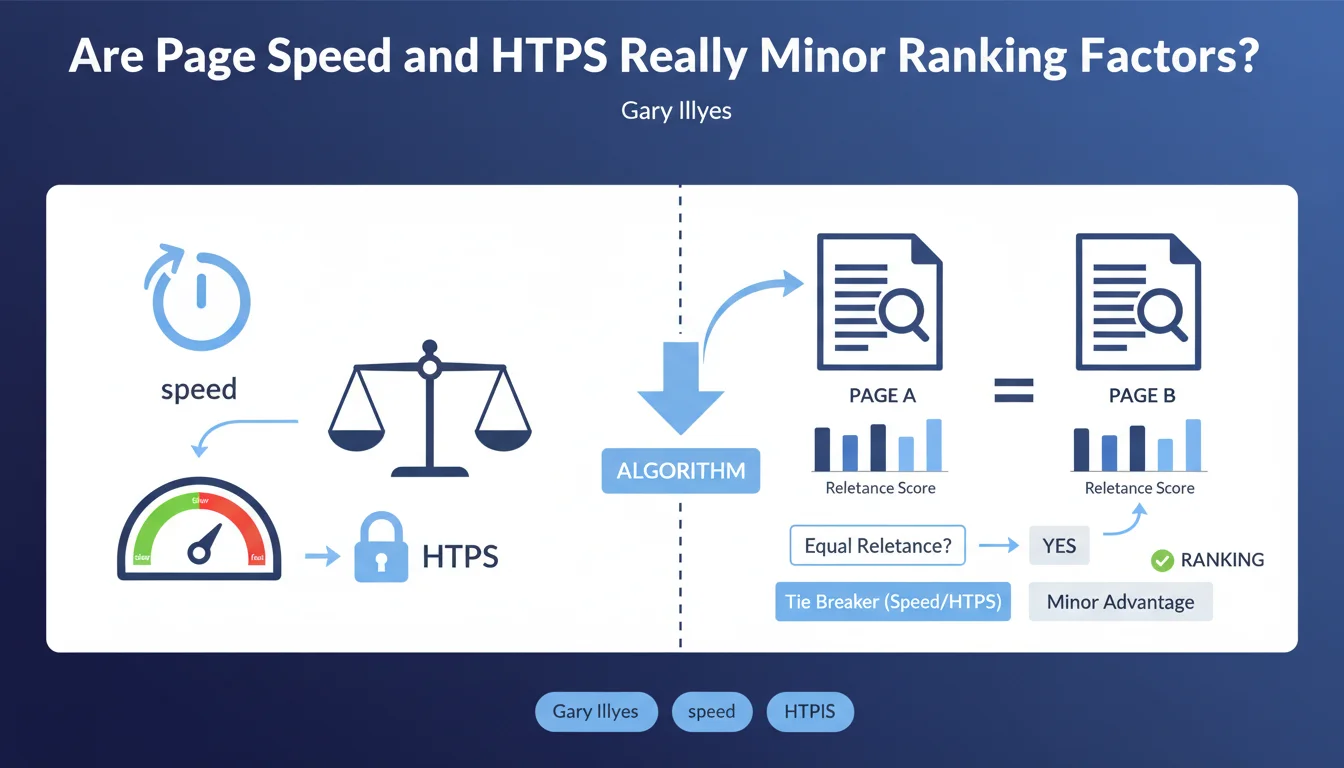
Gary Illyes, official Google representative, reveals that Page Speed and HTTPS function as tiebreakers rather than as major ranking factors. A "tie breaker" only comes into play when two pages have a nearly identical relevance score for a given query.
Concretely, these criteria don't propel a mediocre page to first position. They simply allow Google to choose between equivalent content in terms of quality, search intent and traditional SEO signals.
How important are these criteria really in the ranking process?
This statement puts the direct impact of these factors into perspective. A page with excellent content but average loading time will almost always beat a fast page with poor relevance.
Nevertheless, in ultra-competitive sectors where content is of similar quality, these criteria can make the difference between position 1 and position 3. Their role is therefore contextual and situational.
What are the key takeaways from this statement?
- Page Speed and HTTPS are not primary ranking factors
- They act as tiebreaker criteria in case of perfect equality
- Content relevance remains the dominant factor
- These criteria maintain importance in saturated markets
- Google confirms a nuanced and non-absolute approach to these signals
SEO Expert opinion
Does this statement align with real-world observations?
My 15 years of experience confirms this analysis. I've observed sites with mediocre loading times dominating their SERPs thanks to exceptional content and solid backlinks. Page Speed was not the decisive factor.
Conversely, on highly competitive commercial queries (insurance, finance, real estate), I've found that technical optimization including HTTPS and speed can indeed separate players of equivalent level. Gary Illyes' statement therefore corresponds to field reality.
What critical nuances should be added to this statement?
Warning: qualifying these criteria as "tie breakers" doesn't mean they're negligible. An extremely slow site (over 5 seconds) suffers a catastrophic bounce rate that indirectly degrades behavioral signals.
Similarly, the absence of HTTPS generates security alerts in Chrome, drastically reducing click-through rate and trust. The indirect impact of these criteria on user experience therefore remains major, even if their direct algorithmic weight is limited.
When do these criteria actually become decisive?
These factors take on critical importance in three situations: ultra-competitive local searches, high-value transactional queries, and regulated sectors where all players produce standardized content.
In these contexts, technical optimization becomes a real competitive advantage. An e-commerce site with 100 competitors offering the same products must absolutely optimize these aspects to stand out.
Practical impact and recommendations
What optimization strategy should you adopt based on this statement?
The absolute priority remains creating relevant and differentiating content. Invest 70% of your efforts in editorial quality, answering search intent and acquiring natural links.
Then dedicate 20% to basic technical optimization: HTTPS, decent loading time (under 3 seconds), reasonable Core Web Vitals. The remaining 10% concerns advanced technical optimizations.
What misinterpretations must you absolutely avoid?
Don't fall into the trap of completely neglecting Page Speed and HTTPS on the grounds that they're "tie breakers". A slow or unsecured site loses visitors before the algorithm even intervenes.
Also avoid the opposite mistake: over-investing in technical optimization at the expense of content. I've seen technically perfect sites stagnate on page 3 due to lack of valuable content.
How can you audit and prioritize these optimizations concretely?
Start by measuring your actual positioning: are you in an ultra-competitive environment where content is equivalent? If yes, technical optimization deserves more attention.
Use PageSpeed Insights and Search Console to identify major friction points. First fix critical issues (absence of HTTPS, loading time over 5 seconds) before refining the details.
- Verify that 100% of the site is HTTPS with a valid certificate
- Measure actual loading time with Google PageSpeed Insights
- Analyze Core Web Vitals in Search Console
- Prioritize content and search intent above all
- Optimize images and use an appropriate CDN
- Compare your performance with that of the top 3 competitors
- Implement continuous monitoring of performance
- Don't sacrifice functionality to gain a few milliseconds
💬 Comments (0)
Be the first to comment.