
Official statement
What you need to understand
What's the difference between indexing and ranking in Google?
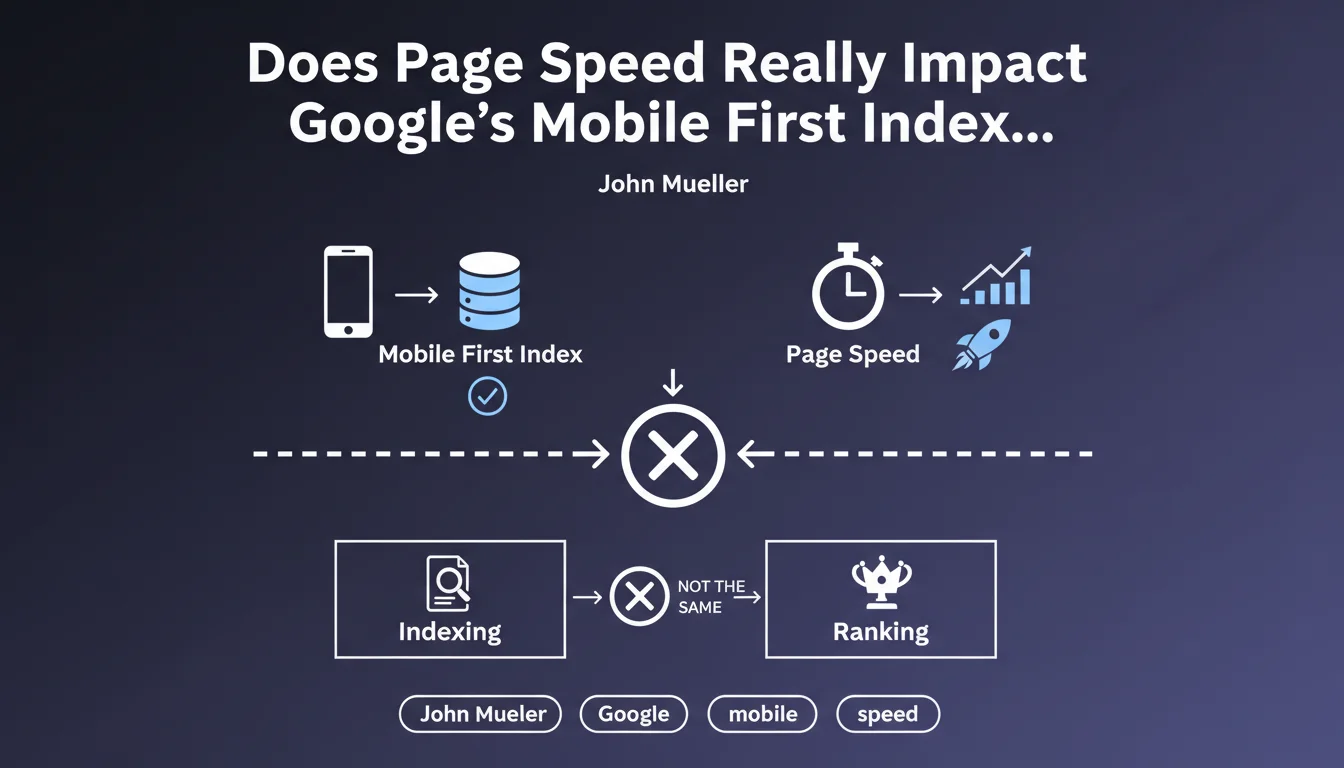
Google clearly distinguishes two fundamental processes: indexing (discovering and storing pages) and ranking (determining their position in results). This distinction is crucial to understanding how the search engine actually works.
Mobile First indexing only concerns how Google discovers and indexes your content: it uses the mobile version of your site as the primary reference. Loading speed, on the other hand, comes into play during ranking, as a relevance factor among hundreds of others.
Why are these two concepts often confused?
This confusion amplified after the announcement of the Speed Update, which made speed an official ranking criterion on mobile. Many SEO practitioners mistakenly believed that a slow site would no longer be indexed by Google.
In reality, a page can be perfectly indexed while being slow, and vice versa. Google can discover and store your content even if performance is mediocre. Your ranking, however, will likely suffer.
What are the specific criteria for each process?
For Mobile First indexing, Google primarily checks content availability on mobile, data structure, and accessibility for Googlebot. Speed is not a blocking criterion for being indexed.
For speed-based ranking, Google evaluates Core Web Vitals (LCP, FID, CLS), overall loading time, and user experience. These metrics influence your position in search results.
- Mobile First indexing determines if and how your content enters Google's index
- Page speed is a ranking factor that affects your positioning
- A slow page can be indexed but poorly ranked
- A fast non-indexable page (robots.txt, noindex) will never be ranked
- Both optimizations are complementary but independent
SEO Expert opinion
Is this distinction actually respected in Google's practice?
After 15 years of observation, I confirm that Google does indeed maintain this separation between indexing and ranking. I have regularly observed very slow sites (3-5 seconds loading time) perfectly indexed, with hundreds of pages in the index.
However, their organic visibility remains limited on competitive queries. Speed becomes a discriminating factor when two pieces of content have similar relevance. Google then uses performance as a tiebreaker criterion.
What nuances should be added to this statement?
The first nuance concerns overall user experience. If your site is so slow that it generates a massive bounce rate, Google will interpret these behavioral signals negatively. Indirectly, speed therefore affects your ranking through user engagement.
The second nuance touches on crawl budget. An extremely slow site can exhaust the resources Googlebot allocates to your domain. On very large sites, this can delay the indexing of new pages, even if it's not a technical blockage.
In what cases does this separation rule become blurry?
For news sites and real-time content, I observe a correlation between speed and index freshness. Fast sites benefit from more frequent crawling, therefore more responsive indexing of new content.
On high-volume page sites (marketplaces, aggregators), speed influences crawl depth. Google will explore fewer pages if each consumes too much time. The theoretical separation then becomes less clear in practice.
Practical impact and recommendations
How can you simultaneously optimize Mobile First indexing and speed?
Prioritize mobile accessibility of your content above all. Verify that main content, images, and links are identical between desktop and mobile. Use responsive images with appropriate srcset attributes.
Then, work on Core Web Vitals specifically: optimize LCP (loading) by preloading critical resources, FID (interactivity) by deferring non-essential JavaScript, and CLS (visual stability) by defining image dimensions.
- Check content parity between mobile and desktop versions in Search Console
- Test your site with Google's Mobile-Friendly Test tool
- Measure your Core Web Vitals via PageSpeed Insights and Chrome UX Report
- Implement a lazy loading system for images outside the viewport
- Compress and minify CSS, JavaScript, and HTML
- Use a CDN to accelerate content distribution
- Regularly monitor the "Page Experience" report in Search Console
What strategic mistakes should you absolutely avoid?
The main error is sacrificing mobile content to gain speed. Removing text, images, or links from your mobile version improves performance but destroys your Mobile First indexing. Google will index this impoverished content.
Another trap: focusing solely on synthetic metrics (Lighthouse) while ignoring real field data from Chrome UX Report. The latter is what really matters for Google's ranking.
What can you do concretely today to secure both aspects?
Start with a comprehensive technical audit via Search Console, "Mobile Usability" and "Core Web Vitals" sections. Identify your problematic pages on these two distinct dimensions.
Then establish a prioritized roadmap: first correct mobile indexing issues (missing content, CSS/JS blockages), then tackle performance optimizations. This sequence ensures you'll be indexed even during the speed improvement phase.
💬 Comments (0)
Be the first to comment.