
Official statement
Other statements from this video 11 ▾
- □ Does a 302 redirect really cause you to lose PageRank compared to a 301?
- □ Are 307 and 308 redirects really pointless for classic SEO?
- □ Does Google really follow JavaScript redirects the same way as server-side redirects?
- □ Do you really need to redirect every single URL individually during a domain migration?
- □ Why do domain mergers and divisions trigger extended SEO ranking swings?
- □ Are geographic redirects really preventing your European content from being indexed?
- □ Are geographic redirects killing your crawl budget? Here's what Google recommends instead
- □ Are interstitials with redirects really blocking Googlebot from indexing your content?
- □ Do you really need bidirectional redirects between mobile and desktop versions to avoid indexing issues?
- □ Why does the URL Inspection Tool show a 200 status code even after a redirect?
- □ Should you really be using 302 redirects between mobile and desktop versions?
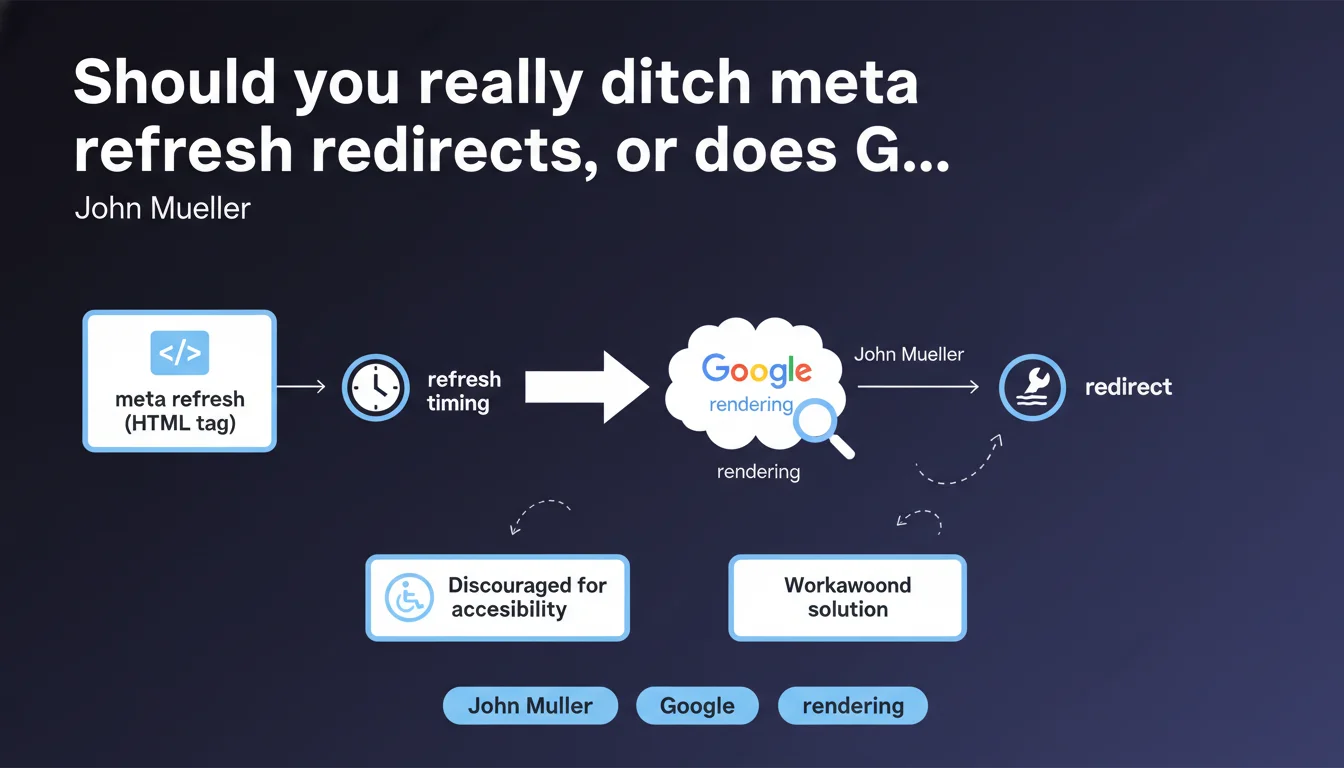
Google treats meta refresh as standard redirects during HTML rendering, so technically it works for SEO. But Mueller explicitly discourages it due to accessibility issues and considers it a workaround. If you still have any, migrate to proper 301/302 server redirects.
What you need to understand
Does Google really crawl meta refresh like standard redirects?
Yes, and that's the whole nuance of this statement. Googlebot executes JavaScript and renders HTML, which means it detects <meta http-equiv="refresh"> tags and follows the redirect specified. Concretely, the bot understands the instruction and passes ranking signals to the destination page.
Let's be honest: that doesn't mean it's optimal. The processing happens after rendering, not at the server level like a true 301. It implies extra crawl delay and unnecessary resource consumption.
Why does Mueller discourage them despite this?
Two major reasons. First, user accessibility: screen readers, older browsers, and certain mobile devices handle these redirects poorly. You can lose part of your audience without even knowing it.
Second, it's a technical workaround. Meta refresh tags were massively abused to bypass server limitations or CMS constraints — situations where a proper server redirect should have been implemented. Google's preference is clear: it's not best practice, even if it technically works.
In what cases are these HTML redirects still being used?
Mainly on shared hosting where .htaccess access is limited, or on constrained CMS installations without server config access. Some cheap landing page tools also generate them automatically.
But here's the problem: in 95% of cases, it's solved in 5 minutes with FTP access and one line of Apache/Nginx config. If you're stuck, it might be worth auditing your entire tech stack.
- Google detects meta refresh during HTML rendering and treats it as a redirect
- They work for SEO but are discouraged for accessibility and performance
- Always prioritize proper 301/302 server redirects configured cleanly
- Meta refresh is a signal of technical debt — if you have them, there's usually an underlying problem
SEO Expert opinion
Does Google's tolerance hide a trap?
Not a trap, but rather a pragmatic compromise. Google knows millions of sites still use these HTML redirects — often unknowingly, via WordPress plugins or legacy CMS. Refusing to crawl them would undermine index coverage.
But watch out: just because Google tolerates a practice doesn't mean it delivers equivalent performance. Server redirects remain faster, consume less crawl budget, and avoid unnecessary round trips. [To verify]: no official data confirms whether PageRank flows through meta refresh as efficiently as through 301s — we assume yes, but Google documents it nowhere.
Do we see real-world performance differences?
On low-volume sites, honestly, the difference is imperceptible. If you have 50 pages and 3 stray meta refreshes in a corner, Googlebot doesn't care. The site crawls normally, redirects pass through.
However, on sites with thousands of pages and tight crawl budget, every inefficiency counts. Meta refresh adds an HTML rendering step before detection — wasted time and resources. I've seen migrations where removing these workaround redirects cut average crawl time per page by 15%.
When does it really become problematic?
When used at scale or in redirect chains. Classic example: URL A redirects via meta refresh to B, which redirects via 302 to C, itself in 301 to D. Googlebot follows, but it loses signals at each hop and slows indexation.
Another case: meta refresh with delay greater than 0 seconds. Some webmasters set a 5-second delay to "display a message" before redirecting. Google still follows, but it's a nightmare for UX and a potential negative ranking signal.
Practical impact and recommendations
What should you do if you discover meta refresh on your site?
First step: audit all your HTML redirects. Crawl your site with Screaming Frog or OnCrawl, filter for <meta http-equiv="refresh"> tags, and list all affected URLs.
Next, identify the cause. Is it a misconfigured WordPress plugin? CMS limitation? Temporary redirects that became permanent? Understanding why they exist prevents recreating them later.
How do you properly migrate to server redirects?
On Apache, create or edit .htaccess with Redirect 301 or RewriteRule directives. On Nginx, edit server config with return 301 statements. On modern CMS (WordPress, Shopify, etc.), use redirect management plugins that write directly at server level.
Test each redirect manually and via Google Search Console — verify that HTTP status codes return 301 (permanent) or 302 (temporary) as intended. Meta refresh doesn't return an HTTP redirect code on first request, which is precisely the problem.
- Crawl your site to detect all active meta refresh instances
- Replace them with proper 301 or 302 server redirects as appropriate
- Eliminate redirect chains (A → B → C) by pointing directly to the final destination
- Verify that HTTP codes returned match your intentions (301 permanent, 302 temporary)
- Monitor impact via Search Console: fewer excluded pages, faster crawl
Should you panic if a few meta refresh redirects persist temporarily?
No. Google follows them, your site won't disappear from the index overnight. But it's a sign of technical debt — the longer you wait, the more it piles up. Handle them progressively if volume is significant.
❓ Frequently Asked Questions
Les meta refresh transmettent-elles le PageRank comme les redirections 301 ?
Peut-on utiliser les meta refresh pour des redirections temporaires ?
Combien de temps Google met-il pour détecter une meta refresh ?
Les meta refresh avec délai (5 secondes par exemple) sont-elles traitées différemment ?
Faut-il corriger en priorité les meta refresh ou d'autres types de redirections ?
🎥 From the same video 11
Other SEO insights extracted from this same Google Search Central video · published on 17/11/2022
🎥 Watch the full video on YouTube →
💬 Comments (0)
Be the first to comment.