
Official statement
Other statements from this video 11 ▾
- □ Is text content really still the cornerstone of Google rankings?
- □ Can Google really identify the technical expertise level of your audience?
- □ Have Domain Names Really Lost Their Ranking Power in Google's Eyes?
- □ Should you really avoid generic keywords in SEO?
- □ Should you really prioritize qualified traffic over raw visitor volume?
- □ Should you use rel=canonical instead of noindex to handle similar content?
- □ Are 301/302 redirects really damaging your user experience and SEO?
- □ Should you sacrifice traffic volume to reach the right audience?
- □ Are impressions and clicks really enough to measure your SEO success?
- □ Is generic content quietly killing your SEO differentiation?
- □ Does user satisfaction rate actually reveal a hidden SEO targeting issue?
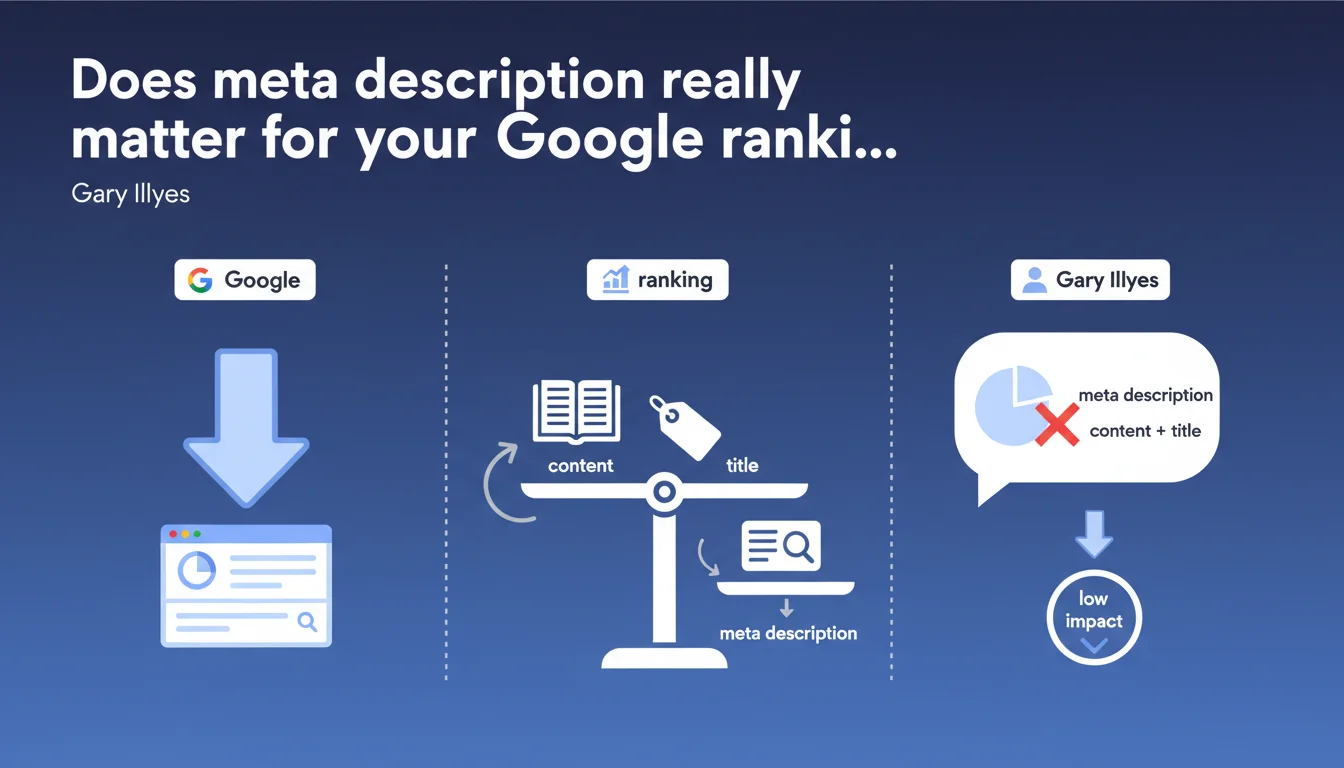
Google confirms that meta description has limited impact on rankings compared to content and page title. It remains crucial for CTR in SERPs. Focus your optimization efforts on the elements that truly matter for the algorithm.
What you need to understand
Why does Google downplay the impact of meta description?
This statement confirms what many SEO practitioners have observed for years: meta description is not a direct ranking factor. Google uses it primarily to generate snippets in search results, but its content doesn't influence the page's position in the algorithm.
The search engine prioritizes stronger signals — the page content itself, the title tag, semantic structure, links. Meta description remains a display element, not a relevance criterion.
What does this change for on-page optimization?
Concretely? It means spending hours perfecting every meta description to stuff keywords is a waste of time in terms of ranking. Effort should focus on visible content, writing quality, and information architecture.
Google can completely ignore your meta description and generate its own snippet based on page content and user query. In approximately 70% of observed cases, Google rewrites meta descriptions.
Should you completely neglect meta description then?
No. It retains an essential marketing function: influencing click-through rate (CTR) from SERPs. A well-written, engaging meta description that matches search intent can make the difference between a click to you or to a competitor.
CTR itself can indirectly impact ranking — it's a behavioral signal Google observes. But the impact remains indirect and secondary compared to classic on-page factors.
- Meta description is not a direct ranking factor
- Google frequently rewrites meta descriptions based on query
- Its main role is optimizing CTR in SERPs
- Prioritize optimization time on content and title
- Good CTR can have positive indirect effects
SEO Expert opinion
Is this statement consistent with real-world observations?
Absolutely. A/B tests conducted by different SEO teams show that a meta description change, with identical content and title, produces no significant position change. However, impact on CTR is measurable and sometimes substantial.
The confusion often comes from SEOs observing a correlation between keywords in meta and good ranking — but this is bias: well-ranked pages typically have rich content that naturally reflects in the meta description.
What nuances should be added to this statement?
First nuance: Google says "limited impact", not "no impact". There may be marginal cases where meta description contributes indirectly — for example through user engagement signals if it drastically improves CTR. [To verify] — Google remains vague on the exact weight of these behavioral signals.
Second point: for certain long-tail informational queries, Google directly extracts passages from the page to create featured snippets. A well-constructed meta description can increase chances of being picked up if it structures information clearly.
In what cases should this rule be nuanced?
For e-commerce and product pages, meta description remains a strong commercial lever. It won't change ranking, but good conversion starts with good CTR. Neglecting metas in this context would be a strategic error.
Also watch out for duplicate metas across a site: even if they don't directly impact ranking, they degrade SERP experience and can hurt the site's overall perception by Google as an indirect quality signal.
Practical impact and recommendations
What should you concretely do with meta descriptions?
Reduce time spent on pure SEO optimization (keyword stuffing, semantic variations). Focus on their marketing function: clarity, call-to-action, differentiation from visible competitors in SERPs.
For new pages, write a concise meta (150-160 characters) that summarizes your value proposition. For auditing an existing site, prioritize fixing duplicate metas and high-traffic strategic pages.
What mistakes should you absolutely avoid?
Stop treating meta description as a keyword placement spot for ranking. Google made it clear: ranking isn't decided there. Save that energy for enriching the page content itself.
Also avoid metas that are too long (beyond 160 characters) that will be truncated, or too generic that give no reason to click. An empty meta is better than a mediocre meta that discredits the result.
How do you verify your metas are properly optimized?
Audit your metas through Google Search Console: identify pages with abnormally low CTR despite good positions. This often signals an unengaging meta description or misalignment with search intent.
Test different formulations on your strategic pages and measure CTR impact. Use SERP preview tools to check actual rendering before publishing.
- Write metas oriented toward conversion and engagement, not keyword stuffing
- Limit yourself to 150-160 characters to avoid truncation
- Fix duplicate metas first on strategic pages
- Monitor CTR in Search Console to identify ineffective metas
- Include a differentiating element or subtle call-to-action
- Accept that Google may rewrite your metas based on query
- Don't waste time over-optimizing each meta — focus on content
❓ Frequently Asked Questions
Dois-je continuer à rédiger des meta descriptions pour toutes mes pages ?
Une meta description peut-elle nuire au classement si elle est mal rédigée ?
Pourquoi Google réécrit-il si souvent mes meta descriptions ?
Les mots-clés dans la meta description sont-ils complètement inutiles ?
Quelle est la longueur optimale d'une meta description aujourd'hui ?
🎥 From the same video 11
Other SEO insights extracted from this same Google Search Central video · published on 24/03/2022
🎥 Watch the full video on YouTube →
💬 Comments (0)
Be the first to comment.